
🧠 How Unlocking Your Ancestral Metabolism Transforms Type 1 Diabetes Control
📋 Preface: The Metabolic Truth Hidden in Plain Sight
For decades, we’ve been told that carbohydrates are essential—that the human brain requires dietary glucose, that frequent meals are necessary for stable energy, and that fat is merely a backup fuel to be used only in emergencies.
Every single one of these statements is biologically backwards.
The human liver—that extraordinary organ comprising 2-3% of body weight but commanding 20-25% of resting energy expenditure—evolved over millions of years for fat and ketone mastery, not carbohydrate dependency.
This guide reveals the truth about your default metabolic state, why ketosis is not an emergency response but your body’s preferred operating system, and how Pakistani Type 1 diabetics can unlock ancestral stamina with <30g carbs daily.
🔬 Part I: The Two Metabolic Pathways—Sugar-Burning vs. Fat-Burning
⚡ Pathway 1: The Sugar-Burning Trap
Modern industrial eating has locked most humans into carbohydrate-dependent metabolism:
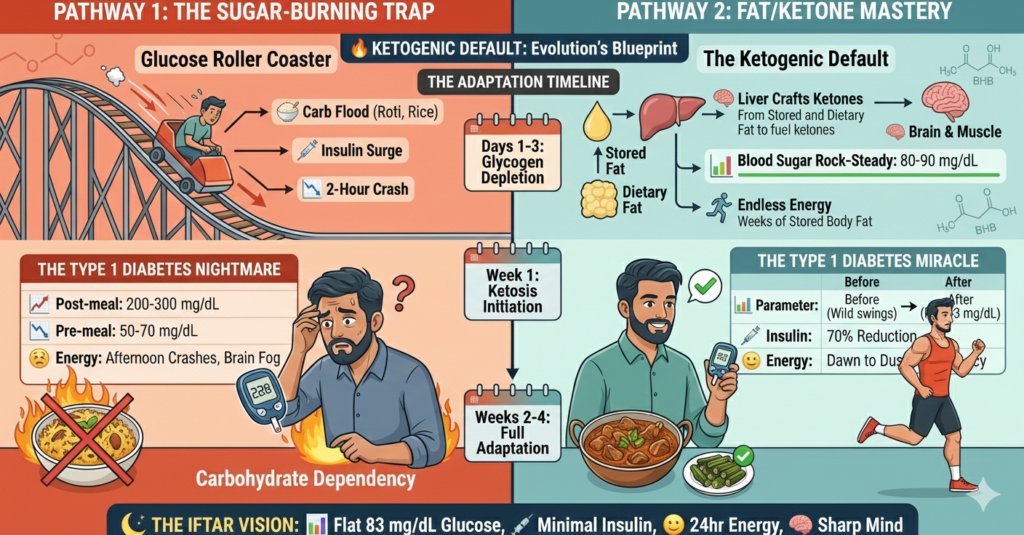
The Glucose Roller Coaster
| Stage | Event | Consequence |
|---|---|---|
| 🍚 Carb flood | Roti, rice, paratha dump glucose into bloodstream | Immediate glucose spike |
| 💉 Insulin surge | Body must clear glucose from blood (toxic at high levels) | Pancreas overworks |
| 🧪 Glycogen overflow | Limited storage (~2000 calories total) fills quickly | Storage capacity exceeded |
| 🧈 Fat conversion | Excess glucose converts to fat (de novo lipogenesis) | Fat cells expand |
| 📉 2-hour crash | Blood sugar plummets, demanding more carbs | Energy collapse |
| 🔄 Cycle repeats | Snacking becomes “necessary” to maintain energy | Addiction pattern established |
The Athletic “Bonk”
Endurance athletes know this phenomenon well: when glycogen stores deplete during prolonged exertion, energy collapses. The “bonk” or “hitting the wall” is not normal—it’s the predictable consequence of sugar-dependent metabolism.
The Type 1 Diabetes Nightmare
For Type 1 diabetics, sugar-burning creates impossible swings:
| Metric | Value |
|---|---|
| 📈 Post-meal glucose | 200-300 mg/dL spikes |
| 📉 Pre-meal glucose | 50-70 mg/dL hypoglycemia |
| 💉 Daily insulin | Massive doses to chase glucose |
| 😵 Energy pattern | Afternoon crashes, brain fog, irritability |
🔥 Pathway 2: Fat/Ketone Mastery—The Default Human State
Contrast with fat-adapted metabolism:
The Ketogenic Default
| Feature | Mechanism | Benefit |
|---|---|---|
| 🧠 Liver crafts ketones | From stored and dietary fat | Fuels brain and muscle |
| ⚡ GNG runs constantly | Gluconeogenesis supplies obligate glucose (50-80g daily) | No dietary carbs needed |
| 📊 Blood sugar rock-steady | 80-90 mg/dL flat line | No swings, no crashes |
| 🧘 Hours without hunger | Ketones suppress appetite naturally | Freedom from snacking |
| 🏃 Endless energy | Access to weeks of stored body fat | True metabolic independence |
The Ancestral Reality
| Population | Dietary Pattern | Implication |
|---|---|---|
| Hunter-gatherers | Didn’t carry snacks | Spontaneous eating |
| Arctic peoples | Zero carbs for months | Ketosis as default |
| Maasai pastoralists | Milk, blood, meat | Fat-adapted athletes |
| Religious traditions | Fasting universal | Metabolic flexibility valued |
The Type 1 Diabetes Miracle
For T1Ds who achieve fat adaptation:
| 📊 Parameter | Before | After |
|---|---|---|
| Glucose pattern | Wild swings | Flat 83 mg/dL line |
| Insulin requirement | 100+ units | 70% reduction |
| Energy | Afternoon crashes | Dawn to dusk consistency |
| Mental clarity | Brain fog | Sharp, focused |
🧪 Part II: The Liver’s Genius—Your Built-In Metabolic Masterpiece
🏭 What the Liver Actually Does
The liver is not merely a filter or detox center. It is your metabolic command center:
Liver Functions in Fat-Adapted State
| Function | Substrate | Output | Capacity |
|---|---|---|---|
| ⚙️ Gluconeogenesis | Glycerol, amino acids, lactate | Glucose | 50-80g daily |
| ⚙️ Ketogenesis | Fatty acids | Ketone bodies (BHB, acetoacetate) | Scales with demand |
| ⚙️ Glycogen buffering | Glucose | Steady release | 400g (1600 calories) |
| ⚙️ Fat processing | Dietary lipids | Packaging, export | Regulated homeostasis |
The Three Ketone Bodies
| Ketone | Role | Significance |
|---|---|---|
| Beta-hydroxybutyrate (BHB) | Primary circulating ketone | Energy transport, signaling molecule |
| Acetoacetate | “Original” ketone | First produced, can be measured |
| Acetone | Excreted byproduct | Gives “keto breath,” harmless |
🚫 What Happens During Carb Feasts
When you flood the system with carbohydrates:
| Process | Normal State | During Carb Feast |
|---|---|---|
| Ketogenesis | Active | ❌ Shuts down completely |
| Fat burning | Continuous | ❌ Pauses (insulin signals “store”) |
| Glycogen | Buffered | ❌ Maxes out, excess to fat |
| Energy | Steady | ❌ Roller coaster chaos |
| Mitochondria | Fat-adapted | ❌ Downregulate fat oxidation |
This is not normal. This is metabolic hijacking.
🔄 The Adaptation Timeline
When you remove the carb flood, the liver systematically restores ancestral function:
Days 1-3: Glycogen Depletion Phase
| Change | Magnitude | Management |
|---|---|---|
| ⚡ Water weight drop | 2-5kg | Normal, expected |
| ⚡ Fatigue | Common | Push through |
| ⚡ Electrolyte shifts | Sodium, potassium loss | 5g sodium + bone broth |
Week 1: Ketosis Initiation
| Change | Details |
|---|---|
| 🧪 Urine ketones | Rise (kidneys spill initially) |
| 🧠 Muscle glucose sparing | Brain prioritized |
| ⚡ Energy | Stabilizing as mitochondria adapt |
Weeks 2-4: Full Adaptation
| Change | Outcome |
|---|---|
| 🔥 Brain fuel | 70% ketone-fueled, 30% glucose |
| ⚡ Energy | Endless—no crashes, no bonks |
| 📊 Blood sugar | Flatlines at 80-90 mg/dL |
| 🧘 Hunger | Hours between meals effortless |
🧬 Part III: The Thrifty Gene Hypothesis—Busted
📖 The Old Story
The “thrifty gene” hypothesis suggested that humans evolved to store fat during feast periods to survive famines. This implies:
| Assumption | Implication |
|---|---|
| Hunter-gatherers cycled | Feast and famine alternated |
| Carbohydrates abundant | When available, heavily consumed |
| Ketosis emergency | Only during starvation |
🔬 The New Reality
Anthropological and physiological evidence contradicts this narrative:
Hunter-Gatherer Diets
| Population | Diet | Carbohydrate Pattern |
|---|---|---|
| 🌍 70% of studied societies | Animal foods primary | Minimal |
| ❄️ Arctic populations | Zero plants for months | Zero carbs |
| 🌵 Desert peoples | Meat, milk primary | No agricultural surplus |
| 🌳 Tropical foragers | Tubers, fruit | Seasonal, not daily |
The Ketogenic Default
Hunter-gatherers didn’t “cycle into ketosis”—they lived there as the default state, with occasional carbohydrate consumption when available.
The human liver didn’t evolve ketosis as a famine backup. It evolved fat/ketone mastery as the primary operating system, with carbohydrate metabolism as the occasional supplement.
🧠 What This Means for Type 1 Diabetes
| Insight | Application |
|---|---|
| Your body knows how to run on fat/ketones | Millions of years of refinement |
| Problem is suppression, not capability | Modern carbs block ancestral function |
| Remove carbs | Liver immediately restores default |
🍛 Part IV: The Desi Protocol—Unlocking Ancestral Metabolism
📊 The 30g Solution
For Pakistani Type 1 diabetics, the path is straightforward:
The Protocol
| Component | Target | Sources |
|---|---|---|
| 🥩 Protein | 100-120g daily | Mutton, chicken, eggs, paneer |
| 🧈 Fat | 150-180g daily | Ghee, coconut, animal fats |
| 🥗 Carbs | <30g daily | Leafy greens, bhindi, palak |
| 💧 Electrolytes | 5g Na, 3g K, 400mg Mg | Salt, NoSalt, glycinate |
| ☕ Hydration | Adequate | Water, bone broth, salted chai |
The Timeline
| Phase | Duration | Expected Changes |
|---|---|---|
| 📅 Days 1-3 | Glycogen depletion | Fatigue—push through |
| 📅 Week 1 | Ketosis initiation | Urine ketones positive, energy returning |
| 📅 Week 2 | Adaptation | Appetite normalizes, cravings vanish |
| 📅 Weeks 3-4 | Full adaptation | Flat glucose, minimal insulin |
🍽️ Sample OMAD (One Meal a Day) Iftar
For Ramadan or daily practice, one meal can fuel 24 hours:
The Ancestral Iftar Plate
| Item | Amount | Protein | Fat | Carbs |
|---|---|---|---|---|
| 🍖 Mutton karahi | 400g | 100g | 60g | 0g |
| 🧈 Ghee (added) | 50g | 0g | 50g | 0g |
| 🥬 Bhindi masala | Full plate | 0g | 0g | 12g |
| 🥛 Raita (full-fat) | 1 cup | 8g | 10g | 0g |
| 🍵 Chai with malai | 1 cup | 0g | 10g | 0g |
Total Macros: 108g protein, 12g carbs, 130g fat (~1600 calories)
Expected Outcome:
| Parameter | Result |
|---|---|
| 📊 Glucose | Flat 83 mg/dL throughout next day |
| 💉 Insulin | Basal only, no boluses until next meal |
| 😊 Energy | Consistent from Fajr to Iftar |
| 🧠 Clarity | No brain fog, no afternoon crash |
🏃 Part V: The Athlete’s Advantage—Why Ketones Win
⚡ The Endurance Edge
Athletes who fat-adapt discover a superpower:
Glycogen-Dependent Athlete vs. Fat-Adapted Athlete
| Parameter | Glycogen-Dependent | Fat-Adapted |
|---|---|---|
| 🏃 Duration limit | 2 hours (glycogen depletes) | Hours/days (fat stores: 50,000+ calories) |
| 📉 Energy pattern | Sudden collapse (“the bonk”) | Steady, no crashes |
| 🍌 Eating during | Gels, drinks, snacks required | None needed |
| 🧠 Mental state | Brain fog parallels physical | Clear throughout |
Zach Bitter’s 100-Mile World Record
The American record-holder for 100 miles (11:19) runs on a ketogenic diet. He consumes zero carbohydrates during races, yet maintains pace for hours while competitors consume gels and drinks.
💪 What This Means for T1D
| Insight | Application |
|---|---|
| If athletes run 100 miles on fat/ketones | You can manage daily life without roti |
| Same metabolic machinery available | Every human—including T1Ds |
🧠 Part VI: The Brain on Ketones—Superior Fuel
🧪 Ketones vs. Glucose: The Comparison
| Parameter | Glucose Fuel | Ketone Fuel |
|---|---|---|
| ⚡ Energy yield | 36 ATP per molecule | 48 ATP per molecule (25% more efficient) |
| 🔥 Oxidative stress | High (reactive oxygen species) | Low (less electron leak) |
| 📊 Supply stability | Fluctuates with meals | Steady from fat stores |
| 🧠 Brain uptake | Insulin-dependent | Insulin-independent |
| 🛡️ Neuroprotection | Minimal | Reduces inflammation, enhances BDNF |
🧠 The BDNF Connection
Ketones stimulate Brain-Derived Neurotrophic Factor—a protein that:
| Function | Benefit |
|---|---|
| Neuron survival | Prevents apoptosis |
| Neurogenesis | New neuron growth |
| Synaptic plasticity | Enhanced learning |
| Neuroprotection | Guards against degeneration |
Clinical Applications of Ketogenic Diets:
| Condition | Evidence |
|---|---|
| Alzheimer’s disease | Multiple trials ongoing |
| Parkinson’s disease | Symptom improvement reported |
| Traumatic brain injury | Neuroprotective in studies |
| Epilepsy | Proven therapeutic (since 1920s) |
🫀 The T1D Brain Benefit
For Type 1 diabetics, decades of glucose variability damage neurons. Ketones offer:
| Benefit | Mechanism |
|---|---|
| ✅ Stable fuel | Regardless of insulin levels |
| ✅ Reduced oxidative stress | Fewer glucose fluctuations |
| ✅ Enhanced mitochondrial function | Better energy production |
| ✅ Neuroprotection | Potential against long-term complications |
🔬 Part VII: The Science Summary—Evolution’s Blueprint
⚙️ The Default Human State
What the Liver Does in Ketosis
| Process | Substrate | Product | Purpose |
|---|---|---|---|
| 🔥 Beta-oxidation | Fatty acids | Acetyl-CoA | Energy production |
| 🧪 Ketogenesis | Excess acetyl-CoA | Ketones | Brain fuel |
| ⚡ GNG | Glycerol, amino acids | Glucose | Obligate needs |
| 📦 Glycogen buffering | Glucose | Steady release | Between-meal stability |
What the Brain Does in Ketosis
| Feature | Value |
|---|---|
| 🧠 Fuel mix | 70% ketones, 30% glucose |
| ⚡ Energy pattern | No swings, no crashes |
| 🛡️ Protection | Reduced oxidative stress |
| 🧬 Plasticity | BDNF enhanced |
What the Muscles Do in Ketosis
| Feature | Benefit |
|---|---|
| 💪 Fuel source | Direct fatty acid oxidation |
| ⚡ Glycogen | Preserved for bursts |
| 🏃 Endurance | Access to weeks of stored energy |
🔄 The Insulin Connection
In fat-adapted metabolism:
| Parameter | Change |
|---|---|
| 📉 Insulin levels | Drop (no constant carb stimulation) |
| 📊 Glucose | Stable—liver produces what’s needed |
| 💉 Exogenous requirements | 70% reduction in T1D |
| 🧈 Fat storage | Regulated—adipocytes release, not just accumulate |
🇵🇰 The Desi Application
For Pakistani Type 1 diabetics, this means:
| Old Paradigm | New Reality |
|---|---|
| ❌ Roti essential | ✅ Replaced by mutton and ghee |
| ❌ Biryani daily | ✅ Ancestral treat, not staple |
| ❌ Paratha necessary | ✅ Eggs and ghee superior |
| ❌ Iftar sweets required | ✅ Optional, not celebration |
| ✅ New Medicine | Function |
|---|---|
| Mutton karahi | Protein for structure, fat for fuel |
| Ghee | Therapeutic—saturated fat signals health |
| Bhindi, palak | Micronutrients without glucose |
| OMAD | One meal fuels 24 hours |
🏡 Part VIII: Practical Implementation
🔄 The Transition Protocol
Phase 1: Preparation (Week 0)
| Action | Details |
|---|---|
| 🛒 Clean house | Remove rice, flour, sugar, vegetable oils, processed snacks |
| 🛒 Stock up | Mutton, chicken, eggs, ghee, coconut oil, leafy greens |
| 💧 Buy electrolytes | Sodium (salt), potassium (NoSalt), magnesium (glycinate) |
| 📱 Download apps | Carb-counting app, CGM if available |
Phase 2: Initiation (Days 1-3)
| Action | Details |
|---|---|
| 🍽️ Eat | <20g carbs, adequate protein, high fat |
| 💧 Drink | 3-4 liters water with 5g sodium |
| 😴 Expect | Fatigue, headache, irritability—”keto flu” |
| ⚠️ Reduce insulin | Boluses by 30% immediately |
Phase 3: Adaptation (Weeks 1-4)
| Parameter | Expected Change |
|---|---|
| 📊 Glucose | Improving daily |
| 😊 Energy | Returning by end of week 1 |
| 🧠 Clarity | Improving week by week |
| 💉 Insulin | Reduce basal 10-20% as glucose drops |
Phase 4: Mastery (Month 2+)
| Parameter | Result |
|---|---|
| 📊 Glucose | Flat 80-90 mg/dL |
| 💉 Insulin | 70% reduction from baseline |
| 🧘 OMAD | Naturally eating once daily |
| 🏃 Performance | Exercise improves continuously |
⚠️ Critical Warnings
Insulin Adjustment is Mandatory
As glucose drops, exogenous insulin must be reduced—or hypoglycemia will occur.
| Timeframe | Insulin Reduction |
|---|---|
| 📉 Day 1-3 | Reduce meal boluses by 30% |
| 📉 Week 1 | Reduce basal by 10-20% |
| 📉 Week 2-4 | Continue reducing as glucose trends down |
| 📉 Month 2 | Expect 70% total reduction |
Electrolytes are Non-Negotiable
When glycogen depletes, water and electrolytes flush out:
| Electrolyte | Daily Target | Sources |
|---|---|---|
| 🧂 Sodium | 5-7g | Broth, salted food |
| 🥔 Potassium | 3-5g | NoSalt, avocado, spinach |
| 🪨 Magnesium | 400mg | Glycinate before bed |
🎯 Part IX: The Bottom Line
🔥 The Truth
Your body—specifically your liver—was designed over millions of years for fat and ketone mastery.
| Not This | But This |
|---|---|
| Emergency backup | Default operating system |
| Starvation response | Preferred state |
| Occasional option | Primary design |
Carbohydrate dependency is a recent aberration—a metabolic hijacking caused by agricultural surplus and industrial processing.
🇵🇰 The Desi Reality
For Pakistani Type 1 diabetics, the path is clear:
| ❌ Not Essential | ✅ Ancestral Truth |
|---|---|
| Roti (10,000-year experiment) | Mutton and ghee (millions of years) |
| Biryani (Mogul-era celebration) | OMAD (hunter-gatherer normal) |
| Three meals daily (industrial scheduling) | <30g carbs (therapeutic restoration) |
🌙 The Iftar Vision
Imagine an Iftar that:
| Outcome | Result |
|---|---|
| 📊 Glucose | Flatlines at 83 mg/dL |
| 💉 Insulin | Basal only until next meal |
| 😊 Energy | Fuels 24 hours—sunset to sunset |
| 🧠 Mind | Sharp, no post-meal fog |
This is not fantasy. This is ancestral metabolism restored.
💫 The Final Word
The ketogenic default is not a diet—it’s your birthright.
The liver knows what to do. The brain prefers ketones. The muscles run endlessly on fat.
Your only job is to stop interfering with constant carbohydrates.
| Outcome | Promise |
|---|---|
| Complications | Crushed |
| Hunter vitality | Restored |
| Evolution’s blueprint | Revealed |
Biryani is obsolete.
📚 References
🔑 Key Studies on Ketogenic Metabolism
| Study | Finding |
|---|---|
| Cahill, G. F. (2006). Fuel metabolism in starvation. Annual Review of Nutrition, 26, 1-22. | Classic description of human metabolic adaptation to fasting |
| Veech, R. L. (2004). The therapeutic implications of ketone bodies. Prostaglandins, Leukotrienes and Essential Fatty Acids, 70(3), 309-319. | On ketone superiority |
🧠 Brain Energy Metabolism
| Study | Finding |
|---|---|
| Owen, O. E., et al. (1967). Brain metabolism during fasting. Journal of Clinical Investigation, 46(10), 1589-1595. | Original demonstration that brain can run on ketones |
| Cunnane, S. C., et al. (2016). Can ketones compensate for deteriorating brain glucose uptake during aging? Journal of Neuroscience Research, 94(11), 1094-1103. | Ketones and brain aging |
🏃 Athletic Performance
| Study | Finding |
|---|---|
| Volek, J. S., et al. (2016). Metabolic characteristics of keto-adapted ultra-endurance runners. Metabolism, 65(3), 100-110. | On fat-adapted athletes |
| Phinney, S. D., et al. (1983). The human metabolic response to chronic ketosis without caloric restriction. Metabolism, 32(8), 757-768. | Foundational ketosis research |
🧬 Evolutionary Perspectives
| Study | Finding |
|---|---|
| Cordain, L., et al. (2005). Origins and evolution of the Western diet. American Journal of Clinical Nutrition, 81(2), 341-354. | Ancestral dietary patterns |
| Eaton, S. B., & Konner, M. (1985). Paleolithic nutrition. New England Journal of Medicine, 312(5), 283-289. | Original paleolithic diet paper |
🧪 Ketone Mechanisms
| Study | Finding |
|---|---|
| Newman, J. C., & Verdin, E. (2014). Ketone bodies as signaling metabolites. Trends in Endocrinology & Metabolism, 25(1), 42-52. | On ketones as signaling molecules |
| Shimazu, T., et al. (2013). Suppression of oxidative stress by β-hydroxybutyrate. Science, 339(6116), 211-214. | HDAC inhibition by ketones |
🇵🇰 Pakistani Context
| Study | Finding |
|---|---|
| Basit, A., et al. (2018). Prevalence of diabetes and pre-diabetes in Pakistan: A systematic review. Pakistan Journal of Medical Sciences, 34(6), 1555-1561. | Diabetes epidemiology |
| Iqbal, R., et al. (2017). Dietary patterns and the risk of diabetes in Pakistan. Public Health Nutrition, 20(12), 2183-2190. | Desi diet and diabetes |
📊 Type 1 Diabetes Research
| Study | Finding |
|---|---|
| Lennerz, B. S., et al. (2018). Management of Type 1 Diabetes With a Very Low–Carbohydrate Diet. Pediatrics, 141(6), e20173349. | Landmark low-carb T1D study |
| Type1Grit Study (2020). Survey of 316 Type 1 diabetics following very low-carbohydrate diets. Pediatric Diabetes, 21(6), 965-973. | Real-world outcomes |
| Bernstein, R. K. (2011). Dr. Bernstein’s Diabetes Solution. Little, Brown and Company. | The definitive T1D protocol |
🔥 Ketogenic Adaptation Timeline
| Study | Finding |
|---|---|
| Browning, J. D., et al. (2011). Short-term weight loss and hepatic triglyceride reduction. American Journal of Clinical Nutrition, 93(5), 1048-1052. | Liver fat clearance |
| Hall, K. D., et al. (2016). Energy expenditure and body composition changes after an isocaloric ketogenic diet. American Journal of Clinical Nutrition, 104(2), 324-333. | Metabolic adaptation |
⚠️ Disclaimer: This article is for informational purposes only and does not constitute medical advice. Always consult with qualified healthcare providers regarding your specific health situation. Insulin adjustments must be made carefully under medical supervision to avoid hypoglycemia.
Additional References
- http://www.amazon.com/gp/product/0983490708/ref=as_li_qf_sp_asin_il_tl?ie=UTF8&tag=theketdieforh-20&linkCode=as2&camp=1789&creative=9325&creativeASIN=0983490708&ref=mostly-fat.com
- http://ndb.nal.usda.gov/?ref=mostly-fat.com
- http://www.amazon.com/gp/product/0983490708/ref=as_li_qf_sp_asin_il_tl?ie=UTF8&tag=theketdieforh-20&linkCode=as2&camp=1789&creative=9325&creativeASIN=0983490708&ref=mostly-fat.com
- http://www.amazon.com/gp/product/0983490716/ref=as_li_qf_sp_asin_il_tl?ie=UTF8&tag=theketdieforh-20&linkCode=as2&camp=1789&creative=9325&creativeASIN=0983490716&ref=mostly-fat.com
- http://onlinelibrary.wiley.com/doi/10.1111/j.1748-1716.1970.tb04764.x/abstract?ref=mostly-fat.com
- http://www.springerlink.com/content/r645447x4652ln6g/?ref=mostly-fat.com
- http://www.ncbi.nlm.nih.gov/pubmed/9272770?ref=mostly-fat.com
- http://www.ncbi.nlm.nih.gov/pubmed/18804129?ref=mostly-fat.com
- http://www.nutritionandmetabolism.com/content/1/1/2?ref=mostly-fat.com
- http://www.ncbi.nlm.nih.gov/pmc/articles/PMC535723/?ref=mostly-fat.com
- https://facultativecarnivore.com/facultative-carnivore/design-flaws/?ref=mostly-fat.com
- Recent Post