
🧠 Dr. Ludwig’s Revolutionary Approach to Effortless Weight Loss
📋 Preface: Flipping Conventional Wisdom
What if everything you’ve been told about weight loss is backwards?
For decades, the message has been simple: eat less, move more, burn more calories than you consume. And when that fails—as it does for millions of people—the conclusion is equally simple: you lack willpower.
But what if the problem isn’t your willpower? What if it’s your hormones?
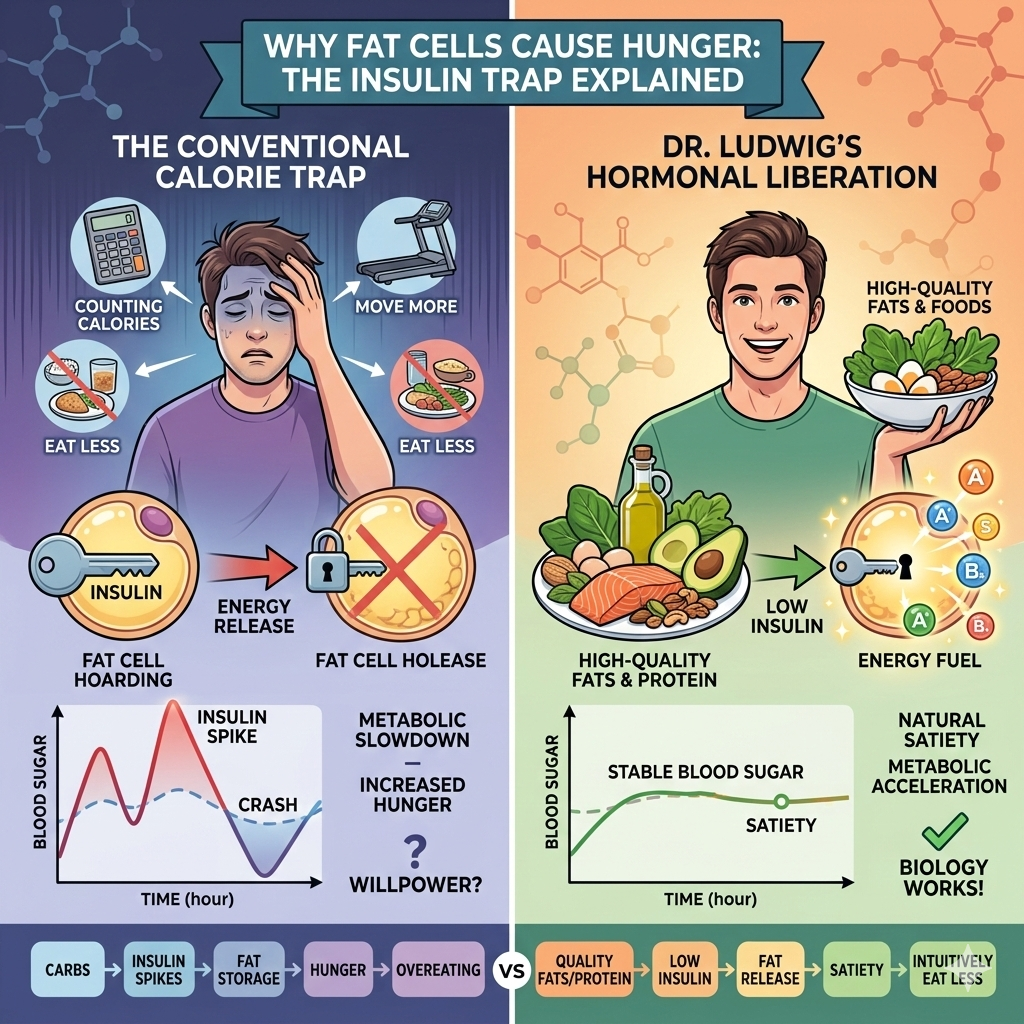
Dr. David Ludwig’s groundbreaking book Always Hungry? presents a revolutionary paradigm: fat cells don’t cause overeating—insulin-driven fat storage starves the body first, triggering insatiable hunger.
This guide explains the science, exposes the failures of traditional dieting, and provides a practical protocol for breaking free from the insulin trap.
🔬 Part I: The Conventional Wisdom—Why Low-Fat Dieting Fails
📉 The Calorie-Restriction Trap
Traditional low-fat dieting follows a simple logic:
| Assumption | Reality |
|---|---|
| Cut calories | Body fights back |
| Reduce fat | Carbs replace fat |
| Eat less | Hunger increases |
| Move more | Metabolism slows |
The result? A vicious cycle that leaves people heavier, hungrier, and more discouraged than when they started.
❄️ The Metabolic Ice Bath
Dr. Ludwig describes calorie restriction as throwing a blanket on a fever—it treats the symptom while ignoring the cause.
| Effect of Calorie Restriction | Result |
|---|---|
| Metabolism slows | Body conserves energy |
| Hunger hormones surge | Ghrelin increases |
| Muscle loss | Resting metabolic rate drops |
| Fat cells tighten grip | Energy remains locked away |
This is why 95% of dieters regain lost weight within 1-5 years. The body isn’t broken—it’s fighting back.
🧠 The Willpower Myth
When dieting fails, the cultural narrative blames the individual:
| Accusation | Truth |
|---|---|
| “You lack discipline” | Hormones drive hunger |
| “You’re not trying hard enough” | Metabolism adapts |
| “You have no willpower” | Biology overrides intention |
| “You’re broken” | The model is broken, not you |
But let me say this clearly: you are not weak. You are fighting a biological system designed to resist starvation.
🧪 Part II: The Insulin Trap—How Fat Cells Hoard Energy
⚡ The Carbohydrate-Insulin Connection
Dr. Ludwig’s model flips the traditional calorie equation:
| Traditional View | Ludwig’s Model |
|---|---|
| Calories in > calories out → weight gain | Hormones regulate fat storage |
| Eat less → lose weight | Insulin drives fat accumulation |
| Fat makes you fat | Carbs spike insulin |
| Willpower determines success | Biology determines hunger |
🏭 The Fat Cell Hoarding Cycle
When you eat high-carb meals, a cascade begins:
| Step | Event | Consequence |
|---|---|---|
| 1 | Glucose spikes | Blood sugar rises |
| 2 | Insulin floods | Pancreas responds |
| 3 | Fat cells overfill | Adipocytes expand |
| 4 | Energy blocked | Fuel locked away |
| 5 | Body perceives starvation | Brain signals hunger |
| 6 | Overeating ensues | Cycle repeats |
The Cruel Paradox:
| System | Experience |
|---|---|
| Fat cells | Overflowing with energy |
| Bloodstream | Depleted of fuel |
| Brain | Starvation signal |
| Muscles | Energy-starved |
| You | Ravenously hungry |
You are simultaneously overfed and undernourished—fat cells hoarding energy while the rest of your body starves.
📉 The Metabolic Crash
This insulin-driven cycle destroys metabolism:
| Consequence | Mechanism |
|---|---|
| Metabolism tanks | Body conserves energy |
| Cravings intensify | Brain demands quick fuel |
| Energy crashes | Blood sugar swings |
| Willpower crumbles | Biology overwhelms intention |
This is not a character flaw. This is biology.
🍽️ Part III: Dr. Ludwig’s Solution—Fix Hormones, Not Calories
🔑 The Core Principle
“The body knows its perfect weight when properly fed.” — Dr. David Ludwig
| Old Paradigm | New Paradigm |
|---|---|
| Cut calories | Fix hormones |
| Count everything | Eat until satisfied |
| Fear fat | Embrace healthy fats |
| Restrict portions | Trust appetite |
| Fight hunger | Eliminate its cause |
🔄 The Three-Phase Protocol
Phase 1: Hormone Reset (2-4 weeks)
| Component | Target | Examples |
|---|---|---|
| Carbohydrates | <20g daily | Leafy greens only |
| Protein | Adequate | Eggs, fish, poultry |
| Fat | Liberal | Full-fat dairy, nuts, olive oil |
| Hunger | Eat until satisfied | No calorie counting |
| Cravings | Expected to vanish | Within days |
What Happens in Phase 1:
| Change | Timeline |
|---|---|
| Fat cells unlock | Days 1-3 |
| Fuel flows freely | Week 1 |
| Cravings disappear | Week 1-2 |
| Energy stabilizes | Week 2 |
| Wellbeing surges | Week 2-3 |
| Weight loss begins | Week 3-4 |
Phase 2: Metabolic Re-entry (Ongoing)
| Food Type | Examples | Frequency |
|---|---|---|
| Quality carbs | Berries, root vegetables | Gradual reintroduction |
| Legumes | Lentils, chickpeas | In moderation |
| Whole grains | Limited, if tolerated | Test individually |
Phase 3: Lifetime Maintenance
| Principle | Practice |
|---|---|
| Listen to hunger | Eat when hungry, stop when satisfied |
| Prioritize quality | Whole foods, healthy fats |
| Trust the process | Body finds its set point |
📊 Part IV: The Evidence—Pilot Study Results
👥 200+ Participants
Dr. Ludwig’s pilot study produced remarkable results:
| Outcome | Finding |
|---|---|
| Hunger | Disappeared instantly |
| Cravings | Vanished within days |
| Wellbeing | Surged before weight loss |
| Satisfaction | High adherence |
| Weight loss | Effortless and sustained |
🧠 The Key Insight
“Hunger disappeared before the scale moved.”
This is crucial: participants stopped feeling hungry before they lost significant weight. The hormonal shift preceded the physical change.
| Order | Event |
|---|---|
| 1 | Hormones reset |
| 2 | Hunger normalizes |
| 3 | Cravings vanish |
| 4 | Energy returns |
| 5 | Weight drops |
Traditional dieting demands weight loss first, hoping willpower will follow. Ludwig’s approach fixes the biology, and the weight loss follows naturally.
🍛 Part V: The Always Hungry? Protocol in Practice
🚫 Problem Foods to Avoid
| Food | Insulin Effect | Why It Traps You |
|---|---|---|
| Grain bowl | Fat lock + cravings | Rapid glucose spike |
| Low-fat yogurt | Metabolic slowdown | Sugar replaces fat |
| Sugar snack | Starvation signal | Insulin flood then crash |
| Pasta | Energy hoarding | Fat cells tighten grip |
| Bread | Hunger trigger | Brain starved |
| Rice | Overeating cycle | Fuel locked away |
✅ Ludwig Fix—What to Eat Instead
| Instead Of | Eat This | Outcome |
|---|---|---|
| Grain bowl | Ghee salmon + nuts | Satiety restored |
| Low-fat yoghurt | Full-fat Greek + berries | Cravings gone |
| Sugar snack | Dark chocolate (70%+) | Metabolism reignited |
| Pasta | Zucchini noodles + meat sauce | Fuel flows freely |
| Sandwich | Lettuce wraps + avocado | Energy unlocked |
| Cereal | Eggs + full-fat yoghurt | Stable blood sugar |
🍽️ Sample Day on Phase 1
Breakfast
| Food | Why It Works |
|---|---|
| 3 eggs fried in butter | Protein + satiating fat |
| Full-fat Greek yoghurt | No sugar, high satisfaction |
| Handful of walnuts | Healthy fats, no insulin spike |
Lunch
| Food | Why It Works |
|---|---|
| Salmon with olive oil | Omega-3s + fat saturation |
| Large salad with avocado | Fiber + healthy fats |
| Olive oil dressing | No sugar, pure fat |
Dinner
| Food | Why It Works |
|---|---|
| Grass-fed beef or lamb | High-quality protein |
| Roasted vegetables in ghee | Carbs <20g |
| Full-fat cheese | Satiety |
Snack (if hungry)
| Food | Why It Works |
|---|---|
| Dark chocolate (2 squares) | Satisfies without spike |
| Handful of macadamia nuts | Pure fat, no insulin |
| Full-fat cottage cheese | Protein + fat |
⚖️ The Golden Rule
No calorie counting. Eat when hungry. Stop when satisfied.
This is not a restriction diet—it’s a liberation diet.
🌟 Part VI: Why Quality Beats Quantity
📊 The Quality-Quantity Revolution
| Old Focus | New Focus |
|---|---|
| How many calories | What kind of food |
| Portion size | Hormone effect |
| Fat grams | Insulin response |
| Scale weight | Metabolic health |
🧪 The Hormone-Driven Body
When you eat quality food:
| Effect | Result |
|---|---|
| Insulin normalizes | Fat cells release energy |
| Hunger hormones reset | Appetite matches need |
| Metabolism accelerates | Calories burned increase |
| Cravings extinguish | Freedom from food obsession |
🎯 The Set Point Phenomenon
The body has a natural weight range it defends:
| State | What Happens |
|---|---|
| Above set point | Hunger decreases, metabolism increases |
| Below set point | Hunger increases, metabolism decreases |
| At set point | Effortless maintenance |
Ludwig’s protocol allows the body to find its natural set point without fighting biology.
🧠 Part VII: The Science Summary—Why This Works
⚙️ The Hormonal Hierarchy
| Factor | Influence on Weight |
|---|---|
| Insulin | Primary driver of fat storage |
| Cortisol | Stress hormone, promotes belly fat |
| Leptin | Satiety hormone, disrupted by insulin |
| Ghrelin | Hunger hormone, spikes with restriction |
| Glucagon | Fat-release hormone, suppressed by insulin |
🔄 The Virtuous Cycle
When you fix hormones:
| Step | Effect |
|---|---|
| 1 | Insulin drops |
| 2 | Fat cells release energy |
| 3 | Blood fuel increases |
| 4 | Brain satiety signals activate |
| 5 | Hunger normalizes |
| 6 | Cravings vanish |
| 7 | Metabolism rises |
| 8 | Weight normalizes |
📉 The Insignificance of Calories
Dr. Ludwig explains:
“Calories are important, but they’re not the main event. Hormones determine whether those calories get burned for energy or stored as fat.”
Two people eating identical calories can have completely different outcomes based on hormonal status.
| Scenario | Hormones | Outcome |
|---|---|---|
| Person A | Balanced | Calories burned |
| Person B | Insulin-resistant | Calories stored |
| Same intake | Different biology | Different result |
This is why calorie counting alone fails.
🎯 Part VIII: The Bottom Line
🔥 The Truth About Weight Loss
| Myth | Reality |
|---|---|
| Overeating causes obesity | Obesity causes overeating |
| Fat cells fill because you eat | You eat because fat cells hoard |
| Willpower is the solution | Hormones are the key |
| Eat less, move more | Fix insulin, trust appetite |
🇵🇰 The Desi Application
For Pakistani readers, this means:
| Old Trap | New Win |
|---|---|
| Roti-heavy meals | Ghee-based vegetables + meat |
| Low-fat dahi | Full-fat yoghurt |
| Sugary chai | Unsweetened chai with malai |
| Fried snacks | Nuts and dark chocolate |
| Rice portions | Cauliflower rice |
💫 The Liberation
Imagine:
| Freedom | Experience |
|---|---|
| No counting | Eat intuitively |
| No cravings | Food loses its power |
| No guilt | Satisfaction without shame |
| No willpower | Biology works for you |
This is not fantasy. This is hormonal freedom.
🕊️ The Final Word
Dr. Ludwig’s message is one of hope:
“Your body knows its perfect weight. Feed it properly, and it will find its way.”
| Promise | Fulfillment |
|---|---|
| Fat cells freed | Energy flows |
| Hormones balanced | Hunger tamed |
| Cravings extinct | Food freedom |
| Weight normalized | Effortless maintenance |
Quality over quantity. Hormones over calories. Trust over restriction.
The body knows what to do.
📚 References
🔑 Key Research on the Carbohydrate-Insulin Model
| Study | Finding |
|---|---|
| Ludwig, D. S., & Ebbeling, C. B. (2018). The carbohydrate-insulin model of obesity: Beyond “calories in, calories out.” JAMA Internal Medicine, 178(8), 1098-1103. | Comprehensive review of the hormonal model of obesity |
| Ebbeling, C. B., et al. (2012). Effects of dietary composition on energy expenditure during weight-loss maintenance. JAMA, 307(24), 2627-2634. | Low-glycemic load diets prevented metabolic slowdown |
🧪 Insulin and Fat Cell Biology
| Study | Finding |
|---|---|
| Ludwig, D. S., et al. (2021). Competing paradigms of obesity pathogenesis: Energy balance versus carbohydrate-insulin models. European Journal of Clinical Nutrition, 75(9), 1289-1298. | Head-to-head comparison of obesity models |
| Taubes, G. (2013). The science of obesity: What do we really know about what makes us fat? BMJ, 346, f1050. | Critical analysis of the calorie-centric model |
📊 Clinical Trials
| Study | Finding |
|---|---|
| Ebbeling, C. B., et al. (2018). Effects of a low carbohydrate diet on energy expenditure during weight loss maintenance: Randomized trial. BMJ, 363, k4583. | Low-carb diet increased energy expenditure by 200-300 calories/day |
| Ludwig, D. S., et al. (2019). Dietary fat: From foe to friend? Science, 362(6416), 764-770. | Re-evaluation of dietary fat’s role in health |
🧠 Hunger and Satiety Mechanisms
| Study | Finding |
|---|---|
| Sumithran, P., et al. (2011). Long-term persistence of hormonal adaptations to weight loss. New England Journal of Medicine, 365(17), 1597-1604. | Weight loss induces persistent hormonal changes driving hunger |
| Ludwig, D. S. (2016). Always Hungry? Conquer cravings, retrain your fat cells, and lose weight permanently. Grand Central Publishing. | The complete protocol with supporting science |
🔥 Metabolic Adaptation
| Study | Finding |
|---|---|
| Leibel, R. L., et al. (1995). Changes in energy expenditure resulting from altered body weight. New England Journal of Medicine, 332(10), 621-628. | Classic study demonstrating metabolic adaptation to weight loss |
| Rosenbaum, M., & Leibel, R. L. (2010). Adaptive thermogenesis in humans. International Journal of Obesity, 34(S1), S47-S55. | Review of how metabolism fights weight loss |
📺 Video Resource
| Resource | Link |
|---|---|
| Dr. Ludwig Interview | Watch on YouTube |
⚠️ Disclaimer: This article is for informational purposes only and does not constitute medical advice. Always consult with qualified healthcare providers before making significant changes to your diet, especially if you have existing health conditions or take medications. The Always Hungry? protocol should be undertaken with appropriate medical supervision.
- Recent Post