
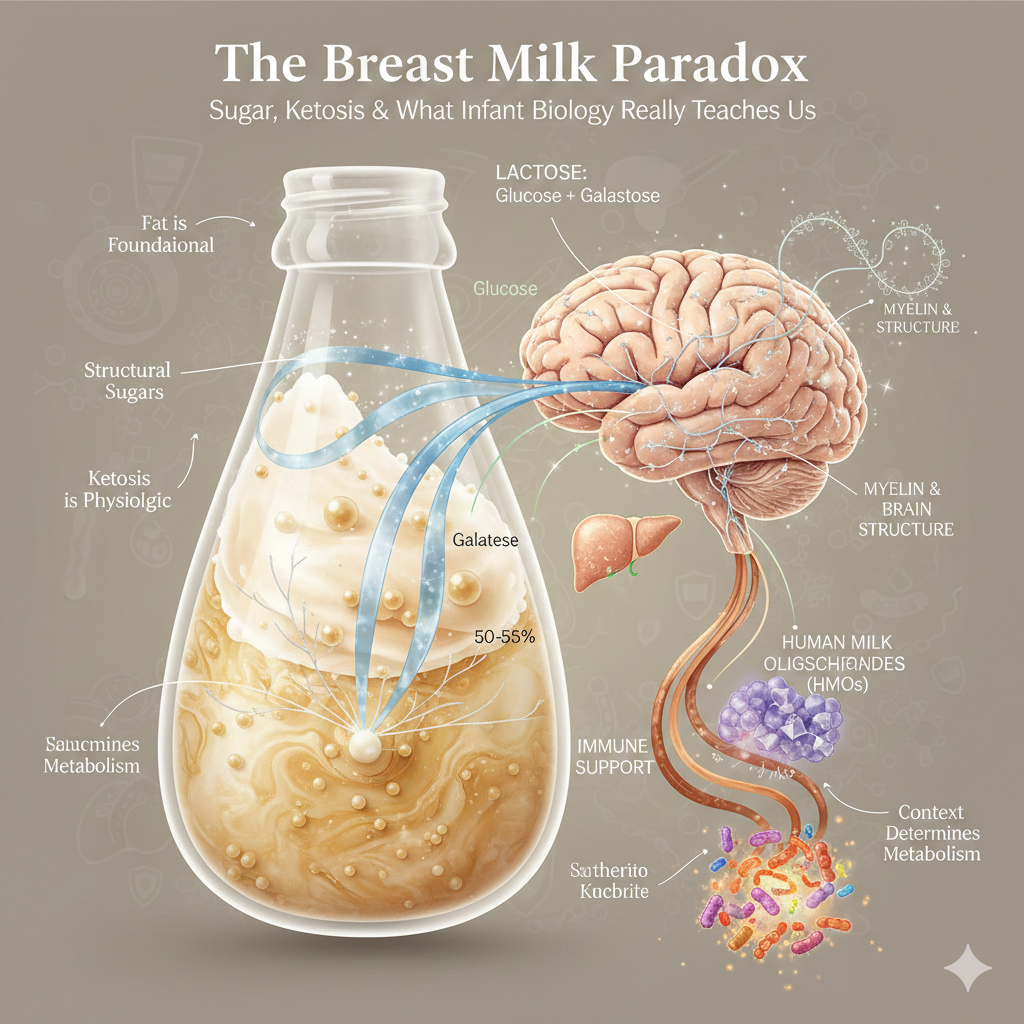
Sugar, Ketosis & What Infant Biology Really Teaches Us
For years, whenever we discuss infants being naturally in mild ketosis, someone raises the same objection:
“But breast milk is 40% carbohydrate.
Babies can’t be ketogenic.”
Let’s slow this down.
That statement assumes something very adult:
Carbohydrate present = carbohydrate burned as fuel.
Infant metabolism does not work that way.
And breast milk is not “sweet chai in a bottle.”
🧬 First: What’s Actually in Breast Milk?
On average, human breast milk provides:
🧈 50–55% fat
🥛 38–41% carbohydrate
🥩 5–7% protein
Fat is the dominant energy source.
Carbohydrate is mostly lactose.
But lactose is not just glucose.
It’s:
Glucose + Galactose
And that distinction changes everything.
🧠 Galactose: Not Just “Sugar”
When lactose is digested, it splits into:
Glucose → can be used for energy
Galactose → primarily structural
Galactose is a critical component of:
Cerebrosides
Glycosphingolipids
Myelin
Myelin is the insulation around nerves.
Infancy is a period of explosive brain growth and rapid myelination.
That galactose isn’t primarily being burned.
It’s being built into brain tissue.
That’s not fuel metabolism.
That’s construction biology.
🧪 The Forgotten Player: Human Milk Oligosaccharides
After lactose and fat, the third largest component of breast milk is:
🧫 Human Milk Oligosaccharides (HMOs)
Here’s what most people don’t realize:
They are largely indigestible.
They:
Feed bifidobacteria
Block pathogens
Deliver sialic acid for brain development
Support immune maturation
Most pass through the infant gut intact.
They are not caloric drivers.
They are biological signaling molecules.
So again:
Carbohydrate present ≠ carbohydrate oxidized.
🔥 So Are Babies Actually in Ketosis?
Yes.
Healthy breastfed infants commonly display:
Mild hyperketonemia
Active ketone uptake into brain tissue
High rates of fat-derived energy use
This is observed physiology.
Not theory.
Why?
Because:
🧈 Milk is fat-dominant
👶 Infant livers produce ketones efficiently
🧠 The developing brain avidly uses ketones
And here’s the key:
Ketones are not just burned for ATP.
They are used as carbon donors for:
Cholesterol synthesis
Myelin formation
Membrane construction
In early life, ketones are growth substrates.
⚖️ The Metabolic Partitioning Principle
The real lesson is this:
Substrates are partitioned based on developmental need.
In infancy:
Galactose → brain structure
HMOs → microbiome & immunity
Ketones → brain fuel + lipid synthesis
Glucose → selectively used
In adulthood:
Brain growth is stable
Myelination is largely complete
Lipogenesis demand is lower
Substrate routing changes
You cannot scale infant macro percentages directly to adults.
But you can extract biological principles.
🧠 What Breast Milk Actually Teaches Us
✔ Fat is foundational in human metabolism
✔ Ketosis is physiologic in early life
✔ Sugars can serve structural, not just energetic roles
✔ Glucose is not the only preferred brain fuel
✔ Biology is context-dependent
What it does not prove:
❌ Adults can remain ketogenic on 40% carbohydrate
❌ All sugars behave like lactose
❌ Refined carbohydrates mimic breast milk
❌ Infant metabolism = adult metabolism
That leap is where logic breaks.
Why This Matters in Our Context
In Pakistan, we often hear:
“But babies drink milk with sugar and they’re healthy.”
Important clarification:
Breast milk sugar ≠ table sugar
Lactose ≠ sucrose
Galactose ≠ glucose spike
Structural substrate ≠ refined carbohydrate load
An adult consuming:
Sweet chai
Roti + rice
Halwa
Ultra-processed snacks
is not replicating infant metabolism.
They are overwhelming glycolysis.
Completely different biological terrain.
🧩 The Bigger Insight
The breast milk paradox isn’t a contradiction.
It’s a reminder.
Metabolism is not about percentages.
It’s about:
Hormonal environment
Developmental stage
Tissue demand
Substrate routing
Infants are in mild ketosis because fat dominates energy and because ketones are required for growth — even while structural sugars are present.
That is elegant physiology.
💚 HealO Takeaway
Breast milk doesn’t argue for high-carb living.
It argues for metabolic intelligence.
It shows us:
Ketosis is natural
Fat is not pathological
Sugars are multifunctional
Context determines metabolism
Biology is smarter than diet debates.
And when we understand partitioning instead of just percentages,
we stop arguing about macros —
and start respecting physiology.
References
- http://advances.nutrition.org/content/2/3/275.full?ref=mostly-fat.com
- http://www.researchgate.net/publication/234095885_Medina__Tabernero_J._Neuroscience.Res._(2005)_792-10/file/79e4150f09823da781.pdf?ref=mostly-fat.com
- http://www.ncbi.nlm.nih.gov/pubmed/15916931?ref=mostly-fat.com
- http://www.researchgate.net/publication/234095885_Medina__Tabernero_J._Neuroscience.Res._(2005)_792-10/file/79e4150f09823da781.pdf?ref=mostly-fat.com
- http://www.ncbi.nlm.nih.gov/pubmed/3884390?ref=mostly-fat.com
- http://www.ingentaconnect.com/content/hum/endo/2002/00000019/00000001/art00004?ref=mostly-fat.com
- http://www.ncbi.nlm.nih.gov/pubmed/3542066?ref=mostly-fat.com
- http://www.ncbi.nlm.nih.gov/pubmed/10805165?ref=mostly-fat.com
- http://www.ncbi.nlm.nih.gov/pmc/articles/PMC3753522/?ref=mostly-fat.com
- http://www.ncbi.nlm.nih.gov/pubmed/7558546?ref=mostly-fat.com
- http://www.ncbi.nlm.nih.gov/pubmed/23896931?ref=mostly-fat.com
- http://www.ncbi.nlm.nih.gov/pubmed/24116864?ref=mostly-fat.com
- http://www.ncbi.nlm.nih.gov/pmc/articles/PMC1755833/?ref=mostly-fat.com
- http://www.sciencedirect.com/science/article/pii/S0021755713001782?ref=mostly-fat.com
- http://www.ncbi.nlm.nih.gov/pubmed/21232762?ref=mostly-fat.com
- https://www.ncbi.nlm.nih.gov/pubmed/11875170?ref=mostly-fat.com
- Recent Post