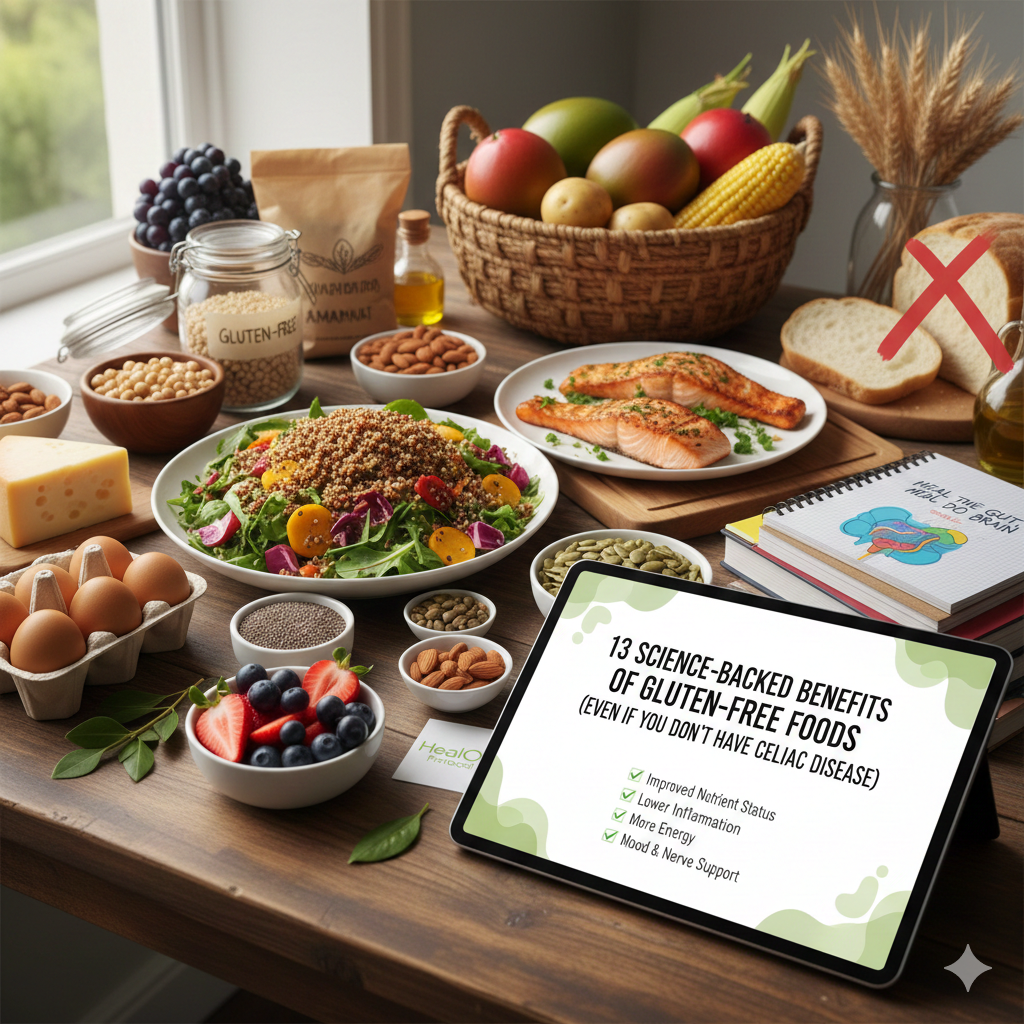
(Even If You Don’t Have Celiac Disease)
Going gluten-free isn’t a trend—it’s a therapeutic intervention for millions. For many people, removing wheat, barley, and rye reduces inflammation, restores gut integrity, improves energy and mood, and lowers autoimmune burden.
Science increasingly shows that gluten—and its frequent companion fructans—can trigger immune and neurological effects well beyond the gut, even in non-celiac individuals.
Here’s what the research actually says—and how to do gluten-free the right way.
Table of Contents
Top 10 Benefits of Gluten-Free Foods
Celiac vs. Non-Celiac Sensitivity: Test or Trial?
Personal Insight & Smart Swaps
Naturally Gluten-Free Foods
Key Takeaway
Top 10 Benefits of Gluten-Free Foods
Gluten proteins (gliadin) and wheat fructans can activate immune signaling, disrupt tight junctions, and alter the microbiome. Removing them often leads to system-wide improvements, not just digestive relief.
| Benefit | What the Science Shows |
|---|
| Improved Nutrient Status | Post-elimination, many show higher magnesium, B-vitamins, vitamins C & K, and iron due to improved absorption—not because gluten is nutritious (it isn’t) |
| Lower Inflammation | Gluten and fructans activate zonulin, cytokines, and mast cells—driving gut and systemic inflammation |
| Gut Healing | Gluten removal lowers intestinal permeability (“leaky gut”) and improves IBS/IBD symptoms, especially when combined with low-FODMAP strategies |
| More Energy | Fatigue, anemia, and “chronic tiredness” often resolve once malabsorption and immune activation stop |
| Better Sleep | Reduced inflammation and stress hormone signaling improve sleep quality; benefits seen in celiac and sensitivity |
| Clearer Brain (“Brain Fog”) | Up to 90% of non-celiac gluten sensitivity patients report rapid cognitive improvement |
| Mood & Nerve Support | Reductions in depression, anxiety, neuropathy, migraines, and some neurodevelopmental symptoms reported |
| Stronger Bones | Chronic inflammation impairs bone density; gluten removal improves markers of bone health |
| Healthier Skin & Joints | Improvements seen in eczema, psoriasis, acne, rheumatoid arthritis, and joint pain |
| Lower Autoimmune Risk | Gluten exposure linked to higher risk of T1D, thyroid disease, MS, and other autoimmune conditions |
Bonus effects:
Weight normalization and improved cardiometabolic markers often occur—not because gluten causes obesity, but because removing it reduces ultra-processed food intake.
Celiac vs. Non-Celiac Gluten Sensitivity: Test or Trial?
83% of people with celiac disease remain undiagnosed
Average diagnostic delay: 11+ years
Non-celiac gluten sensitivity (NCGS) is estimated to be 6× more common than celiac disease
Overlapping Symptoms
Bloating, reflux, nausea
Fatigue, migraines, nerve pain
Brain fog, depression, anxiety
Infertility, anemia, vitamin deficiencies
Why Testing Often Fails
No definitive test for NCGS
Celiac tests require ongoing gluten exposure
Many people feel worse re-introducing gluten just to get tested
HealO Practical Protocol
Eliminate gluten for 3–4 weeks (gliadin antibodies persist)
Assess digestion, energy, mood, skin, pain
If symptoms resolve → consider formal celiac testing only if clinically necessary
Relief comes first. Labels come later.
Personal Insight & Smart Swaps
Many people report changes beyond digestion:
Acne clearing
Improved sleep and mood
Less dental inflammation
Better exercise recovery
Is it gluten—or fructans, pesticides, or modern wheat hybrids?
You don’t need to know the exact culprit to benefit. A structured elimination tells the truth faster than speculation.
Better Gluten-Free Staples
These outperform wheat nutritionally without immune activation.
Naturally Gluten-Free Foods (No Label Needed)
All vegetables and fruits
Grass-fed meats, poultry, eggs
Fish (especially sardines, salmon)
Dairy: milk, yogurt, cheese
Legumes, nuts, seeds
Potatoes, rice, corn
Quinoa, chia, cassava, soy
The key is replacement, not restriction. Gluten-free done poorly equals junk food. Done well, it’s deeply nourishing.
Key Takeaway
Gluten-free eating isn’t about trends—it’s about removing a common immune trigger in a highly processed food system.
For many people—especially those with gut, brain, skin, bone, or autoimmune symptoms—gluten removal delivers benefits that conventional “balanced diets” fail to provide.
HealO principle:
If removing a food restores health, that food was never essential.
References
- https://www.mdpi.com/2072-6643/11/3/537/htm
- https://www.nature.com/articles/s41598-022-09346-y
- https://pubmed.ncbi.nlm.nih.gov/35185424/
- https://pubmed.ncbi.nlm.nih.gov/36183751/
- https://pubmed.ncbi.nlm.nih.gov/35376973/
- https://healo-mf.com/how-to-feel-better-after-eating-gluten-fast-recovery-protocol/
- https://pubmed.ncbi.nlm.nih.gov/33585949/
- https://pubmed.ncbi.nlm.nih.gov/28587774/
- https://www.ncbi.nlm.nih.gov/pmc/articles/PMC6996528/
- https://pubmed.ncbi.nlm.nih.gov/36266939/
- https://www.ncbi.nlm.nih.gov/pmc/articles/PMC6630947/
- https://gut.bmj.com/content/68/2/377.long
- https://www.beyondceliac.org/research-news/fatigue-is-often-found-in-celiac-disease/
- https://www.ncbi.nlm.nih.gov/pmc/articles/PMC8937616/
- https://pubmed.ncbi.nlm.nih.gov/29415685/
- https://www.healthcentral.com/article/is-a-leaky-gut-to-blame-for-your-insomnia
- https://www.ncbi.nlm.nih.gov/pmc/articles/PMC4011484/
- https://pubmed.ncbi.nlm.nih.gov/34049371/
- https://www.ncbi.nlm.nih.gov/pmc/articles/PMC7454984/
- https://pubmed.ncbi.nlm.nih.gov/31050907/
- https://www.ncbi.nlm.nih.gov/pmc/articles/PMC3641836/
- https://www.mdpi.com/2072-6643/12/3/822
- https://pubmed.ncbi.nlm.nih.gov/28658068/
- https://pubmed.ncbi.nlm.nih.gov/29050807/
- https://www.ncbi.nlm.nih.gov/pmc/articles/PMC6586915/
- https://rootcausemedicalclinics.com/is-gluten-intolerance-causing-your-osteoporosis/
- https://pubmed.ncbi.nlm.nih.gov/11107867/
- https://pubmed.ncbi.nlm.nih.gov/33999573/
- https://www.ncbi.nlm.nih.gov/pmc/articles/PMC9237855/
- https://pubmed.ncbi.nlm.nih.gov/33677948/
- https://pubmed.ncbi.nlm.nih.gov/18255352/
- https://www.glutenfreesociety.org/autoimmune-heart-inflammation-does-gluten-play-a-role/
- https://www.lovedentistry.net/oral-health/gluten-free-diet-teeth/
- https://www.beyondceliac.org/celiac-disease/facts-and-figures/
- https://www.badgut.org/information-centre/a-z-digestive-topics/celiac-disease-still-vastly-under-diagnosed/
- https://pubmed.ncbi.nlm.nih.gov/31909482/

One Response