Struggling with weight loss isn’t a discipline problem.
It’s a hunger-awareness problem.
If you don’t know which hunger is driving you, you’ll fight the wrong battle—and lose.
At HealO, we teach this first:
👉 Name the hunger. Then neutralize it.
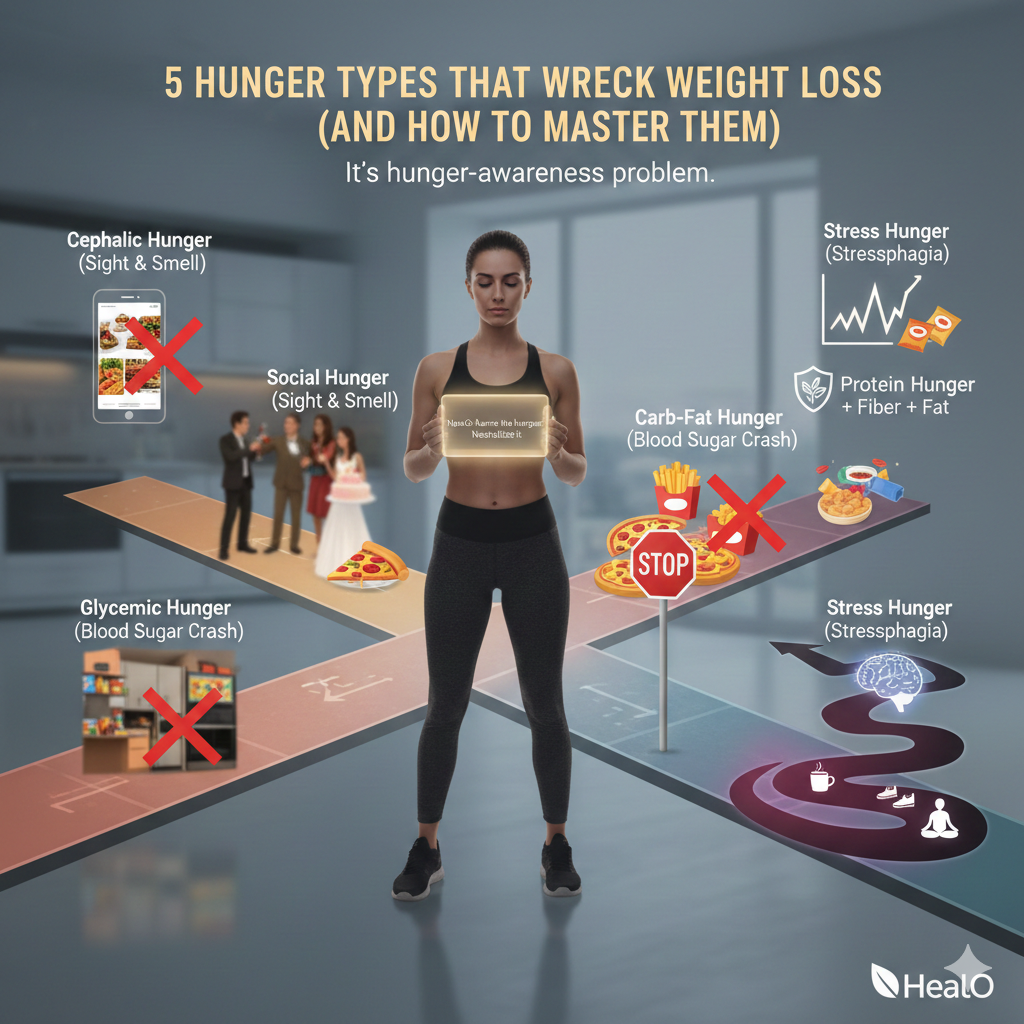
The 5 Hunger Types You Must Recognize
| Hunger Type | What Triggers It | HealO Counter-Move |
|---|
1. Cephalic Hunger (Sight & Smell Hunger)
Trigger:
Food ads, open kitchens, office snacks, scrolling reels
This is a Pavlovian response. Your brain releases insulin before you eat—just by seeing food.
Fix:
Pre-plan meals and portions
Keep trigger foods out of sight
Don’t rely on “just saying no”
If food is visible, hunger is inevitable.
2. Social Hunger
Trigger:
Dinners, meetings, weddings, birthdays, “just one bite” culture
You’re eating to belong, not because your body needs fuel.
Fix:
You don’t need to eat everything to be part of the moment.
3. Carb-Fat Reward Hunger
Trigger:
Ultra-palatable combos (pizza, fries, mac & cheese)
Carbs alone? Fine.
Fat alone? Satiating.
Carb + fat together? Dopamine overload.
This combination hijacks reward circuits far more than fat or carbs alone.
Fix:
Pasta isn’t the issue.
Pasta + cheese + oil is.
4. Glycemic Hunger (Blood Sugar Crash)
Trigger:
Post-meal glucose spikes → crashes → urgent cravings
Classic scenario:
Pizza at lunch → 3 PM crash → candy, coffee, snacks.
Low-carb diets reduce this cycle and increase energy expenditure by ~200 kcal/day compared to high-carb diets (Ludwig et al.).
Fix:
Build meals around protein + fiber + fat
Avoid refined carbs alone
No spike → no crash → no panic hunger
5. Stress Hunger (Stressphagia)
Trigger:
Long days, emotional overload, poor sleep
Stress raises cortisol, destabilizes blood sugar, and increases drive for fast dopamine (processed foods).
Processed diets can drive ~600 extra calories/day compared to whole foods (Hall et al.).
Fix:
Hungry after a hard day ≠ need for food.
Often it’s a need for relief.
Bonus: The “Dessert Effect”
Even when you’re full, sensory variety resets appetite.
Sweet after savory overrides satiety signals—this is why dessert feels “necessary.”
Fix:
HealO Defense Strategy
Weight loss isn’t about iron willpower.
It’s about:
🧠 Education (know the hunger type)
🏠 Environment control (reduce triggers)
🍽️ Metabolic stability (protect blood sugar)
Willpower alone always loses.
Systems win.
HealO Takeaway
Hunger is not one thing.
It’s a set of biological and psychological signals.
Master them, and weight loss stops feeling like a fight.
Name the hunger.
Neutralize the trigger.
Let biology work for you—not against you.
References
- https://www.nejm.org/doi/full/10.1056/NEJMra2402679
- https://pubmed.ncbi.nlm.nih.gov/37495211/
- https://www.rhitrition.com/articles/the-different-types-of-hunger
- https://withinhealth.com/learn/articles/types-of-hunger
- https://www.nutritionist-resource.org.uk/articles/7-types-of-hunger-and-what-they-mean-for-mindful-eating
- https://link.springer.com/article/10.1007/s12671-023-02263-9
- https://www.nutrition.va.gov/docs/TypesOfHungerApr2023.pdf
- https://courses.lumenlearning.com/waymaker-psychology/chapter/hunger-and-eating/
- https://pubmed.ncbi.nlm.nih.gov/26762623/
- https://www.ncbi.nlm.nih.gov/books/NBK209365/
- https://pubmed.ncbi.nlm.nih.gov/39849268/
- https://pubmed.ncbi.nlm.nih.gov/33693662/
- https://www.ncbi.nlm.nih.gov/books/NBK555906/
- https://pmc.ncbi.nlm.nih.gov/articles/PMC12181122/
- https://pubmed.ncbi.nlm.nih.gov/39842012/
- https://www.ncbi.nlm.nih.gov/books/NBK278931/
- https://pmc.ncbi.nlm.nih.gov/articles/PMC11397003/
- https://pubmed.ncbi.nlm.nih.gov/18646014/
- https://pmc.ncbi.nlm.nih.gov/articles/PMC2467458/
- https://pubmed.ncbi.nlm.nih.gov/21997419/
- https://pubmed.ncbi.nlm.nih.gov/27489006/
- https://pubmed.ncbi.nlm.nih.gov/30893841/
- https://pubmed.ncbi.nlm.nih.gov/11104587/
- https://pmc.ncbi.nlm.nih.gov/articles/PMC6009994/
- https://my.clevelandclinic.org/health/articles/22513-neurotransmitters
- https://pmc.ncbi.nlm.nih.gov/articles/PMC10357121/
- https://pmc.ncbi.nlm.nih.gov/articles/PMC10107831/
- https://pmc.ncbi.nlm.nih.gov/articles/PMC3698025/
- https://pmc.ncbi.nlm.nih.gov/articles/PMC12370526/
- https://pubmed.ncbi.nlm.nih.gov/19538695/
- https://pubmed.ncbi.nlm.nih.gov/29857497/
- https://pmc.ncbi.nlm.nih.gov/articles/PMC2849909/
- https://pmc.ncbi.nlm.nih.gov/articles/PMC4796328/
- https://pubmed.ncbi.nlm.nih.gov/29857497/
- https://pmc.ncbi.nlm.nih.gov/articles/PMC3174087/

One Response