Vitamin K2—once overlooked, now impossible to ignore—is emerging as a critical growth nutrient for children. Despite “balanced” diets, most kids fall short, quietly compromising bone strength, vascular health, and inflammatory balance during their most important growth years.
Here’s why HealO recommends paying attention—early.
Table of Contents
Vitamins 101 for Kids
K1 vs. K2 Breakdown
How K2 Builds Bones
5 Reasons to Supplement
Bone-Boosting Cofactors
Supplement Guide
Safety & Side Effects
Final Thoughts
Vitamins 101 for Kids
The word vitamin comes from “vital amine”—life-essential compounds the body cannot produce in sufficient amounts. Childhood growth places extraordinary demands on nutrient systems, especially bone remodeling.
Modern realities—processed foods, picky eating, soil depletion—create silent gaps.
One of the most under-recognized? Vitamin K2.
K1 vs. K2 Breakdown
Vitamin K was discovered in 1929 by Henrik Dam, originally linked only to blood clotting (Koagulation). For decades, research stopped there.
Since the early 2000s, science has revealed a crucial distinction:
Vitamin K1 (Phylloquinone)
Vitamin K2 (Menaquinones: MK-4, MK-7)
Found in fermented and animal foods
Long half-life (especially MK-7)
Activates bone- and vessel-protective proteins
| Function | K1 | K2 |
|---|
| Blood clotting | ✓ | ✓ |
| Bone mineralization | ✗ | ✓ |
| Arterial health | ✗ | ✓ |
How K2 Builds Bones
Bones are living tissue, not calcium storage tanks.
Vitamin K2 activates key proteins that direct minerals where they belong:
Without K2, these proteins remain inactive, even if calcium and vitamin D are adequate.
Children—especially during growth spurts—have exceptionally high demand for this activation.
5 Reasons to Supplement
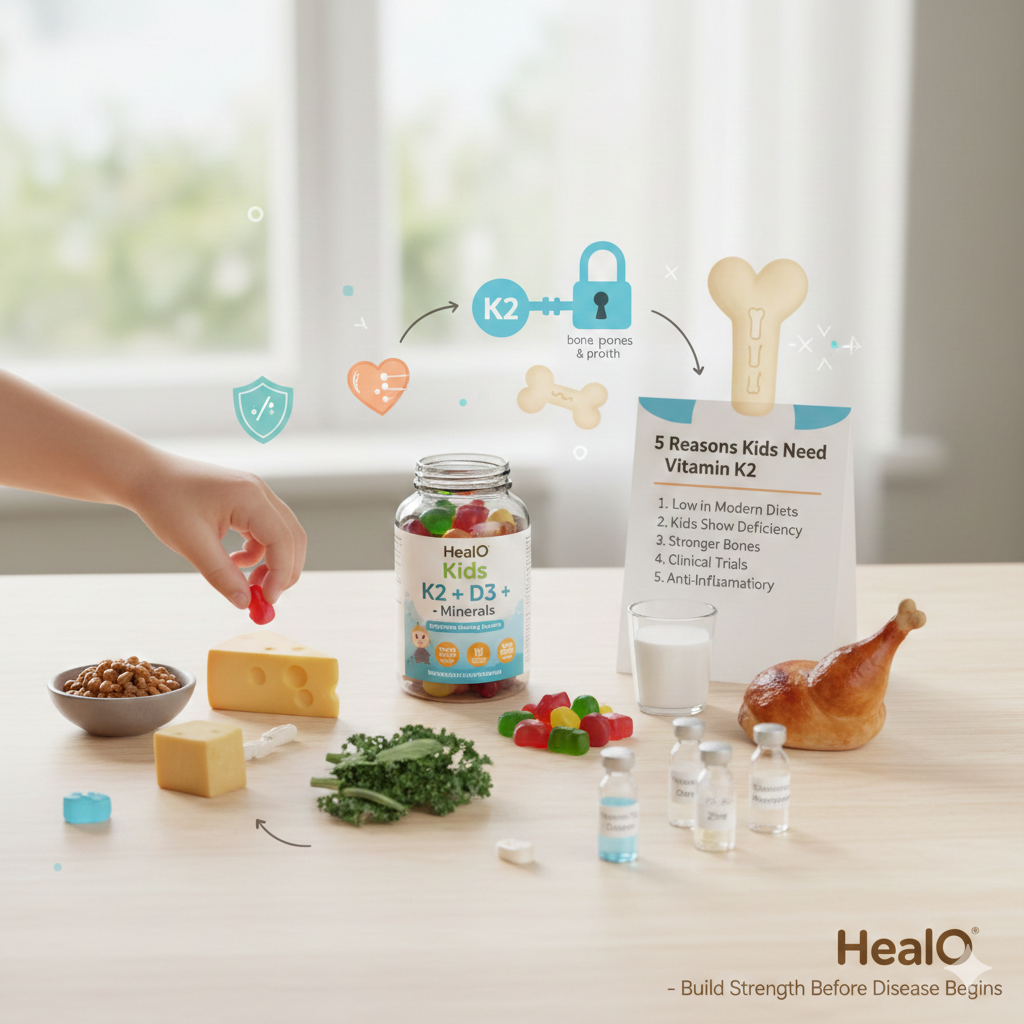
1. Modern Diets Are Severely Low in K2
Children today consume ~50% less vitamin K-rich foods than children in the 1950s. Fermented foods, organ meats, and grass-fed dairy—natural K2 sources—are largely absent from modern plates.
2. Kids Show the Worst Deficiency Markers
Research shows children have 8–10× higher levels of inactive osteocalcin than adults—making them the most K2-deficient age group measured.
This biochemical pattern predicts future osteoporosis risk.
3. Higher K2 Status = Stronger Bones in Youth
Girls aged 3–16 years with higher vitamin K status show greater bone mineral content
Children with chronic conditions (e.g., beta-thalassemia) experienced reduced osteopenia with MK-7 + vitamin D3
4. Human Trials Confirm MK-7 Works in Kids
A randomized trial using 45 mcg/day of MK-7 (MenaQ7®) for 8 weeks showed:
5. K2 May Help Control Inflammation
Low-grade inflammation interferes with bone formation in children.
Cell and animal studies show MK-7 down-regulates inflammatory cytokines (TNF-α, IL-1β). Human trials are ongoing, but the mechanism is promising.
Bone-Boosting Cofactors (HealO Framework)
Vitamin K2 works best in synergy:
Vitamin D3 – hormone-like calcium regulation
Magnesium – mineral transport & enzyme function
Zinc – growth & bone matrix synthesis
Calcium & phosphorus – structural components
👉 The most common childhood deficiencies globally: K2, D3, magnesium, zinc
Supplement Guide (HealO-Approved Logic)
Food alone rarely provides enough K2.
What to look for:
Dosing (evidence-based):
Children: 45 mcg/day
Adults: 180 mcg/day
Forms: drops or gummies improve compliance.
Long-term adult trials show 180 mcg/day MK-7 reduces bone loss and improves strength over 3 years.
Safety & Side Effects
Vitamin K2 has an exceptional safety profile.
No established upper limit in humans.
⚠️ Only caution: children on anticoagulant therapy—medical supervision required.
Final Thoughts
Childhood is the only window to build peak bone mass.
Low vitamin K2 intake—driven by ultra-processed diets—sets the stage for fragile bones, inflammation, and vascular issues later in life. Supplementing clinically validated MK-7, alongside D3 and minerals, is a preventive investment in lifelong resilience.
HealO principle: build strength before disease begins.
References
- https://www.ncbi.nlm.nih.gov/pmc/articles/PMC3255495
- https://www.ncbi.nlm.nih.gov/pubmed/16869104
- https://www.ncbi.nlm.nih.gov/pubmed/24296867
- https://www.ncbi.nlm.nih.gov/pubmed/17349078
- https://www.ncbi.nlm.nih.gov/pubmed/17349078
- https://www.ncbi.nlm.nih.gov/pubmed/19450370
- https://www.ncbi.nlm.nih.gov/pmc/articles/PMC3178021/
- https://www.ncbi.nlm.nih.gov/pubmed/27200471
- https://www.ncbi.nlm.nih.gov/books/NBK209820/
- https://academic.oup.com/jn/article/148/suppl_3/1567S/5026326
- https://www.ncbi.nlm.nih.gov/pubmed/6885274
- https://www.ncbi.nlm.nih.gov/pubmed/29617314
- https://www.ncbi.nlm.nih.gov/pubmed/30371151
- https://www.ncbi.nlm.nih.gov/pubmed/21781006
- https://www.ncbi.nlm.nih.gov/pubmed/18279558
- https://www.nutraceuticalsworld.com/contents/view_breaking-news/2019-01-11/vitamin-k2-status-linked-to-brain-and-eye-health/991
- https://www.ncbi.nlm.nih.gov/pubmed/24089220
- https://www.ncbi.nlm.nih.gov/pubmed/15514282
- https://www.ncbi.nlm.nih.gov/pubmed/18722618
- https://www.ncbi.nlm.nih.gov/pubmed/25694037
- https://www.ncbi.nlm.nih.gov/pubmed/24402301
- https://www.ncbi.nlm.nih.gov/pubmed/24845468
- https://www.ncbi.nlm.nih.gov/pubmed/20424220
- https://www.ncbi.nlm.nih.gov/pubmed/29724016
- https://www.ncbi.nlm.nih.gov/pubmed/439009
- https://www.ncbi.nlm.nih.gov/pubmed/29882816
- https://www.ncbi.nlm.nih.gov/pubmed/30618350
- https://pubmed.ncbi.nlm.nih.gov/17874826/
- https://www.ncbi.nlm.nih.gov/pmc/articles/PMC2730374/
- https://www.mdpi.com/1422-0067/24/3/2986
- Schurgers LJ et al. J Nutr Biochem. Vitamin K2 and bone metabolism.
https://www.ncbi.nlm.nih.gov/pubmed/11374034 - Tsugawa N. Nutrients. Vitamin K metabolism and function
https://www.ncbi.nlm.nih.gov/pubmed/16469998 - van Summeren MJ et al. Br J Nutr. Vitamin K status in children.
- O’Connor E et al. Bone. Osteocalcin activation and bone density in youth.
- Knapen MHJ et al. Osteoporosis Int. MK-7 supplementation and bone health.
- Theuwissen E et al. Thromb Haemost. Safety of long-term MK-7 use.
- Beulens JWJ et al. J Nutr. Distinct roles of vitamin K1 vs K2.
- Shea MK et al. Am J Clin Nutr. Vitamin K intake trends in children.
- https://www.ncbi.nlm.nih.gov/pubmed/17158229?dopt=Abstract
- https://www.ncbi.nlm.nih.gov/pmc/articles/PMC4566462/
- https://www.ncbi.nlm.nih.gov/pmc/articles/PMC2169349/
- https://www.ncbi.nlm.nih.gov/pmc/articles/PMC3255495
- https://www.ncbi.nlm.nih.gov/pubmed/16869104
- https://www.ncbi.nlm.nih.gov/pubmed/17349078
- https://www.ncbi.nlm.nih.gov/books/NBK209820/

2 Responses