Personalized nutrition designed for your unique health goals.

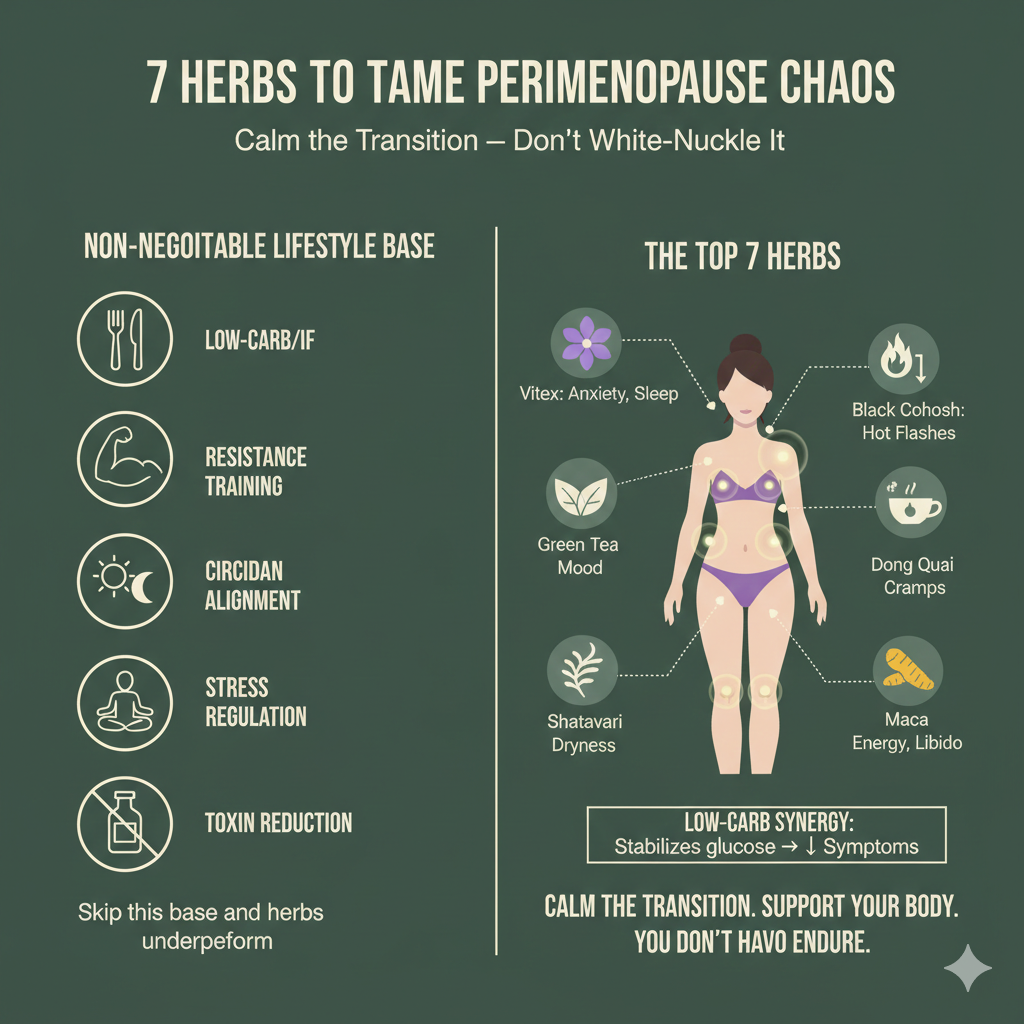
Calm the Transition — Don’t White-Knuckle It

Perimenopause typically begins in the mid-30s to 40s and can last 3–10 years.
What women feel isn’t random aging—it’s hormonal volatility + inflammation.

Common signs:

  • Erratic cycles

  • Hot flashes & night sweats

  • Insomnia, anxiety, low mood

  • Fatigue, joint pain

  • Weight gain (especially central)

  • Libido decline

This phase is manageable—but only if foundations come first.


Non-Negotiable Lifestyle Base (Before Herbs)

Herbs modulate signals; lifestyle controls the volume.

  • Low-carb ± gentle IF → improves insulin sensitivity & estrogen clearance

  • Resistance training (2–3×/week) → preserves muscle, bone, metabolic rate

  • Circadian alignment → morning/noon sunlight, dark nights

  • Stress regulation → prayer/meditation, breathwork, cold exposure (optional)

  • Toxin reduction → ultra-processed foods, alcohol, endocrine disruptors

Skip this base and herbs underperform.


The Top 7 Herbs (Used Strategically)

HerbBest ForTypical DoseKey Cautions
Vitex (Chasteberry)PMS, high prolactin, anxiety, sleep~400 mg/dayNeeds 3+ months; dopaminergic—avoid with dopamine meds
MacaEnergy, libido, mood, hot flashes2–3 g/dayStart low; supports thyroid/adrenals
ShatavariVaginal dryness, vitality, bone support500–1000 mg/dayTraditional tonic; generally gentle
Dong QuaiCramps, pelvic pain, inflammationUsually in blendsAvoid with blood thinners
Green Tea (Matcha)Bone density, insulin sensitivity, mood2–3 cups/dayUse tested, low–heavy-metal sources
Turmeric (Curcumin)Joint pain, hot flashes, inflammation~500 mg w/ piperineAvoid with gallbladder disease
Black CohoshHot flashes, night sweats, mood20–40 mg/dayShort-term use; monitor liver

How These Herbs Actually Work

  • Vitex → dopamine signaling → prolactin normalization → better luteal phase

  • Maca & Shatavari → adaptogenic support for stress, libido, vitality

  • Green tea & Dong quai → antioxidant + vascular + metabolic effects

  • Turmeric & Black cohosh → inflammation and thermoregulation modulation

They don’t replace hormones—they improve the environment hormones operate in.


How to Use Herbs Without Backfiring

Do this instead of “throwing everything in”:

  • Work with a knowledgeable practitioner if possible

  • Stack only 2–3 herbs max

  • Give each stack 6–8 weeks before judging

  • Track: sleep, hot flashes, mood, cycle length, joint pain

  • Many women tolerate stronger support in the luteal phase

More is not better. Precision is.


Low-Carb Synergy (Why It Matters Here)

Blood sugar swings amplify:

  • Cortisol

  • Estrogen volatility

  • Hot flashes

  • Night wakings

Stabilizing glucose often reduces symptoms before herbs even kick in.


The Real Truth

For many women:

  • Herbs + lifestyle > doing nothing

  • Herbs + lifestyle ± HRT > suffering

Perimenopause isn’t a failure of the body.
It’s a transition that needs different inputs.

You don’t have to endure it.
You get to support it—on your terms.


References
  1. https://www.mayoclinic.org/diseases-conditions/perimenopause/symptoms-causes/syc-20354666
  2. https://pmc.ncbi.nlm.nih.gov/articles/PMC10009319/ 
  3. https://journals.lww.com/menopausejournal/fulltext/2015/05000/hormone_therapy_and_mood_in_perimenopausal_and.14.aspx
  4. https://pmc.ncbi.nlm.nih.gov/articles/PMC10227948/
  5. https://www.sciencedirect.com/science/article/pii/S1262363624000387
  6. https://www.cancer.gov/about-cancer/causes-prevention/risk/hormones/mht-fact-sheet#r5
  7. https://pubmed.ncbi.nlm.nih.gov/28376149/
  8. https://pmc.ncbi.nlm.nih.gov/articles/PMC9370779/
  9. https://citeseerx.ist.psu.edu/document?repid=rep1&type=pdf&doi=d914d5834a60df1969f232714c2e88553fd78d3e
  10. https://www.cjmb.org/uploads/pdf/pdf_CJMB_465.pdf
  11. https://www.bmj.com/content/322/7279/134
  12. https://pubmed.ncbi.nlm.nih.gov/12605350/
  13. https://pubmed.ncbi.nlm.nih.gov/31067851/
  14. https://pubmed.ncbi.nlm.nih.gov/17454163/
  15. https://pmc.ncbi.nlm.nih.gov/articles/PMC2928177/
  16. https://pubmed.ncbi.nlm.nih.gov/24931003/
  17. https://www.frontiersin.org/journals/pharmacology/articles/10.3389/fphar.2024.1360422/full
  18. https://pmc.ncbi.nlm.nih.gov/articles/PMC3614596/
  19. https://pmc.ncbi.nlm.nih.gov/articles/PMC4027291/
  20. https://pmc.ncbi.nlm.nih.gov/articles/PMC4027291/
  21. https://pmc.ncbi.nlm.nih.gov/articles/PMC8708006/
  22. https://pmc.ncbi.nlm.nih.gov/articles/PMC6136974/
  23. https://pmc.ncbi.nlm.nih.gov/articles/PMC10121633/
  24. https://pmc.ncbi.nlm.nih.gov/articles/PMC11079574/
  25. https://pmc.ncbi.nlm.nih.gov/articles/PMC2811999/
  26. https://pmc.ncbi.nlm.nih.gov/articles/PMC10457937/
  27. https://www.sciencedirect.com/science/article/pii/S1043661818308168
  28. https://jneuroinflammation.biomedcentral.com/articles/10.1186/s12974-020-01998-9
  29. https://www.nature.com/articles/s41430-021-00856-y
  30. https://www.frontiersin.org/journals/pharmacology/articles/10.3389/fphar.2018.01366/full
  31. https://www.mdpi.com/2072-6643/15/13/3022
  32. https://www.mdpi.com/2072-6643/15/21/4514?ref=elara.care
  33. https://pmc.ncbi.nlm.nih.gov/articles/PMC10459165/
  34. https://pmc.ncbi.nlm.nih.gov/articles/PMC8471428/
  35. https://pubmed.ncbi.nlm.nih.gov/29722036/
  36. https://www.sciencedirect.com/science/article/pii/S0024320523007543
  37. https://www.sciencedirect.com/science/article/pii/S2161831322008419
  38. https://www.sciencedirect.com/science/article/abs/pii/S2405457724001360
  39. https://pmc.ncbi.nlm.nih.gov/articles/PMC10034080/
  40. https://pubmed.ncbi.nlm.nih.gov/31987231/

2 Responses