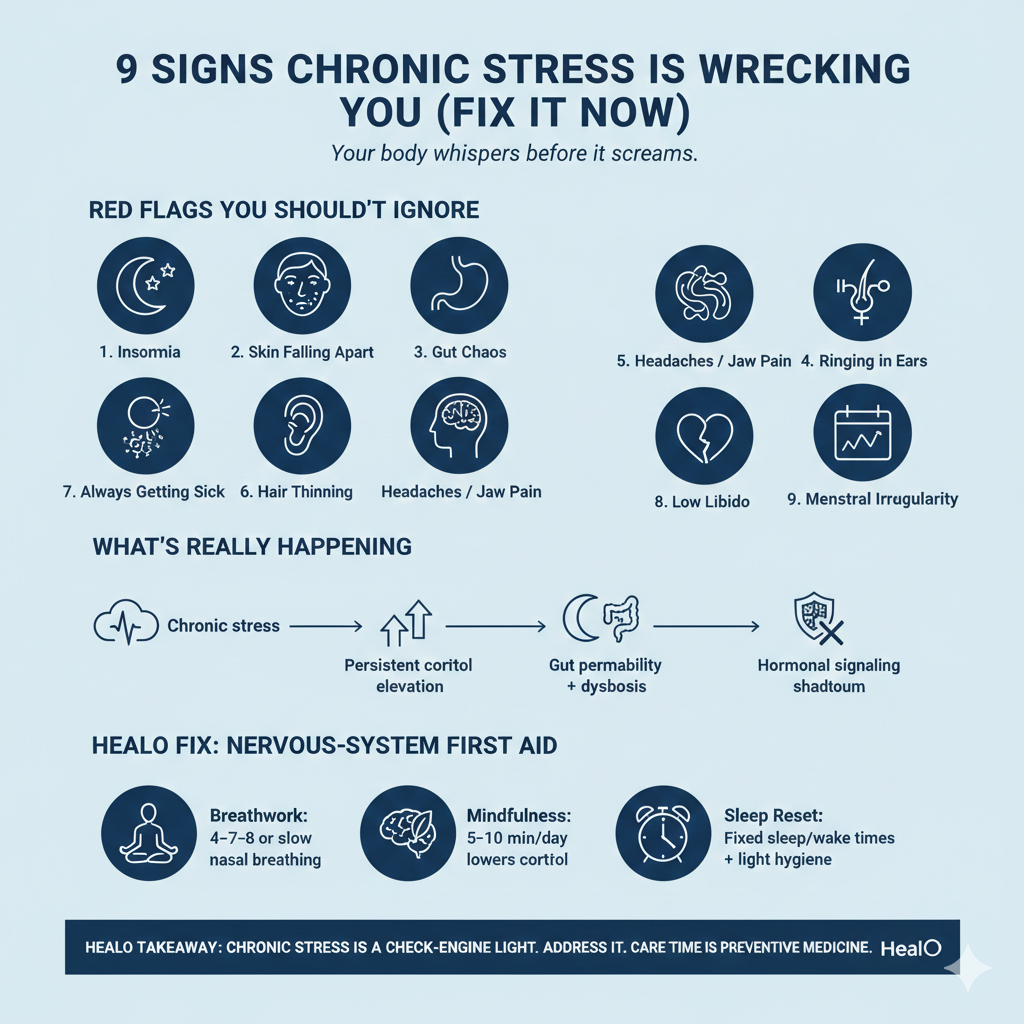
Your body whispers before it screams.
When stress is ignored, cortisol stays elevated, and systems begin to fail—sleep, gut, skin, immunity, hormones.
This isn’t weakness.
It’s biology under pressure.
Red Flags You Shouldn’t Ignore
| Symptom | Why It Happens | Evidence |
|---|
| 1. Insomnia | Cortisol suppresses melatonin production | — |
| 2. Skin Falling Apart | Gut inflammation + cortisol → acne, oiliness, flares | Skin–gut axis |
| 3. Gut Chaos | Stress disrupts the brain–gut axis | PMC4367209 |
| 4. Ringing in Ears | Stress-linked neuroinflammation worsens tinnitus | PMC6407646 |
| 5. Headaches / Jaw Pain | Bruxism, migraines, muscle tension | PMC6781101 |
| 6. Hair Thinning | Stress pushes hair into telogen phase | PMC4606321 |
| 7. Always Getting Sick | Cortisol suppresses immune defense | — |
| 8. Low Libido | Stress hormones blunt sex hormone signaling | — |
| 9. Menstrual Irregularity | Hypothalamic suppression disrupts ovulation | — |
What’s Really Happening
Chronic stress → persistent cortisol elevation →
Your body isn’t “overreacting.”
It’s protecting itself by deprioritizing non-essential functions.
HealO Fix: Nervous-System First Aid
This isn’t about doing more.
It’s about signaling safety to your biology.
Core Reset Tools
Breathwork: 4–7–8 or slow nasal breathing before meals & bed
Mindfulness: Even 5–10 min/day lowers cortisol tone
Sleep Reset: Fixed sleep/wake times + evening light hygiene
You don’t fix stress with supplements first.
You fix it by downshifting the nervous system.
HealO Takeaway
Chronic stress is not a badge of honor.
It’s a check-engine light.
Ignore it → systems fail quietly.
Address it → sleep returns, gut calms, skin clears, hormones recover.
Care time isn’t optional. It’s preventive medicine.
References
- Carabotti, Marilia et al. “The gut-brain axis: interactions between enteric microbiota, central and enteric nervous systems.” Annals of gastroenterology vol. 28,2 (2015): 203-209.
- Ciminelli, Patricia et al. “Tinnitus: The Sound of Stress?.” Clinical practice and epidemiology in mental health : CP & EMH vol. 14 264-269. 31 Oct. 2018, doi:10.2174/1745017901814010264
- Smardz, Joanna et al. “Correlation between Sleep Bruxism, Stress, and Depression-A Polysomnographic Study.” Journal of clinical medicine vol. 8,9 1344. 29 Aug. 2019, doi:10.3390/jcm8091344
- Theeler, Brett J et al. “Headache triggers in the US military.” Headache vol. 50,5 (2010): 790-4. doi:10.1111/j.1526-4610.2009.01571.x
- Malkud, Shashikant. “Telogen Effluvium: A Review.” Journal of clinical and diagnostic research : JCDR vol. 9,9 (2015): WE01-3. doi:10.7860/JCDR/2015/15219.6492
- Bodenmann, Guy & Atkins, David & Schaer, Marcel & Poffet, Valérie. (2010). The Association Between Daily Stress and Sexual Activity. Journal of family psychology : JFP : journal of the Division of Family Psychology of the American Psychological Association (Division 43). 24. 271-9. 10.1037/a0019365.
- Raisanen, Jessica C et al. “Average Associations Between Sexual Desire, Testosterone, and Stress in Women and Men Over Time.” Archives of sexual behavior vol. 47,6 (2018): 1613-1631. doi:10.1007/s10508-018-1231-6
- https://www.ncbi.nlm.nih.gov/pmc/articles/PMC4367209/
- https://www.ncbi.nlm.nih.gov/pmc/articles/PMC6407646/
- https://www.ncbi.nlm.nih.gov/pmc/articles/PMC6781101/
- https://pubmed.ncbi.nlm.nih.gov/19925623/
- https://www.ncbi.nlm.nih.gov/pmc/articles/PMC4606321/
- https://www.researchgate.net/publication/44670652_The_Association_Between_Daily_Stress_and_Sexual_Activity
- https://pubmed.ncbi.nlm.nih.gov/29845444/

2 Responses