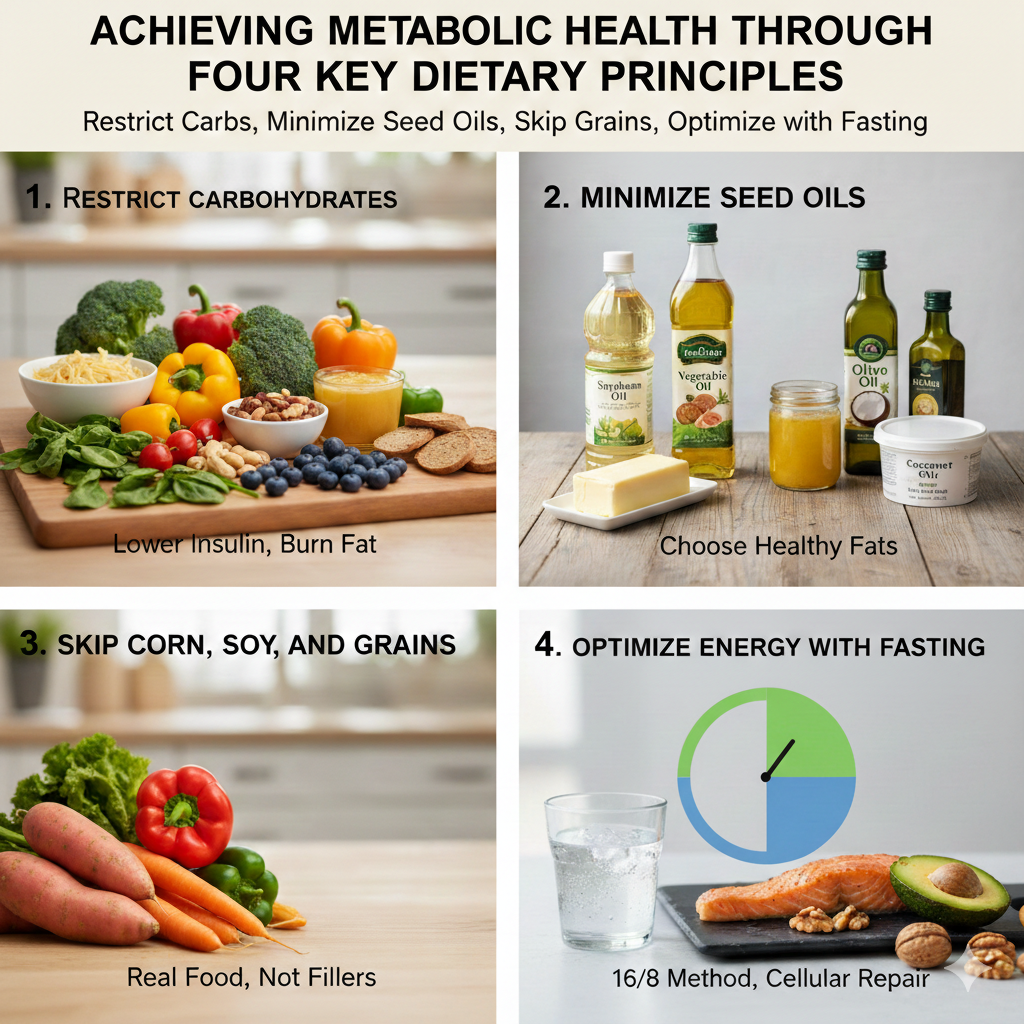
Diets come and go—Atkins, keto, Mediterranean—but no single plan fits everyone. The real path to metabolic health lies in four evidence-based principles backed by science. These aren’t fads; they’re foundational strategies to optimize insulin, reduce inflammation, and unlock your body’s fat-burning potential.
1. Restrict Carbohydrates
Carbs break down into glucose, spiking blood sugar and triggering insulin—a hormone that stores fat. Over time, excess carbs lead to insulin resistance, weight gain, and type 2 diabetes risk.
Why it works:
Lowers insulin levels and improves sensitivity
Promotes fat burning over storage
Boosts HDL cholesterol, cuts triglycerides and blood pressure
How to do it: Limit grains, sugars, and starches. Focus on veggies, nuts, and berries. Even moderate restriction (under 100g/day) yields results.
2. Minimize Seed Oils
Seed oils (soybean, corn, canola) dominate modern food but overload omega-6 fats like linoleic acid, fueling chronic inflammation and heart issues.
Why avoid them:
Imbalances omega-6:omega-3 ratio
Oxidizes easily when heated, creating harmful compounds
Better swaps:
| Avoid These | Choose These |
|---|
| Soybean, corn, canola | Butter, ghee, beef tallow |
| Vegetable oil | Coconut oil, olive oil |
Meat tip: Ruminant meats (beef, lamb) from grass-fed sources are naturally low in linoleic acid—chickens/pigs fed grains aren’t.
3. Skip Corn, Soy, and Grains
These staples are often GMO, glyphosate-heavy, and high-glycemic—promoting insulin spikes and gut issues.
The risks:
Pesticide residues (glyphosate: probable carcinogen)
Rapid blood sugar rises
Anti-nutrients that block mineral absorption
Safer choices: Organic tubers (sweet potatoes), colorful veggies, and fruits. Ditch processed grains for real food.
4. Optimize Energy with Fasting
Balance macros while incorporating fasting to enhance fat metabolism and cellular repair (autophagy).
Fat focus: As carbs drop, ramp up omega-3s (wild fish, walnuts) and stable fats.
Fasting basics:
16/8 method: Eat in an 8-hour window, fast 16
Benefits: Insulin reset, longevity boost, easier weight loss
Pro tips: Hydrate with electrolytes, break fasts with protein/fat.
Your Action Plan
Start with one principle weekly:
Audit carbs—track for 7 days
Swap cooking oils
Clean your grains aisle
Try 12-hour fasts, build to 16/8
These aren’t restrictions—they’re liberation from metabolic chaos. Sustainable metabolic health starts here.
References
Carbohydrate Restriction in Diet Fundamentals References:
- Wright, C. S., & Aronne, L. J. (2012). Causes of obesity. Abdominal Imaging, 37(5), 730-732. Link
- Samuel, V. T., & Shulman, G. I. (2012). Mechanisms for insulin resistance: common threads and missing links. Cell, 148(5), 852-871. Link
- Bazzano, L. A., Hu, T., Reynolds, K., Yao, L., Bunol, C., Liu, Y., … & He, J. (2014). Effects of low-carbohydrate and low-fat diets: a randomized trial. Annals of internal medicine, 161(5), 309-318. Link
Carbohydrate Restriction in Diet Comparison References:
- Bueno, N. B., de Melo, I. S., de Oliveira, S. L., & da Rocha Ataide, T. (2013). Very-low-carbohydrate ketogenic diet v. low-fat diet for long-term weight loss: a meta-analysis of randomised controlled trials. The British Journal of Nutrition, 110(7), 1178-1187. Link
- Shai, I., Schwarzfuchs, D., Henkin, Y., Shahar, D. R., Witkow, S., Greenberg, I., … & Tangi-Rozental, O. (2008). Weight loss with a low-carbohydrate, Mediterranean, or low-fat diet. New England Journal of Medicine, 359(3), 229-241. Link
- Leidy, H. J., Clifton, P. M., Astrup, A., Wycherley, T. P., Westerterp-Plantenga, M. S., Luscombe-Marsh, N. D., … & Mattes, R. D. (2015). The role of protein in weight loss and maintenance. The American Journal of Clinical Nutrition, 101(6), 1320S-1329S. Link
- Volek, J. S., Sharman, M. J., Forsythe, C. E., & Phinney, S. D. (2009). Comparison of a low-carbohydrate and low-fat diet on lipoprotein subclasses in overweight and obese adults. Nutrition & metabolism, 6(1), 1-9. Link
- Forsythe, C. E., Phinney, S. D., Fernandez, M. L., Quann, E. E., Wood, R. J., Bibus, D. M., … & Volek, J. S. (2008). Comparison of low fat and low carbohydrate diets on circulating fatty acid composition and markers of inflammation. Lipids, 43(1), 65-77. Link
- Ruth, M. R., Port, A. M., Shah, M., Bourland, A. C., Istfan, N. W., Nelson, K. P., … & Apovian, C. M. (2013). Consuming a hypocaloric high fat low carbohydrate diet for 12 weeks lowers C-reactive protein, and raises serum adiponectin and high density lipoprotein-cholesterol in obese subjects. Metabolism, 62(12), 1779-1787. Link
- Jenkins, D. J., Kendall, C. W., Augustin, L. S., Franceschi, S., Hamidi, M., Marchie, A., … & Axelsen, M. (2002). Glycemic index: overview of implications in health and disease. The American Journal of Clinical Nutrition, 76(1), 266S-273S. Link
Seed Oil Reduction in Diet References:
- Simopoulos, A. P. (2016). An Increase in the Omega-6/Omega-3 Fatty Acid Ratio Increases the Risk for Obesity. Nutrients, 8(3), 128. Link
- Ramsden, C. E., Zamora, D., Majchrzak-Hong, S., Faurot, K. R., Broste, S. K., Frantz, R. P., … & Hibbeln, J. R. (2016). Re-evaluation of the traditional diet-heart hypothesis: analysis of recovered data from Minnesota Coronary Experiment (1968-73). BMJ, 353, i1246. Link
- Estruch, R., Ros, E., Salas-Salvadó, J., Covas, M. I., Corella, D., Arós, F., … & Martínez-González, M. A. (2018). Primary prevention of cardiovascular disease with a Mediterranean diet supplemented with extra-virgin olive oil or nuts. New England Journal of Medicine, 378(25), e34. Link
- Hu, Y., Hu, F. B., & Manson, J. E. (2019). Marine Omega-3 supplementation and cardiovascular disease: An updated meta-analysis of 13 randomized controlled trials involving 127,477 participants. Journal of the American Heart Association, 8(19), e013543. Link
- Fritsche, K. L. (2008). Too much linoleic acid promotes inflammation—Doesn’t it?. Prostaglandins, Leukotrienes and Essential Fatty Acids, 79(3-5), 173-175. Link
- Wannamethee, S. G., Lowe, G. D., Rumley, A., Bruckdorfer, K. R., & Whincup, P. H. (2004). Associations of vitamin C status, fruit and vegetable intakes, and markers of inflammation and hemostasis. The American Journal of Clinical Nutrition, 79(3), 454-460. Link
- Frankel, E. N., Mailer, R. J., Shoemaker, C. F., Wang, S. C., & Flynn, J. D. (2010). Tests indicate that imported “extra virgin” olive oil often fails international and USDA standards. UC Davis Olive Center. Link
- Wang, S., Unger, S., Duncan, S. E., & O’Keefe, S. F. (2020). Quality and purity of commercial avocado oil. Food Control, 112, 107108. Link
Energy Optimization in Diet References:
- Institute of Medicine. (2005). Dietary Reference Intakes for Energy, Carbohydrate, Fiber, Fat, Fatty Acids, Cholesterol, Protein, and Amino Acids. The National Academies Press. Link
- Simopoulos, A. P. (2002). The importance of the ratio of omega-6/omega-3 essential fatty acids. Biomedicine & Pharmacotherapy, 56(8), 365-379. Link
Fasting as Part of Diet References:
- Patterson, R. E., & Sears, D. D. (2017). Metabolic Effects of Intermittent Fasting. Annual review of nutrition, 37, 371-393. Link
- Chaix, A., Zarrinpar, A., Miu, P., & Panda, S. (2019). Time-restricted feeding is a preventative and therapeutic intervention against diverse nutritional challenges. Cell metabolism, 29(1), 6-16. Link
- Cahill Jr, G. F. (2006). Fuel metabolism in starvation. Annual review of nutrition, 26, 1-22. Link
- Harris, L., Hamilton, S., & Azevedo, L. B. (2018). Intermittent fasting interventions for the treatment of overweight and obesity in adults: a systematic review and meta-analysis. JBI database of systematic reviews and implementation reports, 16(2), 507-547. Link
- Longo, V. D., & Mattson, M. P. (2014). Fasting: molecular mechanisms and clinical applications. Cell metabolism, 19(2), 181-192. Link
- López-Otín, C., Galluzzi, L., Freije, J. M., Madeo, F., & Kroemer, G. (2016). Metabolic control of longevity. Cell, 166(4), 802-821. Link

4 Responses