
Personalized nutrition designed for your unique health goals.
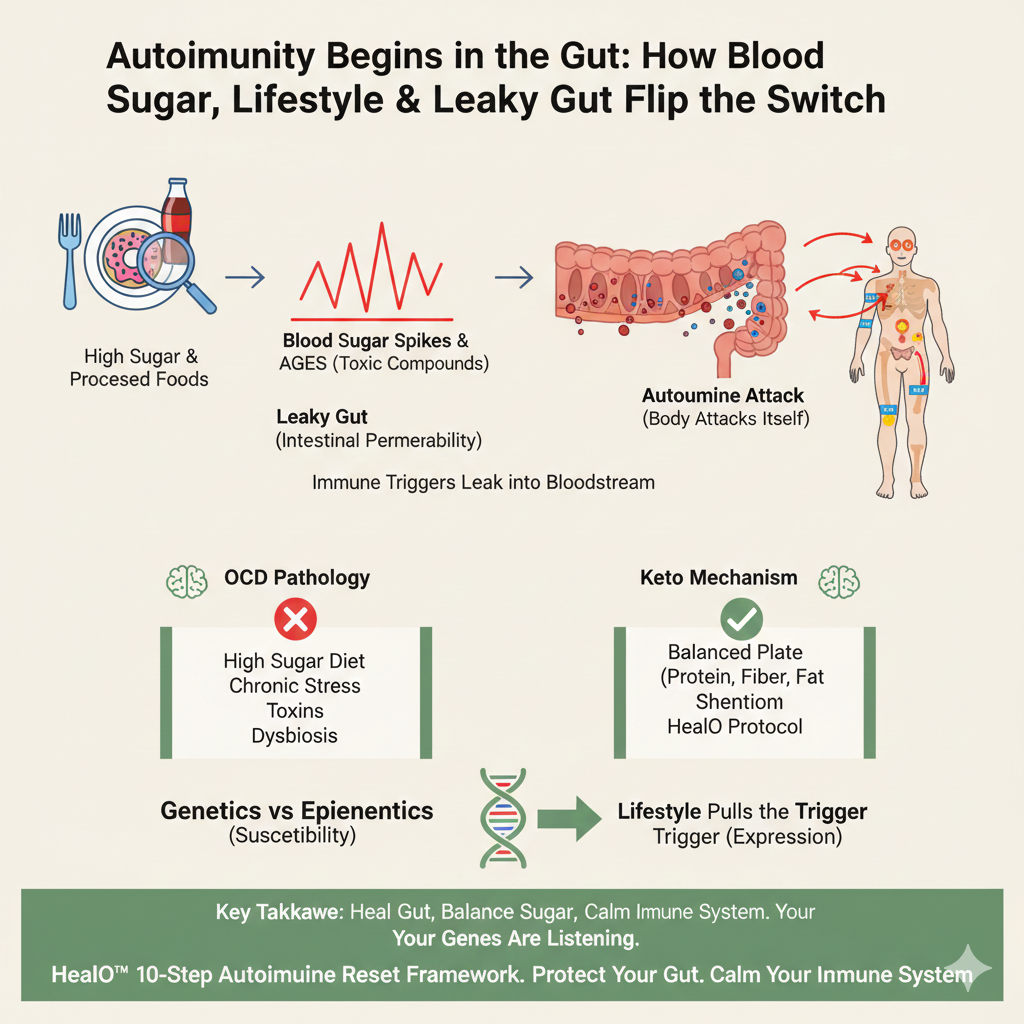
Autoimmune diseases don’t appear overnight. They develop quietly—often years before diagnosis—as inflammation, gut barrier damage, and blood sugar instability slowly train the immune system to attack the body itself.
The good news?
Genes load the gun, but lifestyle pulls the trigger.
Large twin studies show that up to 77% of immune system behavior is driven by environment and habits, not genetics. That means autoimmunity is far more modifiable than most people realize.
Blood Sugar, AGEs & the Gut Barrier
Repeated blood sugar spikes lead to the formation of Advanced Glycation End Products (AGEs)—toxic compounds that:
Damage gut tight junctions
Increase intestinal permeability (leaky gut)
Amplify systemic inflammation
Once the gut barrier weakens, immune triggers like gluten fragments, bacterial toxins, and food antigens leak into circulation—confusing immune cells and fueling autoimmune reactions.
The fix starts on your plate:
Every meal should balance protein, fiber, and healthy fats to blunt glucose spikes and protect the gut lining.
The True Roots of Autoimmunity
Autoimmunity occurs when immune tolerance breaks down and the body attacks its own tissues—thyroid, joints, skin, brain, or gut.
What drives this breakdown?
Leaky gut (the primary gateway)
Chronic inflammation
Immune overactivation (Th17 dominance)
Oxidative stress and toxin overload
📊 Prevalence reality
~25% of people carry autoimmune activity silently
Antibodies often appear 5–10 years before symptoms
Millions remain undiagnosed until tissue damage is advanced
Genetics vs Epigenetics: Who’s Really in Control?
Genetics create susceptibility.
Epigenetics decides expression.
Environmental triggers that flip immune genes “on” include:
Ultra-processed foods & excess salt (boosts Th17 immune cells)
Chronic stress and poor sleep
Infections and gut dysbiosis
Toxins (pollution, cosmetics, pesticides)
🔬 Stanford twin studies confirm:
Lifestyle explains ~77% of immune variation.
The Autoimmune Spectrum: Catch It Early
Autoimmunity progresses in stages:
Silent phase – antibodies present, no symptoms
Reactivity phase – symptoms without formal diagnosis
Disease phase – tissue destruction and irreversible damage
⚠️ Early warning signs:
Persistent fatigue
Brain fog
Joint or muscle aches
Digestive issues
Temperature sensitivity
Proactive antibody testing (thyroid, gut, adrenal markers) can identify risk years before disease onset.
13 Common Autoimmune Triggers (Often Missed)
Dietary Triggers
Gluten & cross-reactive grains (corn, rice)
Sugar & refined carbs
Dairy casein
Nightshades (alkaloids)
Quinoa (saponins)
Chocolate (lectins)
Modern Lifestyle Triggers
Artificial sweeteners
Instant coffee additives
High-salt fast food
Smoking
Excess iodine
Chronic stress
| Trigger | Why It Harms | HealO Fix |
|---|---|---|
| Gluten & grains | Molecular mimicry | 60–90 day elimination |
| Sugar | Fuels inflammation | Berries, stevia only |
| Stress | Skews immune balance | Daily breathwork |
| Toxins | Overloads detox pathways | Filtered water, clean products |
Top Nutrients That Support Immune Tolerance
Food-first always—but deficiencies must be corrected.
Vitamin A (retinol): Regulates immune signaling
Sources: liver, cod liver oilVitamin D: Suppresses Th17 inflammation
Sources: sunlight 20–60 min/dayVitamin K2: Anti-inflammatory for brain & spine
Sources: ghee, fermented foodsIron: Essential for immune regulation post-gut repair
Sources: grass-fed beefKey minerals:
Selenium (Brazil nuts), zinc (organ meats), magnesium (stress + thyroid)
HealO™ 10-Step Autoimmune Reset Framework
Test gut permeability
Repair gut lining (broth, L-glutamine)
Remove gluten & cross-reactive foods (minimum 60 days)
Balance blood sugar daily
Reduce toxic load (food, water, cosmetics)
Calm inflammation (turmeric, green tea)
Optimize mineral intake (sea salt > table salt)
Restore microbiome (probiotics + fiber)
Track antibodies for objective progress
Adjust iteratively—no guesswork
Consistency—not perfection—drives remission.
The Takeaway
Autoimmunity is not random.
It’s predictable, measurable, and modifiable.
When you stabilize blood sugar, heal the gut barrier, and reduce immune triggers, the immune system often relearns tolerance.
Your genes are listening.
What you do daily tells them how to behave.
Ready to Go Deeper?
HealO™ consultations guide testing, elimination, gut repair, and long-term immune balance—without extreme protocols.
Start with your next meal.
Protect your gut.
Calm your immune system.
References
- Marrack, P., Kappler, J. & Kotzin, B. Autoimmune disease: why and where it occurs. Nat Med 7, 899–905 (2001). https://doi.org/10.1038/90935
- Fasano A. Zonulin, regulation of tight junctions, and autoimmune diseases. Ann N Y Acad Sci. 2012;1258(1):25‐33. doi:10.1111/j.1749-6632.2012.06538.x
- Brodin P, Jojic V, Gao T, et al. Variation in the human immune system is largely driven by non-heritable influences. Cell. 2015;160(1-2):37‐47. doi:10.1016/j.cell.2014.12.020
- Steinman, L. A brief history of TH17, the first major revision in the TH1/TH2 hypothesis of T cell–mediated tissue damage. Nat Med 13, 139–145 (2007). https://doi.org/10.1038/nm1551
- Adrenal Insufficiency & Addison’s Disease NIH https://www.niddk.nih.gov/health-information/endocrine-diseases/adrenal-insufficiency-addisons-disease
- Rose NR. Predictors of autoimmune disease: autoantibodies and beyond [published correction appears in Autoimmunity. 2008 Dec;41(8):691]. Autoimmunity. 2008;41(6):419‐428. doi:10.1080/08916930802031686
- A. Vojdani and I. Tarash, “Cross-Reaction between Gliadin and Different Food and Tissue Antigens,” Food and Nutrition Sciences, Vol. 4 No. 1, 2013, pp. 20-32. doi: 10.4236/fns.2013.41005
- Patel B, Schutte R, Sporns P, Doyle J, Jewel L, Fedorak RN. Potato glycoalkaloids adversely affect intestinal permeability and aggravate inflammatory bowel disease. Inflamm Bowel Dis. 2002;8(5):340‐346 doi:10.1097/00054725-200209000-00005
- Ljudmila Stojanovich, Dragomir Marisavljevich Stress as a trigger of autoimmune disease Autoimmunity Reviews Volume 7, Issue 3, January 2008, Pages 209-213. doi:10.1016/j.autrev.2007.11.007
- Vestergaard P, Rejnmark L, Weeke J, et al. Smoking as a risk factor for Graves’ disease, toxic nodular goiter, and autoimmune hypothyroidism. Thyroid. 2002;12(1):69‐75. doi:10.1089/105072502753451995
- Tomer Y, Huber A. The etiology of autoimmune thyroid disease: a story of genes and environment. J Autoimmun. 2009;32(3-4):231‐239. doi:10.1016/j.jaut.2009.02.007
- Sun X, Shan Z, Teng W. Effects of increased iodine intake on thyroid disorders. Endocrinol Metab (Seoul). 2014;29(3):240‐247. doi:10.3803/EnM.2014.29.3.240
- Boukis MA, Koutras DA, Souvatzoglou A, Evangelopoulou A, Vrontakis M, Moulopoulos SD. Thyroid hormone and immunological studies in endemic goiter. J Clin Endocrinol Metab. 1983;57(4):859‐862. doi:10.1210/jcem-57-4-859
- Ikeda U, Wakita D, Ohkuri T, et al. 1α,25-Dihydroxyvitamin D3 and all-trans retinoic acid synergistically inhibit the differentiation and expansion of Th17 cells. Immunol Lett. 2010;134(1):7‐16. doi:10.1016/j.imlet.2010.07.002
- Susan J. Zunino, David H. Storms, Charles B. Stephensen, Diets Rich in Polyphenols and Vitamin A Inhibit the Development of Type I Autoimmune Diabetes in Nonobese Diabetic Mice, The Journal of Nutrition, Volume 137, Issue 5, May 2007, Pages 1216–1221, https://doi.org/10.1093/jn/137.5.1216
- Manicassamy S, Ravindran R, Deng J, et al. Toll-like receptor 2-dependent induction of vitamin A-metabolizing enzymes in dendritic cells promotes T regulatory responses and inhibits autoimmunity. Nat Med. 2009;15(4):401‐409. doi:10.1038/nm.1925
- Hedrén E, Diaz V, Svanberg U. Estimation of carotenoid accessibility from carrots determined by an in vitro digestion method. Eur J Clin Nutr. 2002;56(5):425‐430. doi:10.1038/sj.ejcn.1601329
- Moriya M, Nakatsuji Y, Okuno T, Hamasaki T, Sawada M, Sakoda S. Vitamin K2 ameliorates experimental autoimmune encephalomyelitis in Lewis rats. J Neuroimmunol. 2005;170(1-2):11‐20. doi:10.1016/j.jneuroim.2005.08.001
- Negro R. Selenium and thyroid autoimmunity. Biologics. 2008;2(2):265‐273. doi:10.2147/btt.s2746
- Mooren FC, Golf SW, Völker K. Effect of magnesium on granulocyte function and on the exercise induced inflammatory response. Magnes Res. 2003;16(1):49‐58.
- Chika Kitabayashi, Toshiyuki Fukada, Minoru Kanamoto, Wakana Ohashi, Shintaro Hojyo, Toru Atsumi, Naoko Ueda, Ichiro Azuma, Hiroshi Hirota, Masaaki Murakami, Toshio Hirano, Zinc suppresses Th17 development via inhibition of STAT3 activation, International Immunology, Volume 22, Issue 5, May 2010, Pages 375–386, https://doi.org/10.1093/intimm/dxq017
- Zonulin and Its Regulation of Intestinal Barrier Function: The Biological Door to Inflammation, Autoimmunity, and Cancer Alessio Fasano Physiological Reviews 2011 91:1, 151-175
- Cusick MF, Libbey JE, Fujinami RS. Molecular mimicry as a mechanism of autoimmune disease. Clin Rev Allergy Immunol. 2012;42(1):102‐111. doi:10.1007/s12016-011-8294-7
- Wu D, Wang J, Pae M, Meydani SN. Green tea EGCG, T cells, and T cell-mediated autoimmune diseases. Mol Aspects Med. 2012;33(1):107‐118. doi:10.1016/j.mam.2011.10.001
- Katherine Harmon Salt Linked To Autoimmune Diseases Nature 06 March 2013. https://www.nature.com/news/salt-linked-to-autoimmune-diseases-1.12555
- Richie JP Jr, Nichenametla S, Neidig W, et al. Randomized controlled trial of oral glutathione supplementation on body stores of glutathione. Eur J Nutr. 2015;54(2):251‐263. doi:10.1007/s00394-014-0706-z
- Recent Post