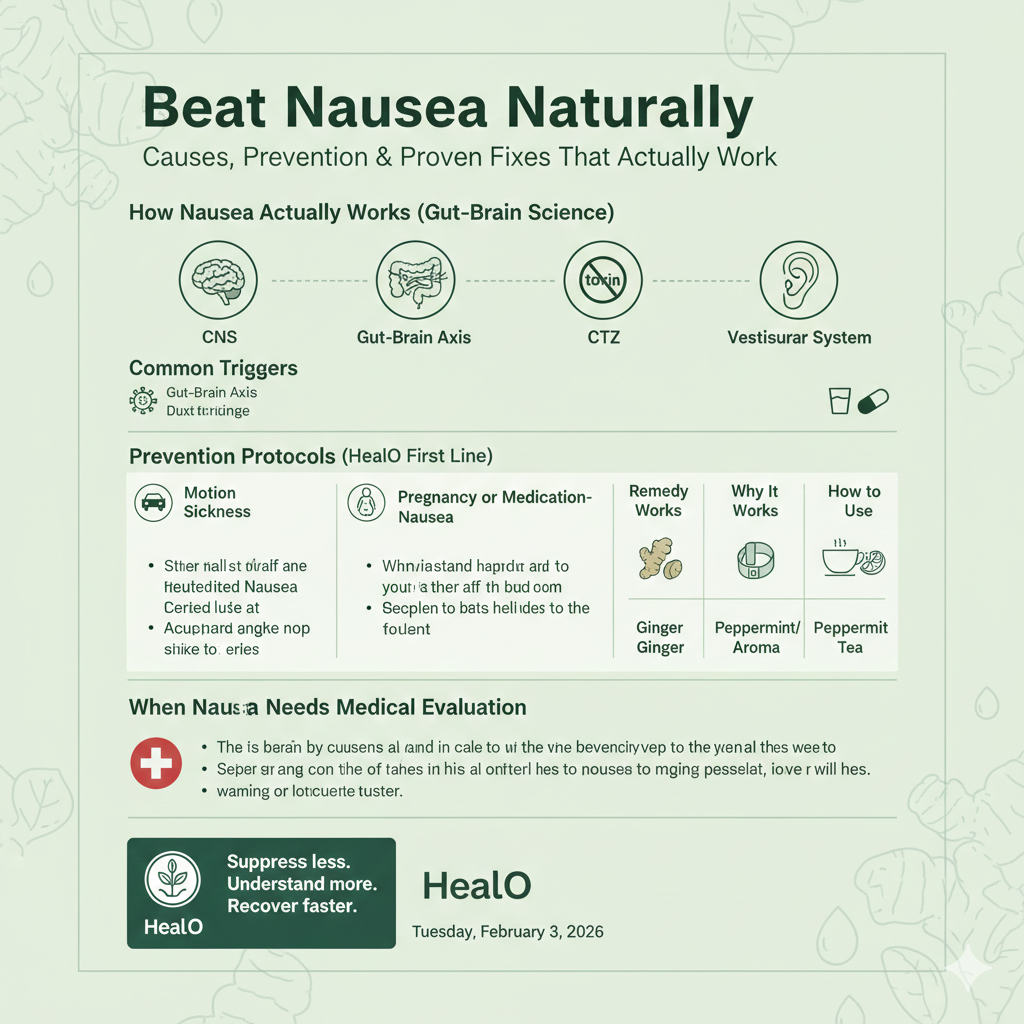
Causes, Prevention & Proven Fixes That Actually Work
Nausea isn’t random.
It’s a protective reflex—your body’s way of saying “something isn’t right.” Whether it’s food poisoning, motion sickness, pregnancy, or medication side effects, nausea is the brain–gut axis pulling the alarm.
Suppressing it blindly misses the point.
Understanding why it happens lets you calm it—naturally and effectively.
How Nausea Actually Works (Gut–Brain Science)
Nausea is coordinated by the vomiting center in the medulla, which integrates signals from four key systems:
1. Central Nervous System (CNS)
Migraines, head injury, strokes, or severe stress can activate nausea pathways directly via the brain and spinal cord.
2. Peripheral & Autonomic Nervous System
Irritation in the stomach or intestines (infection, inflammation, delayed emptying) sends distress signals through the vagus nerve.
3. Chemoreceptor Trigger Zone (CTZ)
This area sits outside the blood–brain barrier and acts as a toxin sensor, detecting:
Medications
Bacterial toxins
Metabolic byproducts
Once triggered, it alerts the vomiting center fast.
4. Vestibular System (Inner Ear)
Motion sickness happens when:
Eyes say “still”
Inner ear says “moving”
This sensory mismatch confuses the brain and provokes nausea—especially in low visibility or screen use during travel.
Common Triggers
Viral or bacterial infections
Motion sickness
Pregnancy
Medications (painkillers, antibiotics, chemo)
Empty stomach or dehydration
Blood sugar dips
Strong smells or visual overload
Prevention Protocols (HealO First Line)
Motion Sickness
Sit in the front seat
Fix eyes on the horizon
Avoid reading or phone use
Eat small, stable snacks (beef jerky, cube of dark chocolate, nuts)
Pregnancy or Medication-Related Nausea
Eat small, frequent low-carb meals
Avoid greasy or spicy foods
Start ginger before symptoms peak
General Prevention
Stay hydrated with electrolytes, not plain water alone
Don’t let the stomach sit empty too long (>24-36 hours)
Manage blood sugar (protein + fat beats sugar spikes)
Natural Treatments (Evidence-Ranked)
| Remedy | Why It Works | How to Use |
|---|
| Ginger | Blocks serotonin (5-HT3) nausea receptors | 1 g fresh ginger or 250 mg capsules |
| P6 Acupressure | Stimulates vagus nerve, calms vomiting reflex | Wrist bands (continuous use) |
| Peppermint / Lemon Aroma | Reduces gut spasm, improves gastric emptying | Inhale oil or diffuse |
| Peppermint Tea | Relaxes GI smooth muscle | Sip slowly |
| CBD (advanced cases) | Activates anti-nausea serotonin pathways | 25–50 mg sublingual (short-term) |
HealO Tip:
Peppermint tea + slow nasal breathing = instant vagal tone boost.
When Nausea Needs Medical Evaluation
Don’t self-manage if nausea is:
Persistent or worsening
Associated with severe pain
Accompanied by neurological symptoms
Occurring daily without a clear trigger
Possible red flags include:
Gallbladder disease
Peptic ulcers
Inner ear disorders
CNS pathology
Pregnancy note: Ginger is considered safe in early pregnancy within recommended doses.
HealO Bottom Line
Nausea isn’t the enemy—it’s a signal.
Support the gut–brain axis, stabilize blood sugar, calm the nervous system, and use targeted natural tools. Most cases resolve quickly when the root trigger is addressed.
Suppress less.
Understand more.
Recover faster.
References
- Kuo B., Singh P. (2017) Nausea and Vomiting Related to the Central Nervous System Diseases. In: Koch K., Hasler W. (eds) Nausea and Vomiting. Springer, Cham
- Turner M, Griffin MJ. Motion sickness in public road transport: passenger behavior and susceptibility. Ergonomics. 1999;42(3):444‐461. doi:10.1080/001401399185586
- Genç F, Tan M. The effect of acupressure application on chemotherapy-induced nausea, vomiting, and anxiety in patients with breast cancer. Palliat Support Care. 2015;13(2):275‐284. doi:10.1017/S1478951514000248
- Lete I, Allué J. The Effectiveness of Ginger in the Prevention of Nausea and Vomiting during Pregnancy and Chemotherapy. Integr Med Insights. 2016;11:11‐17. Published 2016 Mar 31. doi:10.4137/IMI.S36273
- Hunt R, Dienemann J, Norton HJ, et al. Aromatherapy as treatment for postoperative nausea: a randomized trial. Anesth Analg. 2013;117(3):597‐604. doi:10.1213/ANE.0b013e31824a0b1c
- Parker LA, Rock EM, Limebeer CL. Regulation of nausea and vomiting by cannabinoids. Br J Pharmacol. 2011;163(7):1411‐1422. doi:10.1111/j.1476-5381.2010.01176.x