
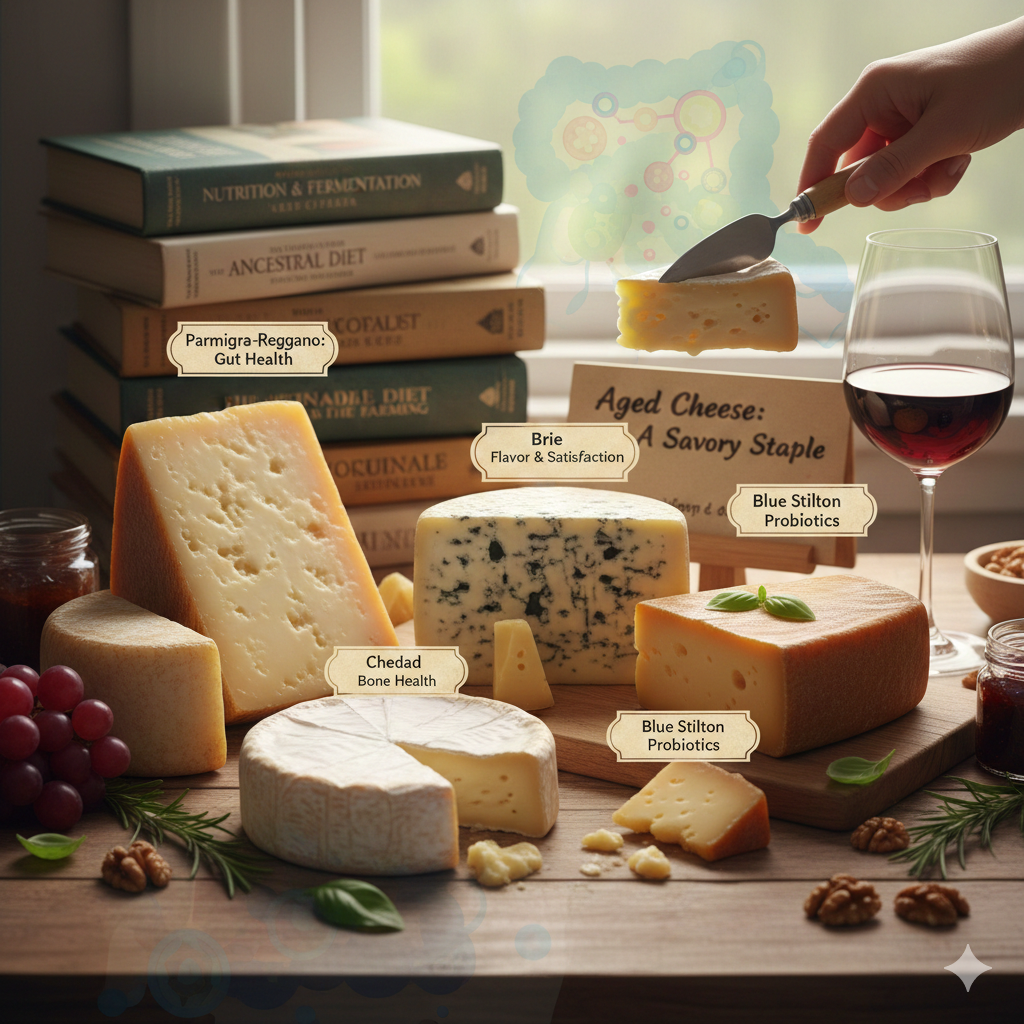
Cheese has endured a bad reputation for decades—blamed for everything from heart disease to environmental harm. But as someone who’s dug into the research on public health, nutrition, and epidemiology, I’m here to set the record straight. Aged cheeses, in particular, offer surprising health perks when chosen wisely. We’ll explore the history, controversies, benefits, and risks, plus practical tips.
Table of Contents
Does Cheese Fit Our Ancestral Diet?
A Brief History of Cheese
Fun Cheese Facts
Navigating Dairy Sensitivities
8 Health Benefits of Aged Cheeses
Potential Risks and How to Enjoy Safely
Does Cheese Fit Our Ancestral Diet?
Health experts often look to our Paleolithic ancestors—about 10,000 years ago—for dietary clues, focusing on natural, unprocessed foods. While strict Paleo excludes dairy, evidence shows goat cheese dates back at least 7,500 years (Nature, 2012). That’s close enough to ancestral eating for aged cheese to deserve a spot in modern diets, especially with its nutrient density.
A Brief History of Cheese
All cheese starts the same: milk separates into curds and whey. Fresh varieties like cottage cheese or mozzarella stay mild and moist. Aged cheeses, stored for 6+ months under precise temperature, humidity, mold, and bacteria, develop bold, complex flavors. This fermentation isn’t just tasty—it’s a health powerhouse.
Fun Cheese Facts
Cheddar: Born in England’s Cheddar village caves, perfect for its sharp profile.
Brie: A soft French cow’s-milk cheese; warm to room temp for peak flavor (Cheese.com).
Blue Stilton: Exclusive to three English counties, using local milk (Cheeseboard.co.uk).
Navigating Dairy Sensitivities
Dairy tops the list of common intolerances, sparking bloating, inflammation, or allergies. I once cut it out for three weeks to test sensitivities—and dreamed of cheese nonstop (sorry, bread lovers). Reintroducing it revealed I tolerate aged varieties well. If cow’s milk bothers you, try goat or sheep cheeses (different proteins) or Jersey cow options. Start small; your body might thrive on the right types.
8 Health Benefits of Aged Cheeses
1. Fermentation Boosts Gut Health
Aged over 60 days, many raw-milk cheeses like Parmigiano-Reggiano undergo deep fermentation, linked to better digestion, mood, diabetes management, and autoimmune support. The tangy taste signals active microbes—skip factory versions lacking this edge.
2. Supports Weight Management
Postmenopausal women eating fermented dairy had less belly fat (Nutrients, 2018). Full-fat dairy correlates with lower obesity in kids (Adv Nutr, 2017) and better BMI in adults (Nutrients, 2017). Processed cheese? It adds pounds—aging makes the difference.
3. Protects Bone Health
Fermented dairy improved bone size in postmenopausal women (Nutrients, 2018), and cheese boosted density in men (Osteoporos Int, 2018). Pair with vitamin D3 for max effect (Eur J Nutr, 2017).
4. Delivers Probiotics
Aged cheeses host resilient probiotics that colonize your gut—over 300 strains across 45 varieties (Int Dairy J, 2007). Each type offers unique strains for endless gut support (J Dairy Sci, 2000).
5. Enhances Flavor and Satisfaction
Aged cheeses’ umami from broken-down proteins, fats, and acids makes meals irresistible—explaining my cheese dreams. The creamy fats curb overeating, turning simple dishes into sensory delights.
6. Packs Nutrients
Opt for organic or grass-fed for omega-3s, CLA (cancer-fighting, metabolism-boosting), vitamin K2 (heart/bone hero), protein, and more:
Calcium, phosphorus, zinc
Vitamins A, B2, B12, trace D
Grass-fed beats conventional (ARS USDA; FASEB J, 2017).
7. Aids Digestion and Immunity
Raw-milk aged cheeses provide immunoglobulins, lactic acid (fights Listeria), digestive enzymes, growth factors, whey, and amino acids to heal the gut lining (Food Control, 2018; PubMed studies).
8. Environmentally Friendly Options
Regenerative dairy farming—using cows, goats, or sheep to restore soil and water—cuts waste and emissions holistically (Front Ecol Environ, 2017). Choose grass-fed, artisan cheeses over conventional; it’s the “new organic” for planet and health.
Potential Risks and How to Enjoy Safely
Risks: High sodium/tyramine (avoid if on MAOIs or low-sodium diets); lactose intolerance (aged has less); overconsumption adds calories/saturated fat. Factory cheeses lack benefits and may promote weight gain.
Tips:
Warm to room temp; pair with wine-like ritual.
Source regenerative/grass-fed from local farmers.
Moderation: 1-2 oz daily.
Test sensitivities gradually.
Aged cheese isn’t villainous—it’s a fermented gem when mindfully chosen. Science supports its role in nutrition, gut health, and even sustainability.
One Response