Blue light isn’t the villain—chronic, artificial exposure is.
Natural blue light from the sun is essential for alertness, metabolism, and appetite timing. But screens deliver a nonstop blue-light signal, long after sunset—confusing the brain, suppressing melatonin, and driving silent inflammation.
At HealO, we treat blue light as a full-stack health disruptor, not just a sleep issue.
Table of Contents
Blue Light: Natural vs Artificial
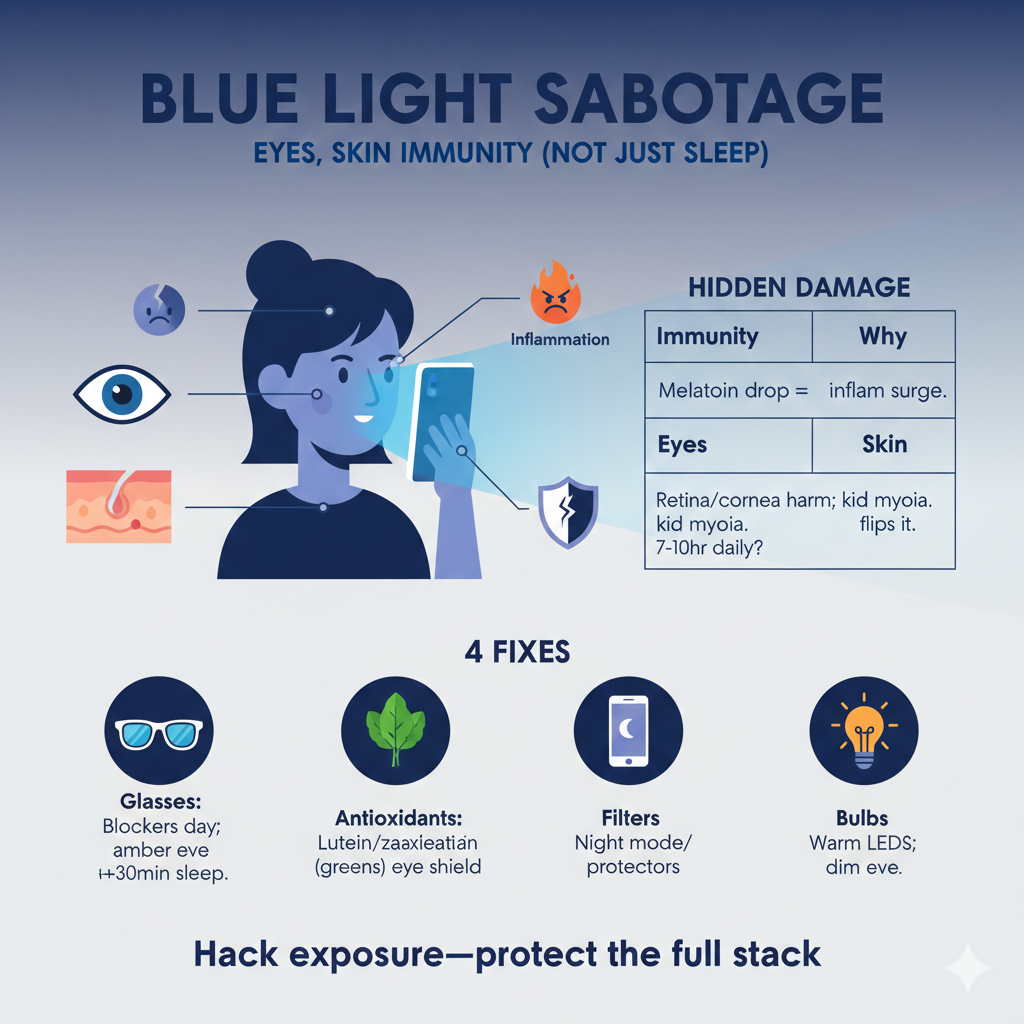
The Hidden Damage Pathway
Eyes, Skin & Immunity: What the Science Shows
The 4 HealO Fixes
HealO Takeaway
Scientific References
1. Blue Light: Natural vs Artificial
| Source | Timing | Effect |
|---|
| Sunlight (blue-rich) | Morning–midday | ↑ Alertness, focus, appetite alignment |
| Screens & LEDs | Evening/night | ↓ Melatonin, ↑ inflammation |
Problem:
Your brain cannot distinguish sunset Netflix from midday sunlight.
2. The Hidden Damage Pathway
Chronic blue light exposure → circadian confusion → systemic effects
| System Hit | Mechanism |
|---|
| Immunity | Melatonin suppression → inflammatory cytokine surge |
| Eyes | Retinal oxidative stress & corneal damage |
| Skin | Free radical generation → aging, acne, pigmentation |
Melatonin is not just a sleep hormone—it is a master antioxidant and immune regulator.
3. What the Science Shows
🧠 Immunity
Blue light suppresses melatonin
Low melatonin = higher systemic inflammation
Chronic exposure weakens immune signaling and recovery
👁️ Eyes
Retinal and corneal oxidative injury
Increased risk of digital eye strain & progressive myopia in children
Average screen time now: 7–10 hours/day
📚 Evidence: Blue light–induced retinal stress and pediatric myopia
🌿 Skin
Blue light penetrates deeper than UV-A
Triggers oxidative stress → wrinkles, hyperpigmentation, acne
📚 Evidence:
👉 Dose + timing determine benefit vs harm.
4. The 4 HealO Fixes (Evidence-Based)
🟠 1. Blue-Blocking Glasses
🧠 Outcome:
↑ Melatonin, ↑ sleep duration by ~30 minutes
📚 Evidence: Amber lenses improve sleep efficiency
🥬 2. Antioxidant Defense (Food-First)
Lutein & Zeaxanthin accumulate in the retina and block blue-light damage.
Best sources:
Spinach, parsley, cinnamon, ginger,peas, lettuce, squash
Egg yolks (highly bioavailable)
Orange peppers (organic)
- Berries, dark chocolate, pecans
📚 Evidence: Retinal protection against blue light
📱 3. Screen Filters & Night Mode
⚠️ Helpful—but not sufficient alone
💡 4. Lighting Hygiene
Think: Sunset lighting indoors
5. HealO Takeaway
Blue light doesn’t just steal sleep—it quietly erodes immunity, vision, and skin health.
HealO Strategy:
🌞 Morning sun exposure
🟠 Evening blue-light defense
🥬 Antioxidant-rich nutrition
💡 Circadian-aligned lighting
Hack exposure. Protect the full stack.
References
- Czepita D, Mojsa A, Ustianowska M, Czepita M, Lachowicz E. Reading, writing, working on a computer or watching television, and myopia. Klin Oczna. 2010;112(10-12):293-5. PMID: 21469524.
- Lorrio S, Rodríguez-Luna A, Delgado-Wicke P, et al. Protective Effect of the Aqueous Extract of Deschampsia antarctica (EDAFENCE®) on Skin Cells against Blue Light Emitted from Digital Devices. Int J Mol Sci. 2020;21(3):988. Published 2020 Feb 2. doi:10.3390/ijms21030988
- Gold MH, Andriessen A, Biron J, Andriessen H. Clinical Efficacy of Self-applied Blue Light Therapy for Mild-to-Moderate Facial Acne. J Clin Aesthet Dermatol. 2009;2(3):44-50.
- Downie LE, Keller PR, Busija L, Lawrenson JG, Hull CC. Blue‐light filtering spectacle lenses for visual performance, sleep, and macular health in adults. Cochrane Database Syst Rev. 2019;2019(1):CD013244. Published 2019 Jan 16. doi:10.1002/14651858.CD013244
- Ari Shechter, Elijah Wookhyun Kim, Marie-Pierre St-Onge, Andrew J. Westwood. Blocking nocturnal blue light for insomnia: A randomized controlled trial. Journal of Psychiatric Research, 2018; 96: 196 DOI: 10.1016/j.jpsychires.2017.10.015
- Buscemi S, Corleo D, Di Pace F, Petroni ML, Satriano A, Marchesini G. The Effect of Lutein on Eye and Extra-Eye Health. Nutrients. 2018;10(9):1321. Published 2018 Sep 18. doi:10.3390/nu10091321
- https://pubmed.ncbi.nlm.nih.gov/21469524/
- https://www.ncbi.nlm.nih.gov/pmc/articles/PMC6288536/
- https://www.ncbi.nlm.nih.gov/pmc/articles/PMC7038134/
- https://www.ncbi.nlm.nih.gov/pmc/articles/PMC2923954/
- https://www.ncbi.nlm.nih.gov/pmc/articles/PMC6353079/#:~:text=By%20reducing%20the%20intraocular%20transmission,damage%2C%20and%20minimising%20sleep%20and
- https://www.sciencedaily.com/releases/2017/12/171215135144.htm
- https://www.ncbi.nlm.nih.gov/pmc/articles/PMC6164534/
- https://www.ncbi.nlm.nih.gov/pmc/articles/PMC6164534/
2 Responses