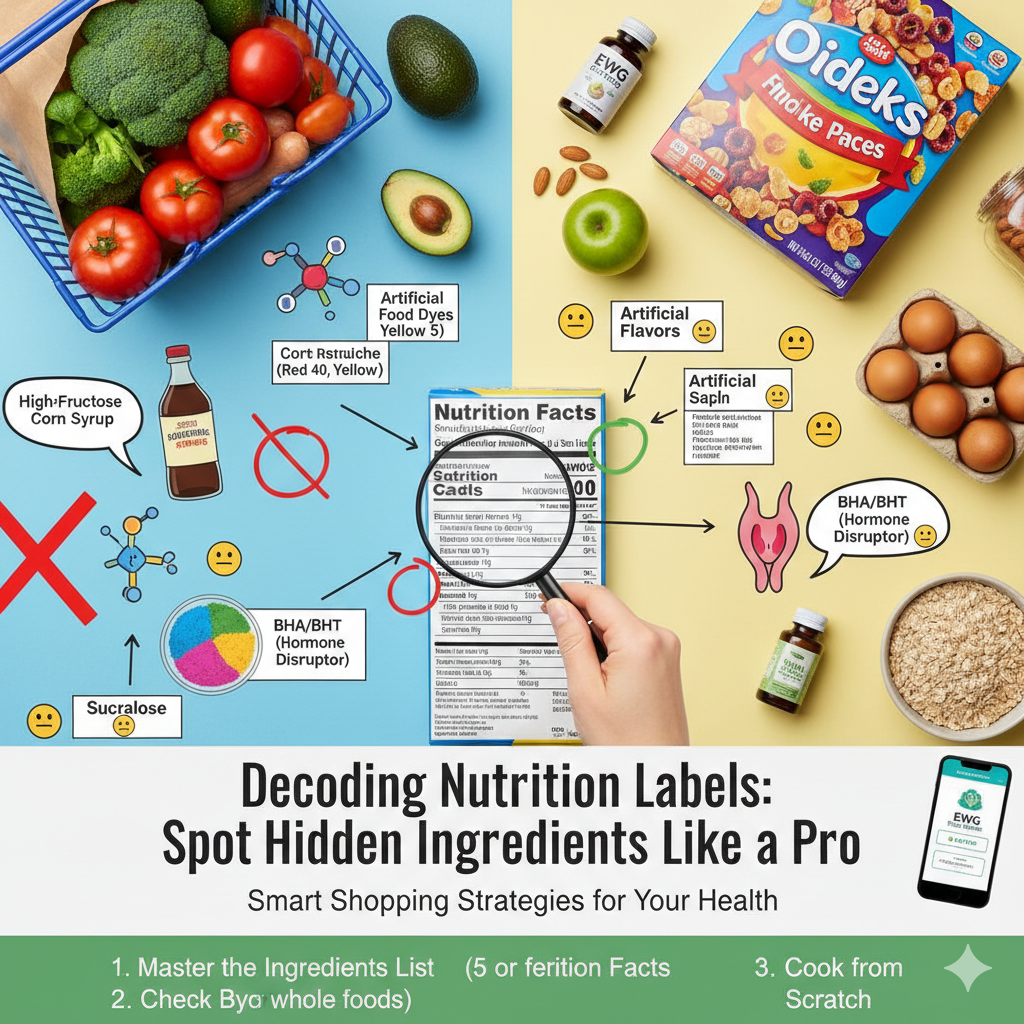
Did you know 60% of packaged foods in America contain additives like artificial colors, preservatives, and sweeteners? These “hidden” ingredients can lurk in everyday items—and some may contribute to issues like obesity, ADHD, allergies, or digestive problems. Here’s your guide to spotting them and shopping smarter.
Secret Sugars (Over 50 Names!)
Sugar hides under dozens of aliases in 68%+ of packaged foods. Watch for these in yogurt, granola, cereal, sauces, and “healthy” bars:
High-fructose corn syrup, dextrose, maltose
Agave nectar, barley malt, rice syrup
Cane juice, evaporated cane sugar
Tip: Natural options like stevia or monk fruit are better bets—they barely raise blood sugar.
Artificial Food Dyes
Colorful candies, cereals, and drinks often contain synthetic dyes. Consumption has surged 500% in 50 years, especially among kids. Look out for:
Red 40, Yellow 5 (Tartrazine), Blue 1
E-numbers like E102 (yellow dye)
Health concerns: Possible links to hyperactivity, allergies, thyroid issues, or digestive upset.
Problematic Preservatives
Not all preservatives are bad, but skip these when possible:
BHA/BHT: In cereals, crackers, beer—may disrupt hormones.
Propylparaben: Pastries, tortillas—potential developmental concerns.
Sodium nitrite/nitrate: Processed meats—excess linked to cancer risk.
Artificial Flavors & Other Red Flags
“Artificial flavors” is a catch-all term that can trigger sensitivities. Also scan for:
MSG (E621), aspartame (E951), sucralose
Partially hydrogenated oils (trans fats)
Emulsifiers like soy lecithin or mono/diglycerides
Smart Shopping Strategies
1. Master the Ingredients List
Ingredients are listed by weight (first = most).
Aim for 5 or fewer recognizable whole-food items.
Use apps like EWG’s Food Scores for quick ingredient checks.
2. Check Beyond Nutrition Facts
Serving sizes can trick you—multiply if eating more. Watch front-panel claims like “low fat” (often hides sugar).
3. Choose Transparent Brands
Support companies that list everything clearly online or on social media.
4. Cook from Scratch
Fresh meats, veggies, eggs, and healthy fats = zero hidden additives.
The Bottom Line
Not every additive is evil, but knowledge is power. By scanning labels for sugar synonyms, dyes, preservatives, and vague “flavors,” you avoid unnecessary health risks. Start small: pick one aisle (like cereal) and clean up your cart. Your body will thank you!
- Sambu, S., Hemaram, U., Murugan, R., & Alsofi, A. A. (2022). Toxicological and Teratogenic Effect of Various Food Additives: An Updated Review. BioMed research international, 2022, 6829409. https://doi.org/10.1155/2022/6829409
- Acton, R. B., Vanderlee, L., Hobin, E. P., & Hammond, D. (2017). Added sugar in the packaged foods and beverages available at a major Canadian retailer in 2015: a descriptive analysis. CMAJ open, 5(1), E1–E6. https://doi.org/10.9778/cmajo.20160076
- Arnold, L. E., Lofthouse, N., & Hurt, E. (2012). Artificial food colors and attention-deficit/hyperactivity symptoms: conclusions to dye for. Neurotherapeutics : the journal of the American Society for Experimental NeuroTherapeutics, 9(3), 599–609. https://doi.org/10.1007/s13311-012-0133-x
- Boris, M., & Mandel, F. S. (1994). Foods and additives are common causes of the attention deficit hyperactive disorder in children. Annals of allergy, 72(5), 462–468.
- Borzelleca, J. F., Capen, C. C., & Hallagan, J. B. (1987). Lifetime toxicity/carcinogenicity study of FD & C Red No. 3 (erythrosine) in rats. Food and chemical toxicology : an international journal published for the British Industrial Biological Research Association, 25(10), 723–733. https://doi.org/10.1016/0278-6915(87)90226-2
- Borzelleca, J. F., Hogan, G. K., & Koestner, A. (1985). Chronic toxicity/carcinogenicity study of FD & C Blue No. 2 in rats. Food and chemical toxicology : an international journal published for the British Industrial Biological Research Association, 23(6), 551–558. https://doi.org/10.1016/0278-6915(85)90178-4
- Kobylewski, S., & Jacobson, M. F. (2012). Toxicology of food dyes. International journal of occupational and environmental health, 18(3), 220–246. https://doi.org/10.1179/1077352512Z.00000000034
- Environmental Working Group, “Skin Deep. Butylated Hydroxyanisole,” [Online]. Available: http://www.ewg.org/skindeep/ingredient/700740/BHA/.
https://www.ewg.org/news-insights/news/2021/10/common-food-additives-capn-crunch-and-apple-jacks-cereal-may-harm-human

2 Responses