
Personalized nutrition designed for your unique health goals.
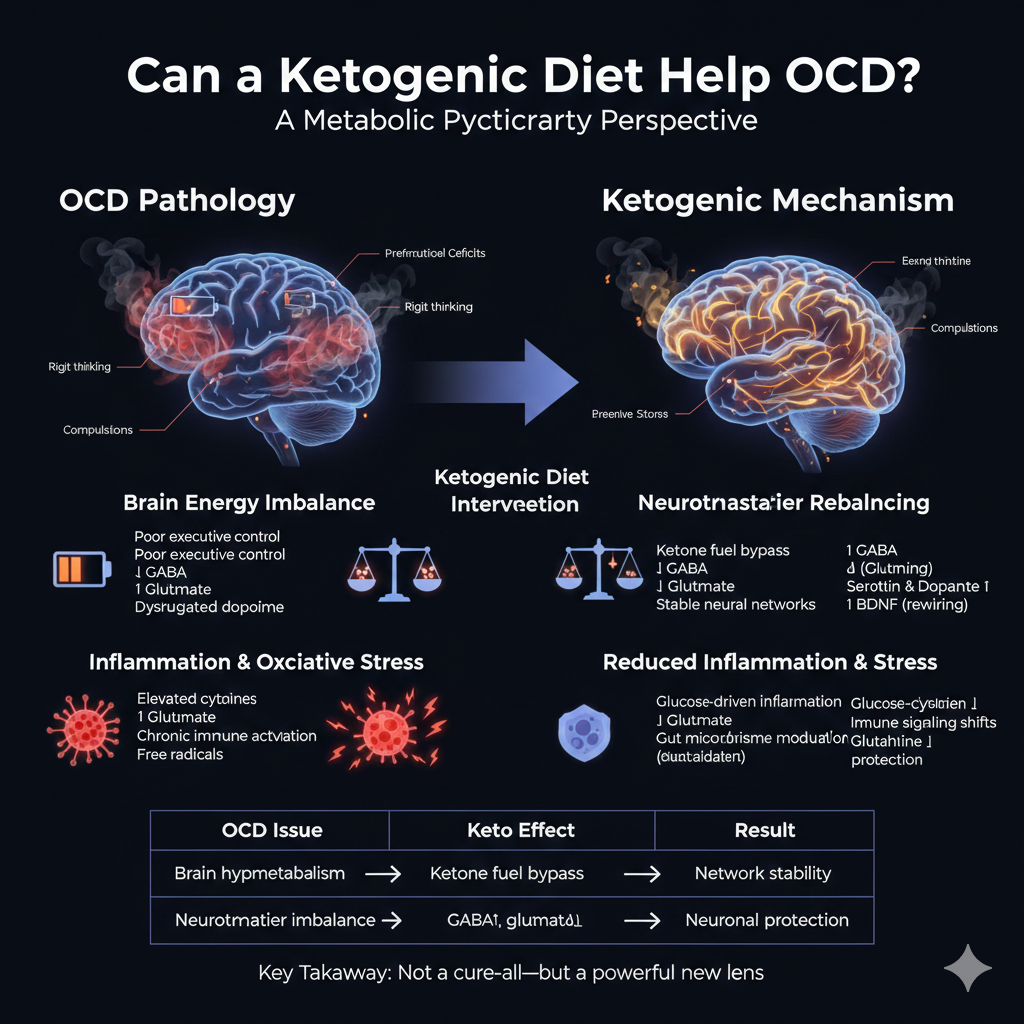
Can a Ketogenic Diet Help OCD?
A Metabolic Psychiatry Perspective
Obsessive–Compulsive Disorder (OCD) isn’t just a “chemical imbalance.” Growing evidence suggests it’s also a brain energy and inflammation disorder. Emerging case reports show that a ketogenic diet, when paired with therapy, may significantly reduce symptoms—sometimes rapidly—especially in treatment-resistant cases.
This doesn’t replace standard care, but it opens a promising new door.
Core Brain Issues in OCD
Research consistently shows that OCD involves multiple overlapping brain problems:
1. Brain Energy Deficits
Key regions like the prefrontal cortex and anterior cingulate cortex show glucose hypometabolism, leading to:
Poor executive control
Rigid thinking
Difficulty “letting go” of compulsions
2. Neurotransmitter Imbalance
OCD brains often show:
↓ Serotonin
↓ GABA (calming neurotransmitter)
↑ Glutamate (excitatory overload)
Dysregulated dopamine signaling
3. Inflammation & Oxidative Stress
Elevated cytokines, chronic immune activation, and excess free radicals correlate with symptom severity and chronicity.
How Ketosis Targets Brain Hypometabolism
Ketones (from a high-fat, very low-carb diet) provide an alternative fuel that bypasses impaired glucose pathways.
What this does:
Fuels hypometabolic brain regions efficiently
Improves mitochondrial function
Stabilizes neural networks without overstimulation
📊 Case reports show symptom improvement when blood ketones reach ~0.8 mmol/L or higher.
Neurotransmitter Rebalancing
Ketogenic metabolism supports brain chemistry more broadly than single-target medications:
↑ GABA production (calming effect)
↓ Glutamate excitotoxicity
Improved serotonin & dopamine signaling
↑ BDNF → supports neural rewiring and flexibility
Unlike SSRIs (which target mainly serotonin), ketones influence multiple systems at once.
Inflammation & Oxidative Stress Reduction
Ketosis helps quiet the inflammatory storm seen in OCD by:
Reducing glucose-driven inflammation
Modulating gut microbiome signaling
Increasing glutathione, the brain’s master antioxidant
Repairing mitochondrial damage
This directly counters oxidative stress linked to OCD severity.
OCD Pathology vs Keto Mechanism
| OCD Issue | Keto Effect | Result |
|---|---|---|
| Brain hypometabolism | Ketone fuel bypass | Energy restored |
| Neurotransmitter imbalance | GABA↑, glutamate↓ | Network stability |
| Neuroinflammation | Immune signaling shifts | Cytokines ↓ |
| Oxidative stress | Glutathione ↑ | Neuronal protection |
Real-World Evidence (Early but Compelling)
2025 case series:
3 patients → 90.5% average reduction in Y-BOCS scores, remission off medication
Symptoms returned when diet stoppedSingle case report:
26-year-old → full remission within weeks on keto + ERP, sustained for 95 weeks
These findings align with the growing field of metabolic psychiatry, especially for OCD cases resistant to medication (~50%).
Getting Started (Safely & Responsibly)
This is not DIY psychiatry.
If explored, it should be:
Adjunctive, not replacement therapy
Paired with CBT / ERP
Supervised if the person is medicated
General framework used in reports:
~1.5:1 fat : (protein + carbs) ratio
Nutrient-dense fats (fatty fish, olives, nuts, avocado)
Track ketones (blood or breath)
Allow 2–4 weeks for adaptation
⚠️ Always consult qualified professionals—especially when adjusting medications.
The Takeaway
OCD may be as much a metabolic brain disorder as a psychiatric one.
While large trials are still needed, early evidence suggests ketogenic therapy may restore brain energy, calm inflammation, and improve cognitive flexibility in otherwise hard-to-treat OCD.
Not a cure-all—but a powerful new lens.
References
- Ahmari, S. E., & Rauch, S. L. (2022). The prefrontal cortex and OCD. Neuropsychopharmacology: Official Publication of the American College of Neuropsychopharmacology, 47(1), 211–224. https://doi.org/10.1038/s41386-021-01130-2
- Asl, M. A., Asgari, P., & Bakhti, Z. (2021). Treatment Approaches Based on Neuroscientific Data in Patients With Obsessive-Compulsive Disorder. International Clinical Neuroscience Journal, 8(3), 107–117
- Attwells, S., Setiawan, E., Wilson, A. A., Rusjan, P. M., Mizrahi, R., Miler, L., Xu, C., Richter, M. A., Kahn, A., Kish, S. J., Houle, S., Ravindran, L., & Meyer, J. H. (2017). Inflammation in the Neurocircuitry of Obsessive-Compulsive Disorder. JAMA Psychiatry, 74(8), 833. https://doi.org/10.1001/jamapsychiatry.2017.1567
- Bannon, S., Gonsalvez, C. J., Croft, R. J., & Boyce, P. M. (2006). Executive functions in obsessive-compulsive disorder: State or trait deficits? The Australian and New Zealand Journal of Psychiatry, 40(11–12), 1031–1038. https://doi.org/10.1080/j.1440-1614.2006.01928.x
- Batistuzzo, M. C., Sottili, B. A., Shavitt, R. G., Lopes, A. C., Cappi, C., Mathis, M. A. de, Pastorello, B., Diniz, J. B., Silva, R. M. F., Miguel, E. C., Hoexter, M. Q., & Otaduy, M. C. (2021). Lower Ventromedial Prefrontal Cortex Glutamate Levels in Patients With Obsessive–Compulsive Disorder. Frontiers in Psychiatry, 12. https://doi.org/10.3389/fpsyt.2021.668304
- Baumgarten, H. G., & Grozdanovic, Z. (1998). Role of serotonin in obsessive-compulsive disorder. The British Journal of Psychiatry, 173(S35), 13–20. https://doi.org/10.1192/S0007125000297857
- Baxter, L. R., Phelps, M. E., Mazziotta, J. C., Guze, B. H., Schwartz, J. M., & Selin, C. E. (1987). Local cerebral glucose metabolic rates in obsessive-compulsive disorder. A comparison with rates in unipolar depression and in normal controls. Archives of General Psychiatry, 44(3), 211–218. https://doi.org/10.1001/archpsyc.1987.01800150017003
- Baxter, L. R., Schwartz, J. M., Phelps, M. E., Mazziotta, J. C., Guze, B. H., Selin, C. E., Gerner, R. H., & Sumida, R. M. (1989). Reduction of prefrontal cortex glucose metabolism common to three types of depression. Archives of General Psychiatry, 46(3), 243–250. https://doi.org/10.1001/archpsyc.1989.01810030049007
- Church, W. H., Adams, R. E., & Wyss, L. S. (2014). Ketogenic diet alters dopaminergic activity in the mouse cortex. Neuroscience Letters, 571, 1-4. https://doi.org/10.1016/j.neulet.2014.04.016
- Del Casale, A., Sorice, S., Padovano, A., Simmaco, M., Ferracuti, S., Lamis, D. A., Rapinesi, C., Sani, G., Girardi, P., Kotzalidis, G. D., & Pompili, M. (2019). Psychopharmacological Treatment of Obsessive-Compulsive Disorder (OCD). Current Neuropharmacology, 17(8), 710–736. https://doi.org/10.2174/1570159X1666618081315501
- Derksen, M., Feenstra, M., Willuhn, I., & Denys, D. (2020). Chapter 44—The serotonergic system in obsessive-compulsive disorder. In C. P. Müller & K. A. Cunningham (Eds.), Handbook of Behavioral Neuroscience (Vol. 31, pp. 865–891). Elsevier. https://doi.org/10.1016/B978-0-444-64125-0.00044-X
- Field, R., Field, T., Pourkazemi, F., & Rooney, K. (2021). Ketogenic diets and the nervous system: A scoping review of neurological outcomes from nutritional ketosis in animal studies. Nutrition Research Reviews, 1–14. https://doi.org/10.1017/S0954422421000214
- Figure 2 | The Role of Antioxidants in the Management of Obsessive-Compulsive Disorder. (n.d.). Retrieved December 18, 2021, from https://www.hindawi.com/journals/omcl/2021/6661514/fig2/
- Fontenelle, L. F., Barbosa, I. G., Luna, J. V., de Sousa, L. P., Abreu, M. N. S., & Teixeira, A. L. (2012). A cytokine study of adult patients with obsessive-compulsive disorder. Comprehensive Psychiatry, 53(6), 797–804. https://doi.org/10.1016/j.comppsych.2011.12.007
- Frick, L., & Pittenger, C. (2016). Microglial Dysregulation in OCD, Tourette Syndrome, and PANDAS. Journal of Immunology Research, 2016, e8606057. https://doi.org/10.1155/2016/8606057
- Gangitano, E., Tozzi, R., Gandini, O., Watanabe, M., Basciani, S., Mariani, S., Lenzi, A., Gnessi, L., & Lubrano, C. (2021). Ketogenic Diet as a Preventive and Supportive Care for COVID-19 Patients. Nutrients, 13(3), 1004. https://doi.org/10.3390/nu13031004
- Gasior, M., Rogawski, M. A., & Hartman, A. L. (2006). Neuroprotective and disease-modifying effects of the ketogenic diet. Behavioural Pharmacology, 17(5–6), 431
- Gerentes, M., Pelissolo, A., Rajagopal, K., Tamouza, R., & Hamdani, N. (2019). Obsessive-Compulsive Disorder: Autoimmunity and Neuroinflammation. Current Psychiatry Reports, 21(8), 78. https://doi.org/10.1007/s11920-019-1062-8
- Ghasemi, H., Nomani, H., Sahebkar, A., & Mohammadpour, A. H. (2020). Anti-inflammatory Augmentation Therapy in Obsessive-compulsive Disorder: A Review. Letters in Drug Design & Discovery, 17(10), 1198–1205. https://doi.org/10.2174/1570180817999200520122910
- How does the Keto Diet Affect the Immune System? (2020, February 25). News-Medical.Net. https://www.azolifesciences.com/article/How-does-the-Keto-Diet-Affect-the-Immune-System.aspx
- Jarrett, S. G., Milder, J. B., Liang, L.-P., & Patel, M. (2008). The ketogenic diet increases mitochondrial glutathione levels. Journal of Neurochemistry, 106(3), 1044–1051. https://doi.org/10.1111/j.1471-4159.2008.05460.x
- Jensen, N. J., Wodschow, H. Z., Nilsson, M., & Rungby, J. (2020). Effects of Ketone Bodies on Brain Metabolism and Function in Neurodegenerative Diseases. International Journal of Molecular Sciences, 21(22). https://doi.org/10.3390/ijms21228767
- Karthik, S., Sharma, L. P., & Narayanaswamy, J. C. (2020). Investigating the Role of Glutamate in Obsessive-Compulsive Disorder: Current Perspectives. Neuropsychiatric Disease and Treatment, 16, 1003. https://doi.org/10.2147/NDT.S211703
- Katzman, M. A., Bleau, P., Blier, P., Chokka, P., Kjernisted, K., Ameringen, M. V., & University, the C. A. G. I. G. on behalf of the A. D. A. of C. C. des troubles anxieux and M. (2014). Canadian clinical practice guidelines for the management of anxiety, posttraumatic stress and obsessive-compulsive disorders. BMC Psychiatry, 14(Suppl 1), S1. https://doi.org/10.1186/1471-244X-14-S1-S1
- Koh, S., Dupuis, N., & Auvin, S. (2020). Ketogenic diet and Neuroinflammation. Epilepsy Research, 167, 106454. https://doi.org/10.1016/j.eplepsyres.2020.106454
- Lissemore, J. I., Booij, L., Leyton, M., Gravel, P., Sookman, D., Nordahl, T. E., & Benkelfat, C. (2021). Neuroimaging of Obsessive-Compulsive Disorder: Insights into Serotonergic Mechanisms. In R. A. J. O. Dierckx, A. Otte, E. F. J. de Vries, A. van Waarde, & I. E. Sommer (Eds.), PET and SPECT in Psychiatry (pp. 457–478). Springer International Publishing. https://doi.org/10.1007/978-3-030-57231-0_13
- Masino, S. A., & Rho, J. M. (2012). Mechanisms of Ketogenic Diet Action. In J. L. Noebels, M. Avoli, M. A. Rogawski, R. W. Olsen, & A. V. Delgado-Escueta (Eds.), Jasper’s Basic Mechanisms of the Epilepsies (4th ed.). National Center for Biotechnology Information (US). http://www.ncbi.nlm.nih.gov/books/NBK98219/
- Masino, S. A., & Rho, J. M. (2019). Metabolism and Epilepsy: Ketogenic Diets as a Homeostatic Link. Brain Research, 1703, 26. https://doi.org/10.1016/j.brainres.2018.05.049
- McGovern, R. A., & Sheth, S. A. (2017). Role of the dorsal anterior cingulate cortex in obsessive-compulsive disorder: Converging evidence from cognitive neuroscience and psychiatric neurosurgery. Journal of Neurosurgery, 126(1), 132–147. https://doi.org/10.3171/2016.1.JNS15601
- Medvedeva, N. S., Masharipov, R. S., Korotkov, A. D., Kireev, M. V., & Medvedev, S. V. (2020). Dynamics of Activity in the Anterior Cingulate Cortex on Development of Obsessive-Compulsive Disorder: A Combined PET and FMRI Study. Neuroscience and Behavioral Physiology, 50(3), 298–305. https://doi.org/10.1007/s11055-020-00901-6
- Mih, S., oust, Masoum, A., Moghaddam, M., Asadi, A., & Bonab, Z. H. (2021). Evaluation the Activity of Enzyme Glutathione Peroxidase, Oxidative Stress Index and Some Biochemical Variables in Serum of Individuals with Obsessive-Compulsive Disorder (OCD). Clinical Schizophrenia & Related Psychoses, 0(0), 1–5
- Morris, A. a. M. (2005). Cerebral ketone body metabolism. Journal of Inherited Metabolic Disease, 28(2), 109–121. https://doi.org/10.1007/s10545-005-5518-0
- Murray, G. K., Knolle, F., Ersche, K. D., Craig, K. J., Abbott, S., Shabbir, S. S., Fineberg, N. A., Suckling, J., Sahakian, B. J., Bullmore, E. T., & Robbins, T. W. (2019). Dopaminergic drug treatment remediates exaggerated cingulate prediction error responses in obsessive-compulsive disorder. Psychopharmacology, 236(8), 2325–2336. https://doi.org/10.1007/s00213-019-05292-2
- Newman, J. C., & Verdin, E. (2017). β-Hydroxybutyrate: A Signaling Metabolite. Annual Review of Nutrition, 37, 51. https://doi.org/10.1146/annurev-nutr-071816-064916
- Pearlman, D. M., Vora, H. S., Marquis, B. G., Najjar, S., & Dudley, L. A. (2014). Anti-basal ganglia antibodies in primary obsessive–compulsive disorder: Systematic review and meta-analysis. The British Journal of Psychiatry, 205(1), 8–16. https://doi.org/10.1192/bjp.bp.113.137018
- Piantadosi, S. C., Chamberlain, B. L., Glausier, J. R., Lewis, D. A., & Ahmari, S. E. (2021). Lower excitatory synaptic gene expression in orbitofrontal cortex and striatum in an initial study of subjects with obsessive compulsive disorder. Molecular Psychiatry, 26(3), 986–998. https://doi.org/10.1038/s41380-019-0431-3
- Rao, N. P., Venkatasubramanian, G., Ravi, V., Kalmady, S., Cherian, A., & Yc, J. R. (2015). Plasma cytokine abnormalities in drug-naïve, comorbidity-free obsessive–compulsive disorder. Psychiatry Research, 229(3), 949–952. https://doi.org/10.1016/j.psychres.2015.07.009
- Russo, A. J., & Pietsch, S. C. (2013). Decreased Hepatocyte Growth Factor (HGF) and Gamma Aminobutyric Acid (GABA) in Individuals with Obsessive-Compulsive Disorder (OCD). Biomarker Insights, 8, BMI.S11931. https://doi.org/10.4137/BMI.S11931
- Snyder, H. R., Kaiser, R. H., Warren, S. L., & Heller, W. (2015). Obsessive-Compulsive Disorder Is Associated With Broad Impairments in Executive Function: A Meta-Analysis. Clinical Psychological Science, 3(2), 301–330. https://doi.org/10.1177/2167702614534210
- Stein, D. J., Costa, D. L. C., Lochner, C., Miguel, E. C., Reddy, Y. C. J., Shavitt, R. G., Heuvel, O. A. van den, & Simpson, H. B. (2019). Obsessive–compulsive disorder. Nature Reviews. Disease Primers, 5(1), 52. https://doi.org/10.1038/s41572-019-0102-3
- Szechtman, H., Harvey, B. H., Woody, E. Z., & Hoffman, K. L. (2020). The Psychopharmacology of Obsessive-Compulsive Disorder: A Preclinical Roadmap. Pharmacological Reviews, 72(1), 80–151. https://doi.org/10.1124/pr.119.017772
- Tanaka, K. (2021). Astroglia and Obsessive Compulsive Disorder. In B. Li, V. Parpura, A. Verkhratsky, & C. Scuderi (Eds.), Astrocytes in Psychiatric Disorders (pp. 139–149). Springer International Publishing. https://doi.org/10.1007/978-3-030-77375-5_7
- van Niekerk, G., Davis, T., Patterton, H.-G., & Engelbrecht, A.-M. (2019). How Does Inflammation-Induced Hyperglycemia Cause Mitochondrial Dysfunction in Immune Cells? BioEssays, 41(5), 1800260. https://doi.org/10.1002/bies.201800260
- Very-low-carbohydrate diet enhances human T-cell immunity through immunometabolic reprogramming. (2021). EMBO Molecular Medicine, 13(8), e14323. https://doi.org/10.15252/emmm.202114323
- White, H., & Venkatesh, B. (2011). Clinical review: Ketones and brain injury. Critical Care, 15(2), 219. https://doi.org/10.1186/cc10020
- Yue, J., Zhong, S., Luo, A., Lai, S., He, T., Luo, Y., Wang, Y., Zhang, Y., Shen, S., Huang, H., Wen, S., & Jia, Y. (2021). Correlations Between Working Memory Impairment and Neurometabolites of the Prefrontal Cortex in Drug-Naive Obsessive-Compulsive Disorder. Neuropsychiatric Disease and Treatment, 17, 2647. https://doi.org/10.2147/NDT.S296488
- Zhu, Y., Fan, Q., Han, X., Zhang, H., Chen, J., Wang, Z., Zhang, Z., Tan, L., Xiao, Z., Tong, S., Maletic-Savatic, M., & Li, Y. (2015). Decreased thalamic glutamate level in unmedicated adult obsessive–compulsive disorder patients detected by proton magnetic resonance spectroscopy. Journal of Affective Disorders, 178, 193–200. https://doi.org/10.1016/j.jad.2015.03.008
- Katzman, M. A., Bleau, P., Blier, P., Chokka, P., Kjernisted, K., & Van Ameringen, M. (2014). https://www.ncbi.nlm.nih.gov/labs/pmc/articles/PMC4120194/
- Szechtman, H., Harvey, B. H., Woody, E. Z., & Hoffman, K. L. (2020). https://doi.org/10.1124/pr.119.017772
- McGovern, R. A., & Sheth, S. A. (2017). https://doi.org/10.3171/2016.1.JNS15601
- Mujica-Parodi, L. R., et al., (2020). Diet modulates brain network stability, a biomarker for brain aging, in young adults. https://pubmed.ncbi.nlm.nih.gov/32127481/
- Masino, S. A., & Rho, J. M. (2019). https://www.ncbi.nlm.nih.gov/labs/pmc/articles/PMC6281876/
- Lissemore, J. I., et al. (2021). https://doi.org/10.1007/978-3-030-57231-0_13
- Karthik, S., Sharma, L. P., & Narayanaswamy, J. C. (2020). Investigating the role of glutamate in obsessive-compulsive disorder: current perspectives.
https://www.ncbi.nlm.nih.gov/labs/pmc/articles/PMC7173854/ - Gerentes, M., Pelissolo, A., Rajagopal, K., Tamouza, R., & Hamdani, N. (2019). Obsessive-compulsive disorder: autoimmunity and neuroinflammation. https://doi.org/10.1007/s11920-019-1062-8
- Ghasemi, H., Nomani, H., Sahebkar, A., & Mohammadpour, A. H. (2020). https://doi.org/10.2174/1570180817999200520122910
- Baratzadeh, F., Elyasi, S., Mohammadpour, A. H., Salari, S., & Sahebkar, A. (2021). The Role of Antioxidants in the Management of Obsessive-Compulsive Disorder. https://doi.org/10.1155/2021/6661514
- Baratzadeh, F., Elyasi, S., Mohammadpour, A. H., Salari, S., & Sahebkar, A. (2021). https://www.hindawi.com/journals/omcl/2021/6661514/
- https://www.hindawi.com/journals/omcl/2021/6661514/fig2/
- Recent Post