
Personalized nutrition designed for your unique health goals.
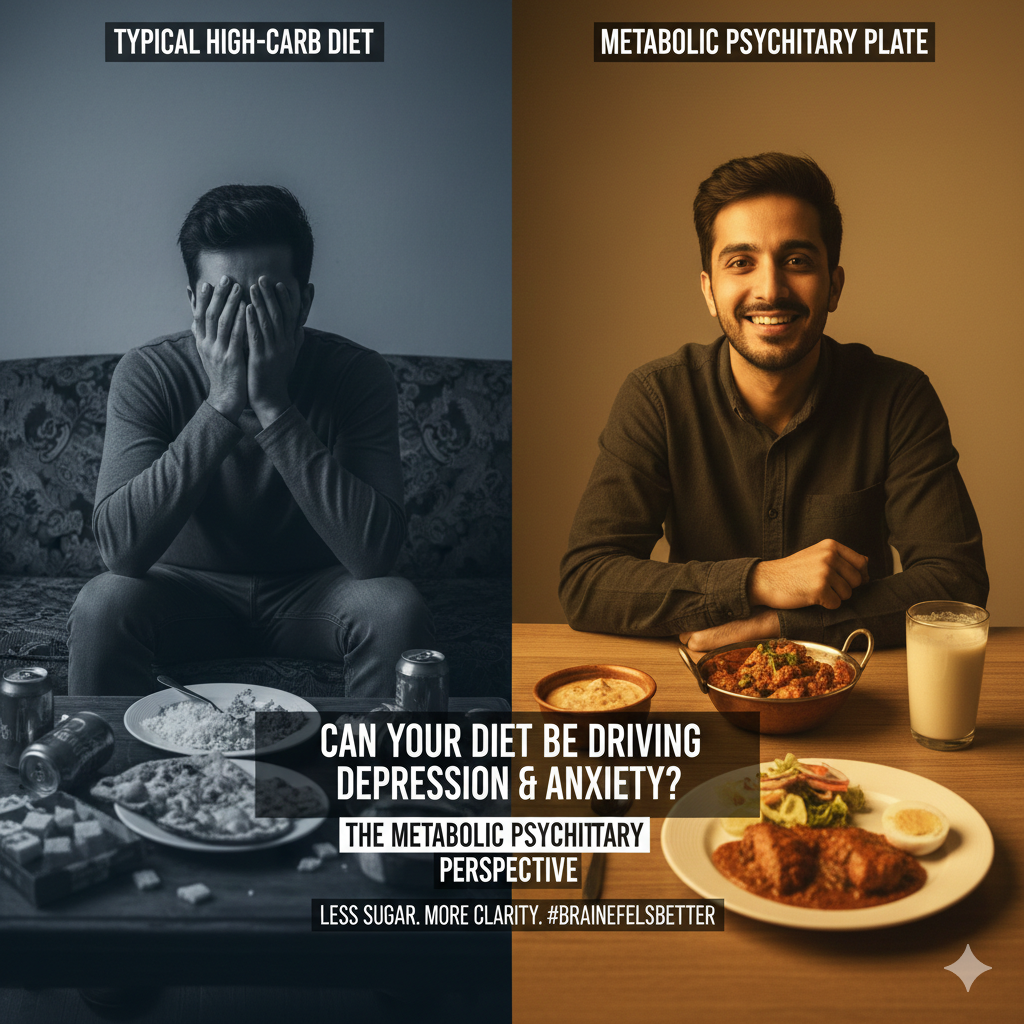
The Metabolic Psychiatry Perspective
Depression and anxiety are not just psychological.
They are also metabolic.
Emerging research in metabolic psychiatry shows that blood sugar instability, inflammation, insulin resistance, and mitochondrial dysfunction significantly influence mood regulation.
In Pakistan — where carb-heavy meals, sugary chai, and refined flour dominate — this connection deserves serious attention.
Let’s unpack it properly.
The Fructose Problem: A Seasonal Mechanism Gone Wrong
Human biology evolved around seasons.
Historically:
Late-summer fruit (high in fructose) signaled winter preparation.
Fructose increased fat storage.
Metabolism slowed.
Activity reduced.
The brain shifted into energy-conservation mode.
This wasn’t depression.
It was survival adaptation.
Today?
Fructose is everywhere:
Soft drinks
Fruit juices (8–10 teaspoons sugar per glass)
Sweet chai (3–4 tsp per cup)
Mithai
Sweetened yoghurt
Bread and packaged cereals
Instead of seasonal exposure, we now consume fructose daily — year-round.
Chronic high fructose intake:
Raises triglycerides
Disrupts insulin and leptin signaling
Promotes visceral fat
Increases systemic inflammation
Impairs mitochondrial efficiency
The result?
Low energy, brain fog, reduced motivation — symptoms that overlap strongly with depression.
Carb-Heavy Diets & Anxiety Spikes
High-glycemic meals common in Pakistani households:
Naan + curry
White rice + dal
Paratha breakfasts
Biscuits with chai
These cause:
Rapid blood sugar spikes
Insulin surges
Glucose crashes
Cortisol release
That crash often feels like:
Irritability
Panic
Brain fog
Sudden fatigue
Cravings
Repeated daily, this pattern destabilizes mood regulation.
Research increasingly links high-glycemic diets to higher rates of depression and anxiety symptoms.
It’s not just emotional.
It’s biochemical.
Inflammation, Gut Health & Mood
Excess sugar and refined carbs:
Feed dysbiosis (gut imbalance)
Increase intestinal permeability
Raise inflammatory markers
Inflammation directly affects:
Serotonin pathways
Dopamine signaling
GABA/glutamate balance
The brain is not separate from metabolism.
It runs on it.
Where Ketogenic Diets Enter the Conversation
A ketogenic approach:
High healthy fats
Moderate protein
Very low carbohydrates (typically under 50g/day)
This shifts fuel use from glucose to ketones.
Ketones:
Provide stable energy to neurons
Improve mitochondrial efficiency
Reduce oxidative stress
Support GABA balance
Increase BDNF (brain-derived neurotrophic factor)
Clinical research in metabolic psychiatry is exploring ketogenic therapy for:
Treatment-resistant depression
Bipolar disorder
Anxiety disorders
Neurodegenerative conditions
Important:
This is not a miracle cure.
But it is a promising therapeutic tool under proper guidance.
What This Means for Pakistan
We do not need imported “keto snacks.”
We need metabolic awareness.
A Lower-Carb Pakistani Plate Example
Breakfast
Anda omlette (2–3 eggs)
Unsweetened chai (optional small ghee swirl)
Lunch
Chicken karahi or saag/palak paneer
Raita
Skip naan / limit to 1 small roti
Snack
Almonds + cheese
Dinner
Mutton keema + palak
Full-fat lassi (unsweetened)
Approximate carbs: 30–50g depending on portions.
This stabilizes:
Blood sugar
Hunger hormones
Energy levels
Adaptation takes 2–4 weeks.
A More Realistic Starting Point (HealO Recommendation)
Before extreme carb restriction:
Step 1: Eliminate Added Sugar
No soda
No fruit juice
No sweet chai
No mithai
No sweetened yoghurt
Step 2: Anchor Every Meal With Protein
Eggs, chicken, fish, beef, paneer, dal.
Step 3: Reduce Refined Flour
Limit naan, white bread, biscuits.
Step 4: Increase Healthy Fats
Ghee (moderate), butter, olive oil, nuts, seeds.
Step 5: Support Electrolytes
Lower-carb eating increases sodium loss — hydrate well.
Important Reality Check
Diet alone does not replace:
Therapy
Psychiatric medication
Trauma work
Sleep correction
But metabolic dysfunction can worsen mental health symptoms.
And improving metabolism often:
Enhances emotional resilience
Reduces energy crashes
Improves clarity
Stabilizes mood swings
The Bigger Question
If your brain runs on fuel…
Why are we feeding it instability five times a day?
Pakistan’s mental health crisis is real.
So is our metabolic crisis.
The two are connected more than we think.
Start with one change:
Remove sugar for 14 days.
Track your:
Mood
Energy
Cravings
Sleep
Your brain may respond faster than you expect.
References
- https://pmc.ncbi.nlm.nih.gov/articles/PMC2963150/
- https://pubmed.ncbi.nlm.nih.gov/40516623/
- https://pubmed.ncbi.nlm.nih.gov/19839027/
- https://pmc.ncbi.nlm.nih.gov/articles/PMC10490497/
- https://pubmed.ncbi.nlm.nih.gov/38609160/
- https://pubmed.ncbi.nlm.nih.gov/17553465/
- https://pmc.ncbi.nlm.nih.gov/articles/PMC4443321/
- https://pubmed.ncbi.nlm.nih.gov/33374894/
- https://pmc.ncbi.nlm.nih.gov/articles/PMC12037248/
- https://pubmed.ncbi.nlm.nih.gov/23280226/
- https://pubmed.ncbi.nlm.nih.gov/36947832/
- https://pmc.ncbi.nlm.nih.gov/articles/PMC2991323/
- https://pmc.ncbi.nlm.nih.gov/articles/PMC7468813/
- https://www.ncbi.nlm.nih.gov/books/NBK459280/
- Recent Post