Calories aren’t the problem.
Food design is.
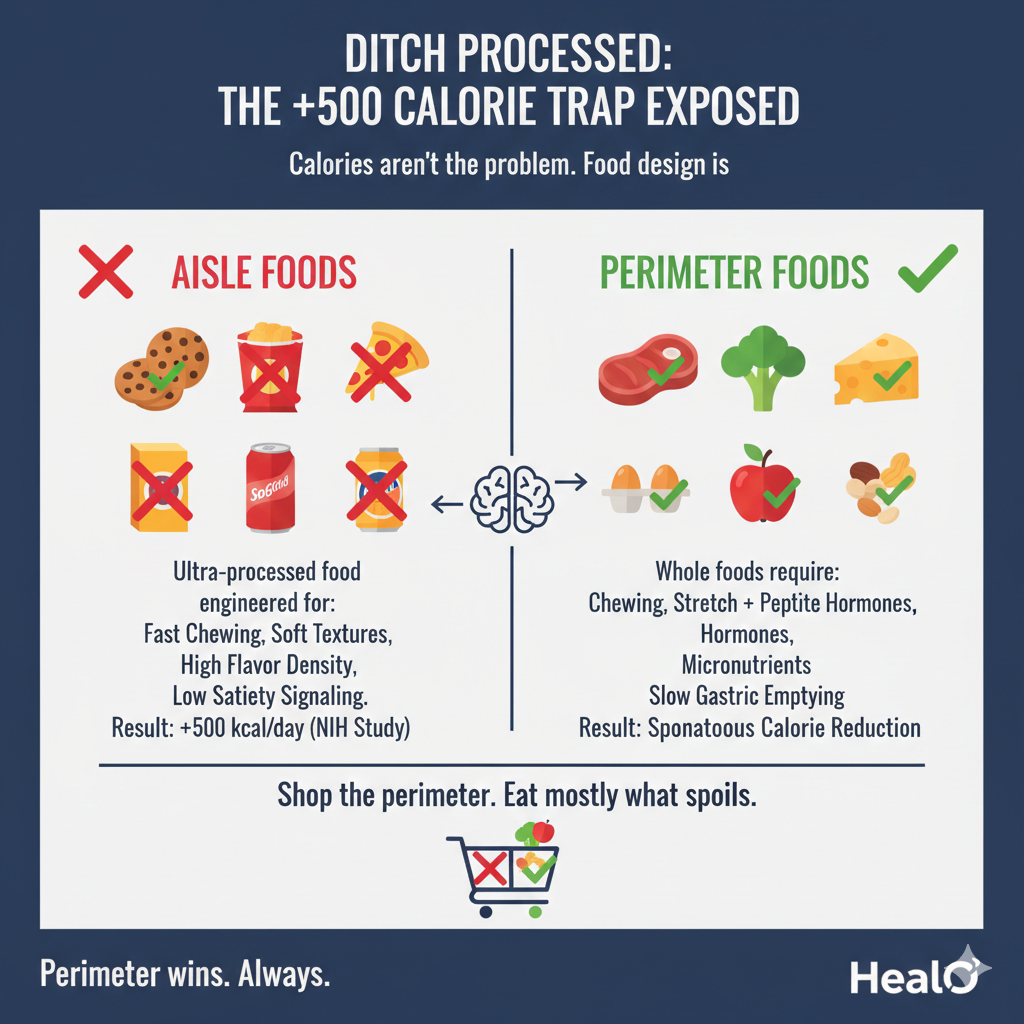
What “Processed” Actually Means
Aisle foods:
Cookies
Chips
Pizza
Cereal
Protein bars
Sugary drinks & juices
Perimeter foods:
Meat & fish
Eggs & dairy
Vegetables
Fruit
Nuts
Same calories on paper.
Very different biology.
The Smoking-Gun Evidence
NIH Metabolic Ward Study (Kevin Hall)
When people ate:
No instruction to eat more.
No willpower test.
The food did it.
This happened despite matching:
Calories
Macronutrients
Fiber
Sodium
👉 The difference was processing.
Why Processed Foods Win the Overeating Game
Ultra-processed foods are engineered for:
Fast chewing
Soft textures
High flavor density
Low satiety signaling
Result:
This is neurobiology, not lack of discipline.
Why Real Food Self-Limits Intake
Whole foods:
You don’t need restraint.
Your body applies the brakes.
The Simplest Fat-Loss Rule That Works
Shop the perimeter. Eat mostly what spoils.
No tracking.
No apps.
No calorie math.
Just remove the engineered trap.
HealO Takeaway
Ultra-processed food isn’t “bad” because of calories.
It’s bad because it bypasses satiety.
Real food doesn’t need willpower.
It brings its own off-switch.
Perimeter wins. Always.
References
- https://www.cell.com/cell-metabolism/fulltext/S1550-4131(19)30248-7
- https://pubmed.ncbi.nlm.nih.gov/31105044/

One Response