
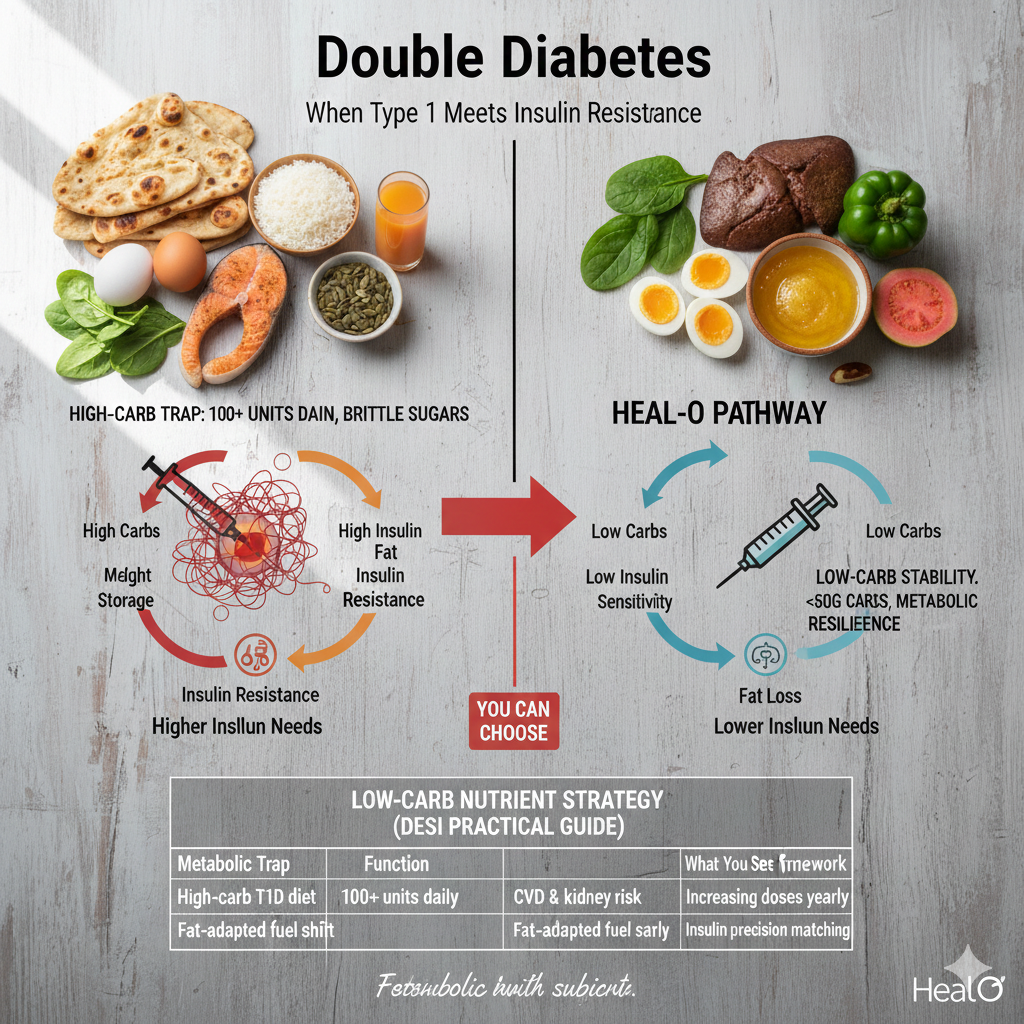
When Type 1 Meets Insulin Resistance
This is the silent trap no one warns Pakistani Type 1 families about.
Your child has Type 1.
Beta cells are gone.
Insulin is required.
But layer high-carb eating on top — roti, rice, biscuits, fruit juices — and something dangerous begins:
Type 1 + insulin resistance = “double diabetes.”
It is not a separate disease.
It is a metabolic consequence.
How the Trap Forms
Standard advice still pushes:
Low-fat.
High-carb.
“Just cover it with insulin.”
Here’s what actually happens:
More carbs → Higher glucose spikes
Higher spikes → Larger insulin doses
Large insulin doses → Fat storage
Fat storage → Insulin resistance
Resistance → Even higher insulin needs
Now you are injecting 100–150 units daily…
Yet sugars remain brittle.
That is not failure.
That is physiology.
A healthy pancreas secretes ~30 units daily.
Some high-carb Type 1 cases are forced into 4–5× that output through injections.
Excess insulin itself promotes resistance.
The cycle feeds itself.
The Pakistan Problem
In our culture, meals revolve around:
Roti
Rice
Naan
Paratha
Grain at breakfast.
Grain at lunch.
Grain at dinner.
When insulin must chase every carb-heavy plate, weight gain becomes common.
Today, nearly 1 in 4 children with Type 1 show overweight traits — increasing risk of:
• Early cardiovascular disease
• Kidney stress
• Fatty liver
• Hypertension
This mirrors Type 2 risk patterns layered onto Type 1.
That is double diabetes.
The Vicious Loop
Carbs demand insulin.
Insulin stores fat.
Fat blocks insulin.
Blocked insulin demands more insulin.
Meanwhile:
Parents panic over hypos.
Extra carbs are given “just in case.”
The cycle continues.
HealO Principle: Small Inputs, Small Errors, Stable Outputs
When carbohydrate intake drops below ~50g/day (individualized and supervised):
• Glucose swings shrink
• Total daily insulin drops significantly
• Fat storage reduces
• Sensitivity improves
• Hypos become less dramatic
Protein and natural fats (eggs, ghee, mutton, fish) provide stable fuel.
Naan crashes.
Ghee stabilizes.
This is metabolic math — not ideology.
Practical Reset Framework
| Metabolic Trap | What You See | HealO Correction |
|---|---|---|
| High-carb T1D diet | 100+ units daily | Controlled <50g carb framework |
| Weight gain overlay | CVD & kidney risk | Fat-adapted fuel shift |
| Hypo-carb panic cycle | Rollercoaster sugars | Protein/fat buffering |
| Rising resistance | Increasing doses yearly | Insulin precision matching |
Clinical Perspective
Richard K. Bernstein, lived 90 years (17 June 1934-15 April 2025) with Type 1, demonstrated one enduring truth:
Smaller carb loads require smaller insulin doses.
Smaller doses create smaller mistakes.
Smaller mistakes protect long-term health.
His data showed some high-carb patients requiring 150 units daily — five times normal pancreatic output.
The issue was not insulin deficiency alone.
It was dietary overload.
Important Medical Guardrails
This is not “stop insulin.”
This is:
• Reduce unnecessary glucose load
• Monitor continuously
• Adjust insulin carefully
• Supervise with a trained physician
• Check ketones appropriately
Type 1 always requires insulin.
But it does not require carb overload.
Why This Matters
Every year of high variability compounds stress on:
• Blood vessels
• Kidneys
• Eyes
• Nerves
Stability now protects decades later.
Double diabetes is not destiny.
It is preventable metabolic layering.
HealO Closing Truth
Fuel drives insulin demand.
Insulin demand shapes resistance.
Resistance predicts complications.
Control the fuel —
You control the trajectory.
Steady levels.
Lower total insulin burden.
Long-term metabolic resilience.
That is the HealO pathway.
References
- https://pubmed.ncbi.nlm.nih.gov/38341550/
- https://en.wikipedia.org/wiki/Double_diabetes#:~:text=Double%20diabetes%20%2D%20Wikipedia,to%20eventually%20use%20oral%20medications.
- https://diabetesjournals.org/clinical/article/43/1/128/157159/Double-Diabetes-A-Clinical-Challenge#:~:text=%E2%80%9CDouble%20diabetes%E2%80%9D%20is%20defined%20as,after%20diabetes%20diagnosis%20(6).
- https://pmc.ncbi.nlm.nih.gov/articles/PMC6828774/#:~:text=A%20potentially%20positive%20family%20history,both%20T1D%20and%20T2D39.
- https://pubmed.ncbi.nlm.nih.gov/19293582/#:~:text=Double%20diabetes:%20a%20mixture%20of,type%202%20diabetes%20in%20youth
- https://www.cureus.com/articles/344808-double-diabetes-a-converging-metabolic-and-autoimmune-disorder-redefining-the-classification-and-management-of-diabetes#:~:text=More%20info-,Double%20Diabetes:%20A%20Converging%20Metabolic%20and%20Autoimmune%20Disorder%20Redefining%20the,diabetes%20from%20classic%20diabetes%20subtypes.
- https://www.diabetesqualified.com.au/double-trouble-a-look-at-double-diabetes/#:~:text=Mixed%20diabetes%20and%20double%20diabetes%20are%20essentially%20the%20same%20thing,be%20associated%20with%20weight%20gain.
- https://pmc.ncbi.nlm.nih.gov/articles/PMC7648474/#:~:text=Abstract,6%20years%20after%20T1D%20diagnosis.
- https://www.youtube.com/watch?v=HQ_eKhs9gcE&t=47
- https://onlinelibrary.wiley.com/doi/full/10.1002/pdi.2120
- https://www.healio.com/news/endocrinology/20171114/as-obesity-rate-rises-double-diabetes-looms-large
- https://pmc.ncbi.nlm.nih.gov/articles/PMC5155236/
- https://www.diabetesqualified.com.au/double-trouble-a-look-at-double-diabetes/
- https://www.medscape.com/viewarticle/cases-double-diabetes-rising-what-know-2025a1000yg6
- https://diatribe.org/understanding-diabetes/can-people-type-1-diabetes-also-get-type-2
- https://www.sciencedirect.com/science/article/pii/S016882271630153X
- https://dom-pubs.onlinelibrary.wiley.com/doi/abs/10.1111/dom.13848
- https://www.sciencedirect.com/science/article/abs/pii/S1043276006002633
- https://www.scribd.com/document/920635243/Dr-Bernsteins-Diabetes-Solution
- https://archive.org/details/isbn_9780316182690
- Recent Post