
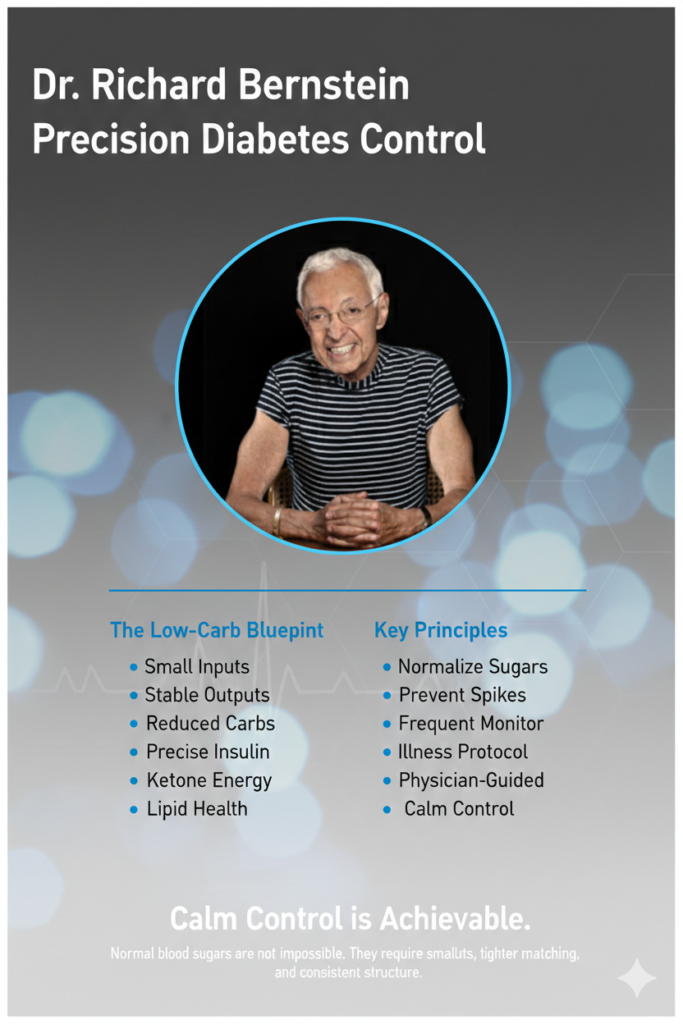
Precision Diabetes Control & The Low-Carb Blueprint
For families navigating Type 1 diabetes, chaos often feels normal.
Spikes.
Crashes.
Corrections.
Fear.
But one physician has spent decades proving that instability is not inevitable.
Richard K. Bernstein lived with Type 1 diabetes since 1946 till 2025 — diagnosed at age 12.
With his approach he remained free of major complications throughout his life.
His method?
Relentless glucose precision through carbohydrate restriction and structured insulin matching.
His YouTube tutorials provide free education — and for many families worldwide, a roadmap to normalization.
Bernstein’s Origin Story
Originally an engineer, Bernstein gained access to one of the first glucometers in 1969 — at a time when home glucose testing was not standard practice.
He discovered a truth:
High-carb diets recommended by conventional authorities produced large swings and progressive complications.
By reducing carbohydrate intake and matching insulin precisely, he stabilized his own sugars — improving neuropathy and long-term markers.
Later, he became a physician to formalize what he had already proven through data.
His central law:
The Law of Small Numbers
Small carb inputs → small insulin doses → small errors → small corrections.
The Core Philosophy
Bernstein teaches:
• Normalize blood sugars — do not “manage highs”
• Prevent spikes rather than chase them
• Reduce carbohydrate to reduce injected insulin
• Prioritize protein and natural fats
His often cited target:
~83 mg/dL (4.6 mmol/L) — fasting and post-meal — approximating non-diabetic physiology.
His principle is clear:
Aim for normal physiology, not “acceptable highs.”
Double Diabetes Prevention
For Pakistani families especially, this message matters.
High-carb cultural eating patterns can push Type 1 patients toward:
• Higher total daily insulin
• Weight gain
• Insulin resistance
• Early cardiovascular risk
Bernstein’s structured low-carb approach reduces total insulin requirements and may decrease long-term resistance layering — helping avoid the “double diabetes” trap.
Core Management Themes From His Teaching
While protocols must be individualized under medical supervision, his educational content commonly emphasizes:
1. Carbohydrate Restriction
Often <30g per day in adult models.
2. Basal-Bolus Precision
Careful separation of background insulin and meal insulin.
3. Pre-Bolusing Protein
Using appropriate insulin timing to match delayed glucose rise.
4. Frequent Monitoring
CGM or structured testing to prevent variability.
5. Illness Management
Frequent testing and proactive insulin adjustments during infection.
Though these seem advanced strategies requiring professional oversight — not DIY experimentation yet persons with Type 1 or the their caretakers should be trained enough sufficient to look after these matrices.
Ketones & Brain Fuel
Bernstein discusses mild nutritional ketosis (0.5–3.0 mmol/L) as a stable energy state.
In this range:
• The brain efficiently uses beta-hydroxybutyrate
• Glucose demand falls
• Hunger stabilizes
• Variability decreases
This is nutritional ketosis — not diabetic ketoacidosis.
Education here is critical.
Diet Structure — Simplified
Bernstein’s dietary model typically includes:
Protein: chicken, fish, eggs, paneer
Vegetables: low-starch vegetables (bhindi, spinach, cauliflower)
Fats: ghee, butter, natural animal fats
Avoided:
• Grains (roti, naan, rice)
• Fruit juices
• High-starch vegetables
• Refined sugars
For Pakistani families:
Mutton seekh over rice.
Egg omlette over paratha.
Paneer + sabzi over naan.
Small inputs. Stable outputs.
Cholesterol & Lipids
Bernstein often addresses lipid myths, emphasizing:
• Triglyceride/HDL ratio as more predictive than total cholesterol
• Insulin reduction improves triglycerides
• Carbohydrate excess drives dyslipidemia
One must be trained enough to read own Lipid panel and manage through low-carb trained physician, particularly for pediatric patients.
Educational Video Starting Points
For parents exploring his content:
• Parent-focused diabetes discussions
• Foundational management lectures
• Illness protocols
• Q&A myth-busting sessions
His style is direct. Data-driven. Uncompromising on precision.
Important Medical Guardrails
Low-carb management in Type 1 diabetes:
• Requires team work between the person with Type 1 and low-carb physician
• Requires insulin dose adjustment
• Requires ketone awareness
• Is not a replacement for insulin
Insulin remains essential.
The strategy reduces volatility — not dependency.
What This Means for a Type 1 Household
When glucose stabilizes:
• Total insulin burden often decreases
• Variability narrows
• Hypoglycemia risk may become more predictable
• Long-term vascular stress declines
Confidence replaces chaos.
Steady levels replace rollercoasters.
And the fear of “double diabetes” diminishes.
HealO Closing Perspective
Bernstein provides a map.
Not dogma.
Not shortcuts.
But disciplined metabolic precision.
For families willing to learn, monitor, and individualize under supervision — the model offers one powerful lesson:
Normal blood sugars are not impossible.
They require smaller inputs, tighter matching, and consistent structure.
Calm control is achievable.
References
- https://diatribe.org/understanding-diabetes/can-people-type-1-diabetes-also-get-type-2
- https://www.sciencedirect.com/science/article/pii/S016882271630153X
- https://dom-pubs.onlinelibrary.wiley.com/doi/abs/10.1111/dom.13848
- https://www.sciencedirect.com/science/article/abs/pii/S1043276006002633
- https://www.scribd.com/document/920635243/Dr-Bernsteins-Diabetes-Solution
- https://archive.org/details/isbn_9780316182690
- https://www.youtube.com/channel/UCuJ11OJynsvHMsN48LG18Ag
- https://www.youtube.com/watch?v=dPd78PnsQNA
- https://www.youtube.com/watch?v=4X7IwzFPn_Q
- https://www.youtube.com/watch?v=qQc2H26T98E&t=469s
- https://www.youtube.com/watch?v=3xdlzHyysNk&t=7s
- https://www.youtube.com/watch?v=3xdlzHyysNk&list=PLs_TA02I6IvX_FakgvWkfziEciqRSgZnz
- https://www.youtube.com/watch?v=3PZno7Nkuuw
- https://www.youtube.com/watch?v=3xdlzHyysNk&t=7s
- https://www.youtube.com/watch?v=3xdlzHyysNk&list=PLs_TA02I6IvX_FakgvWkfziEciqRSgZnz
- https://www.youtube.com/watch?v=3PZno7Nkuuw
- https://www.youtube.com/watch?v=3xdlzHyysNk&t=7s
- https://www.youtube.com/watch?v=3xdlzHyysNk&list=PLs_TA02I6IvX_FakgvWkfziEciqRSgZnz
- https://www.youtube.com/watch?v=3PZno7Nkuuw
- https://www.youtube.com/watch?v=3xdlzHyysNk&t=7s
- https://www.youtube.com/watch?v=3xdlzHyysNk&list=PLs_TA02I6IvX_FakgvWkfziEciqRSgZnz
- https://www.youtube.com/watch?v=3PZno7Nkuuw
- https://www.youtube.com/watch?v=vyOI9bk3VZc
- https://www.youtube.com/watch?v=um0Ly12Wia8
- https://www.youtube.com/watch?v=zJGAbZIvRh8
- https://www.youtube.com/watch?v=GdmK_SCA2ls
- https://www.youtube.com/watch?v=fA1qh4Sty8g
- https://www.youtube.com/watch?v=zJGAbZIvRh8
- https://www.youtube.com/watch?v=Ho9-oD9KSiw
- https://www.youtube.com/watch?v=3PZno7Nkuuw
- Recent Post