When most people think about weight loss, “diet” comes first to mind. But lasting results require more than just cutting calories—physical activity is equally important, if not more so, for both losing weight and keeping it off. Let’s look at why exercise is so effective, how much you need, and the best ways to optimize your results.
Why Physical Activity is Critical for Weight Loss
Weight loss happens when you burn more calories than you take in. While reducing food intake helps, regular physical activity increases the number of calories your body burns each day, making it much easier to achieve and maintain a calorie deficit.
Key benefits of regular exercise:
Burns additional calories for fat loss
Boosts your resting metabolic rate (so you burn more at rest!)
Preserves muscle mass—which is especially important when cutting calories
Research shows that people who keep weight off long-term are those who stick to high levels of physical activity.youtube
How Much Exercise is Enough?
For substantial weight loss and maintenance:
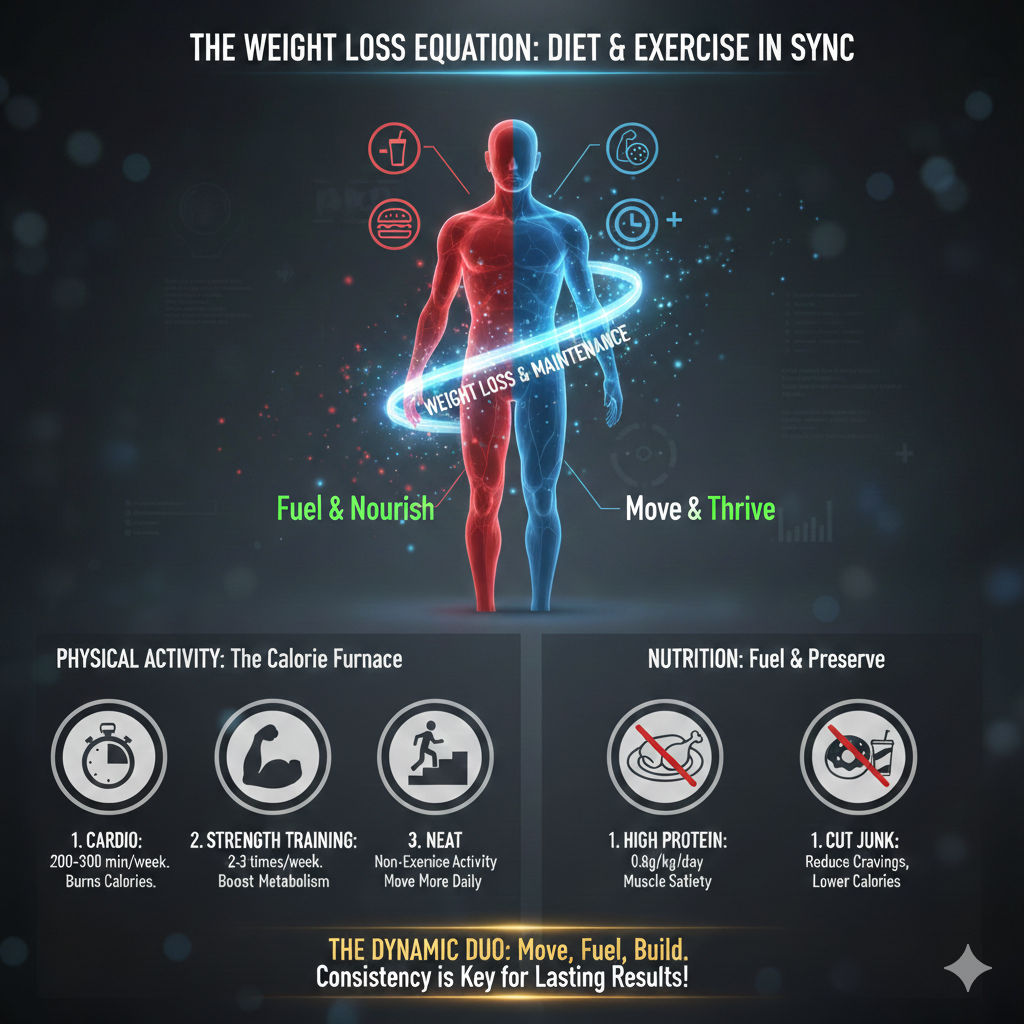
Aim for 200–300 minutes per week (about 40–60 minutes a day, 5–6 days a week) of moderate-to-vigorous exercise.
Moderate activities: Brisk walking, casual cycling, swimming
Vigorous activities: Running, classes, HIIT, basketball
Mixing up both types is best—for variety and continued results.
The Power of Strength Training
Don’t rely on cardio alone! Strength training (resistance exercise):
Builds lean muscle, which burns more calories even when you’re resting
Prevents loss of muscle when you’re losing weight
Means you not only get leaner—you get stronger
Try this:
Do strength exercises (squats, push-ups, resistance bands, weights) at least 2–3 times per week.
Best approach:
Combine aerobic (cardio) and resistance for optimal fat loss AND muscle gain.
Non-Exercise Activity: The Secret Weapon
Calories aren’t just burned in the gym; NEAT (non-exercise activity thermogenesis) is the energy you use moving about daily—walking the dog, cleaning, standing, fidgeting.
NEAT makes a big difference!
Ways to boost NEAT:
Take stairs, walk during calls, park farther away
Stretch or move every hour if sitting a lot
Protein: The Unsung Partner
Pair your exercise efforts with a high-protein diet:
Maintains muscle as you lose weight
Keeps you full and satisfied
Protein goal: About 0.8 grams per kg of body weight per day (more for athletes). For a 75 kg (165 lb) person, that’s at least 60g daily.
Staying Motivated
Set achievable goals (add 10 minutes to workouts each week)
Track your activity (apps, journals)
Reward yourself (with gear, a fun outing, not with food!)
Recap: Your Dynamic Duo
Weight loss isn’t just about eating less. Physical activity is your ticket to better, more permanent results.
Move more: Combine cardio, NEAT, and strength training
Eat enough protein to protect muscle
Have fun and keep it fresh for lifelong benefits
Remember: Consistency is key—find ways to move every day, and your healthier, fitter body will follow!
References
- Donnelly JE, Blair SN, Jakicic JM, et al. American College of Sports Medicine Position Stand. Appropriate physical activity intervention strategies for weight loss and prevention of weight regain for adults. Med Sci Sports Exerc. Feb 2009;41(2):459-71. doi:10.1249/MSS.0b013e3181949333
- Tate DF, Jeffery RW, Sherwood NE, Wing RR. Long-term weight losses associated with prescription of higher physical activity goals. Are higher levels of physical activity protective against weight regain? Am J Clin Nutr. Apr 2007;85(4):954-9. doi:10.1093/ajcn/85.4.954
- Pollock ML, Franklin BA, Balady GJ, et al. AHA Science Advisory. Resistance exercise in individuals with and without cardiovascular disease: benefits, rationale, safety, and prescription: An advisory from the Committee on Exercise, Rehabilitation, and Prevention, Council on Clinical Cardiology, American Heart Association; Position paper endorsed by the American College of Sports Medicine. Circulation. Feb 22 2000;101(7):828-33. doi:10.1161/01.cir.101.7.828
- Newman AB, Lee JS, Visser M, et al. Weight change and the conservation of lean mass in old age: the Health, Aging and Body Composition Study. Am J Clin Nutr. Oct 2005;82(4):872-8; quiz 915-6. doi:10.1093/ajcn/82.4.872
- Donnelly JE, Sharp T, Houmard J, et al. Muscle hypertrophy with large-scale weight loss and resistance training. Am J Clin Nutr. Oct 1993;58(4):561-5. doi:10.1093/ajcn/58.4.561
- Levine JA, Kotz CM. NEAT–non-exercise activity thermogenesis–egocentric & geocentric environmental factors vs. biological regulation. Acta Physiol Scand. Aug 2005;184(4):309-18. doi:10.1111/j.1365-201X.2005.01467.x
- Verreijen AM, Engberink MF, Memelink RG, van der Plas SE, Visser M, Weijs PJ. Effect of a high protein diet and/or resistance exercise on the preservation of fat free mass during weight loss in overweight and obese older adults: a randomized controlled trial. Nutr J. Feb 6 2017;16(1):10. doi:10.1186/s12937-017-0229-6