Evidence Says Yes — With Clear Limits
Mental health isn’t “all in the head.”
It’s biochemical, inflammatory, metabolic, and social.
Food touches all four.
What the Evidence Actually Supports
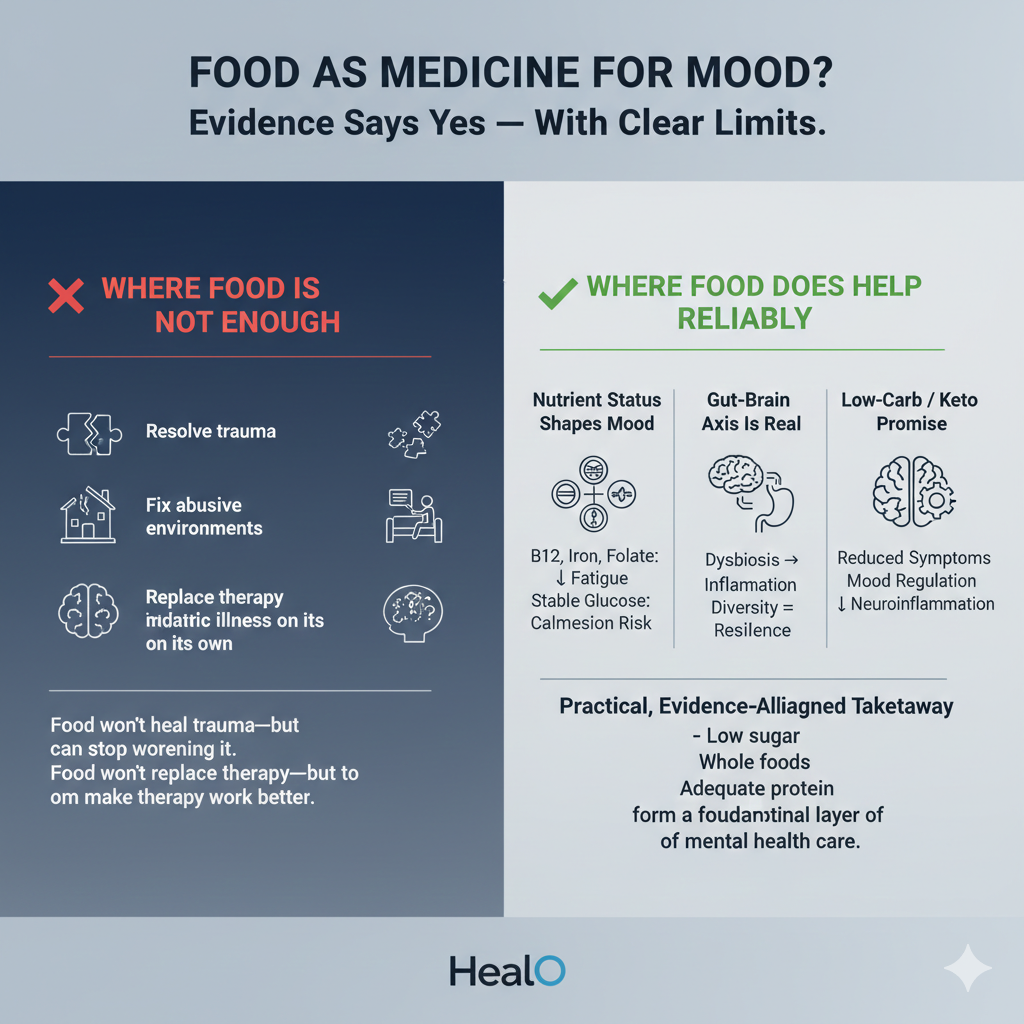
1. Nutrient status shapes mood
Deficiencies linked to higher depression/anxiety risk:
B12 → neuropathy, low mood, cognitive fog
Iron / folate / copper → fatigue, anhedonia, poor stress tolerance
Diabetes / insulin resistance → doubled depression risk
These aren’t fringe claims — they’re reproducible findings.
2. Blood sugar instability worsens mental health
High-GI diets →
Result: anxiety, irritability, low mood, brain fog.
Stable glucose = calmer nervous system.
3. Gut–brain axis is real
Dysbiosis → inflammation → altered neurotransmission
Gut permeability correlates with mood disorders
Microbiome diversity predicts resilience
Food is the primary microbiome signal.
4. Low-carb / ketogenic diets show promise
Emerging data shows:
Reduced depressive symptoms
Improved emotional regulation
Some clients reduce meds under supervision
Mechanisms likely include:
This is adjunct therapy, not ideology.
Where Food Is Not Enough
Let’s be honest — and ethical.
Food does not:
Anyone claiming otherwise is overselling.
Where Food Does Help Reliably
Think of nutrition as load reduction, not a cure.
Real food can:
Remove inflammatory drag
Replete missing substrates
Stabilize energy + hormones
Improve treatment response
That alone can lift symptoms from:
“Overwhelming” → “manageable”
And that matters.
Practical, Evidence-Aligned Takeaway
Not magic. Not placebo. Not everything.
But:
Low sugar
Whole foods
Adequate protein
Micronutrient repletion
…form a foundational layer of mental health care.
Bottom Line
Food won’t heal trauma —
but it can stop worsening it.
Food won’t replace therapy —
but it can make therapy work better.
And the evidence?
It’s only getting stronger.
References
- https://www.ncbi.nlm.nih.gov/pmc/articles/PMC3317401/
- https://www.ncbi.nlm.nih.gov/pmc/articles/PMC5532289/
- https://www.ncbi.nlm.nih.gov/pubmed/11375373
- https://www.ncbi.nlm.nih.gov/pmc/articles/PMC3022608/
- https://www.nature.com/articles/s41598-017-05649-7
- https://www.ncbi.nlm.nih.gov/pmc/articles/PMC3856388/
- https://www.ncbi.nlm.nih.gov/pmc/articles/PMC4515860/
- https://www.ncbi.nlm.nih.gov/pmc/articles/PMC5154680/
- https://www.ncbi.nlm.nih.gov/pubmed/29189904
- https://www.ncbi.nlm.nih.gov/pubmed/30588894
- https://www.ncbi.nlm.nih.gov/pubmed/30269866
- https://www.ncbi.nlm.nih.gov/pubmed/30075165
- https://www.ncbi.nlm.nih.gov/pmc/articles/PMC5357645/
- https://www.ncbi.nlm.nih.gov/pmc/articles/PMC5863039/
- https://www.ncbi.nlm.nih.gov/pubmed/28808808
- https://www.cochranelibrary.com/cdsr/doi/10.10%E2%80%A6
- https://link.springer.com/article/10.1007/s40501-024-00339-4
- https://jamanetwork.com/journals/jamapsychiatry/article-abstract/2840626
- https://jamanetwork.com/journals/jamapsychiatry/fullarticle/2844388
- https://www.thelancet.com/infographics-do/ultra-processed-food-2025
- https://mentalhealthketo.com/2025/11/20/carnitine-and-ketone-production-in-medical-ketogenic-diets/?s=09
- https://jamanetwork.com/journals/jamapsychiatry/article-abstract/2840626?s=09

2 Responses