
Personalized nutrition designed for your unique health goals.
Furtive Eating: Why Secret Snacking Keeps You Stuck (And How to Break Free)
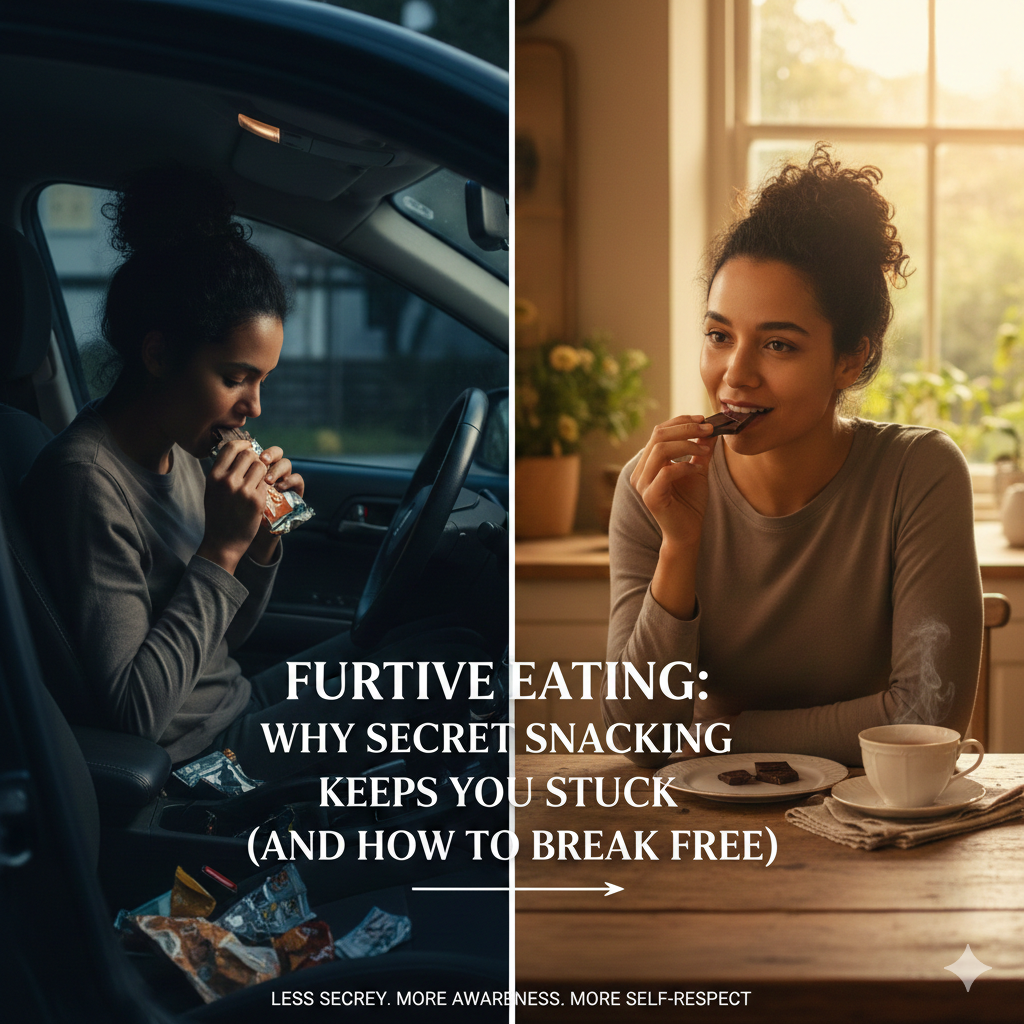
Furtive eating means eating in secret—hiding wrappers, rushing bites, sneaking food late at night or in the car.
The calories still count.
But the pleasure disappears.
What remains? Shame.
And shame fuels the cycle.
What Drives Secret Eating?
“Furtive” means sneaky. In food culture, it’s often rooted in:
Labeling foods as “bad”
Internalized diet rules
Fear of judgment (real or imagined)
Weight warnings from doctors or family
The belief that indulgence equals failure
You may think:
“I shouldn’t want this.”
“If someone sees me, they’ll judge me.”
“I’ve already messed up—might as well finish it.”
But here’s the truth:
👉 Gut hormones differ from person to person.
👉 Cravings are biologically normal.
👉 Desire is not a moral failure.
Diet culture turns normal appetite into secrecy.
Amal’s Story (A Common Pattern)
Amal was pre-diabetic. She had hidden sweets since childhood—wrappers tucked deep into bins, eaten alone.
When her GP warned her about weight, the secrecy intensified.
Restriction → Shame → Secret eating → Overeating → More shame.
The spiral wasn’t about chocolate.
It was about judgment—internal and external.
The Psychological Trap: Experiential Avoidance
Furtive eating is often experiential avoidance—trying to suppress desire instead of allowing it.
Suppressing cravings tends to:
Increase preoccupation
Trigger binge episodes
Amplify self-criticism
Openness, surprisingly, often reduces intensity.
The internal critic says:
“You’re weak.”
“This proves you have no control.”
But secrecy is the problem—not the food itself.
How to Break the Furtive Cycle
The goal is not banning foods.
It’s removing secrecy.
1. Acknowledge Desire Neutrally
Instead of:
“I’m terrible for wanting this.”
Try:
“I notice I’m craving chocolate.”
No drama. No morality. Just awareness.
2. Open the Act
If you’re going to eat it:
Buy it openly.
Put it on a plate.
Sit at a table.
Eat it slowly.
No hiding. No rushing.
Pleasure increases. Shame decreases.
3. Add Ceremony
Turn the snack into a moment:
Use a plate.
Use a serviette.
Sit down.
Taste each bite.
Rushed bites amplify guilt.
Mindful bites restore control.
4. Track the Shift
Notice:
Do cravings reduce when eaten openly?
Do you stop earlier?
Does intensity drop?
Many people find:
They buy less.
They share more.
They feel calmer around food.
Amal eventually moved from hiding sweets to occasionally enjoying them at the table—with less compulsion.
What Changes When You Go Open?
| Furtive Habit | Open Shift | Result |
|---|---|---|
| Hiding in car | Eating at table | Shame ↓ |
| Rushing bites | Slowing down | Cravings fade faster |
| Self-judging | Naming neutrally | Flexibility ↑ |
Secrecy feeds compulsion.
Visibility builds regulation.
When It’s More Serious
If secret eating feels:
Punitive
Out of control
Accompanied by distress or self-harm thoughts
That’s not a discipline issue. It’s a support signal.
Consult:
A physician
A therapist trained in eating behaviors
Organizations like BEAT (or local equivalents)
There is no weakness in asking for help.
A Healthier Reframe
Instead of:
“Why am I like this?”
Try:
“This desire is human. I choose to respond consciously.”
Healing your relationship with food isn’t revolution.
It’s evolution.
Less secrecy.
More awareness.
More self-respect.
And ironically—often less overeating.
References
- https://pubmed.ncbi.nlm.nih.gov/30623972/
- https://pubmed.ncbi.nlm.nih.gov/31033037/
- https://pmc.ncbi.nlm.nih.gov/articles/PMC10604454/
- https://pmc.ncbi.nlm.nih.gov/articles/PMC3511603/
- https://pmc.ncbi.nlm.nih.gov/articles/PMC7392799/
- https://pubmed.ncbi.nlm.nih.gov/33913377/
- https://pmc.ncbi.nlm.nih.gov/articles/PMC10124920/
- https://pmc.ncbi.nlm.nih.gov/articles/PMC8905886/
- https://onlinelibrary.wiley.com/doi/10.1002/eat.23490
- https://pmc.ncbi.nlm.nih.gov/articles/PMC9670577/
- https://pmc.ncbi.nlm.nih.gov/articles/PMC6796218/
- https://pmc.ncbi.nlm.nih.gov/articles/PMC6647198/
- https://pubmed.ncbi.nlm.nih.gov/36478397/
- Recent Post