Your gut houses trillions of bacteria that influence digestion, immunity, energy, and even mood. A healthy gut extracts nutrients efficiently and fights off pathogens, but imbalances can lead to bloating, fatigue, or weakened defenses. Three key players—prebiotics, probiotics, and digestive enzymes—offer science-backed ways to support it.
Prebiotics: Food for Your Good Bacteria
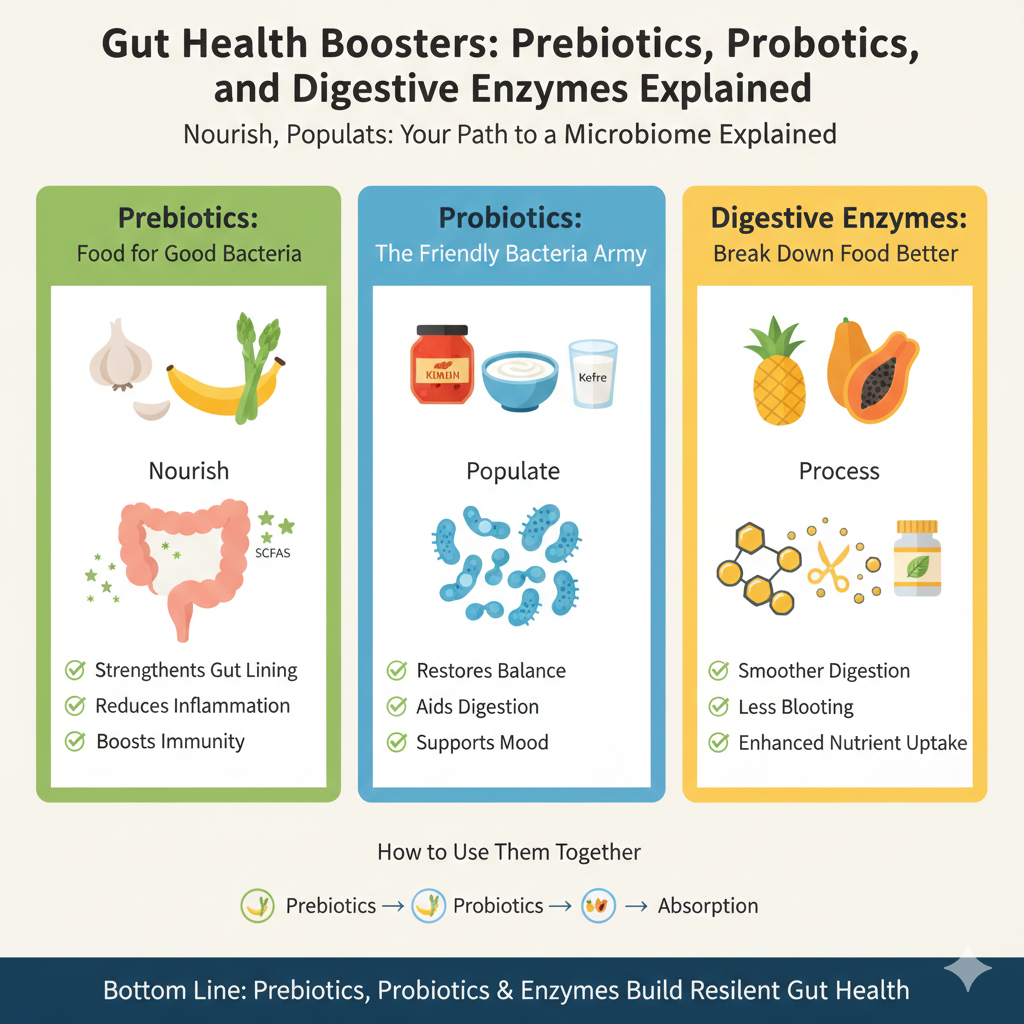
Prebiotics are non-digestible fibers that feed beneficial gut microbes. They ferment in the colon, producing short-chain fatty acids (SCFAs) like butyrate, which strengthen the gut lining and reduce inflammation.
Key benefits:
Better nutrient absorption and weight regulation
Stronger immunity and lower colon cancer risk
Improved mood via the gut-brain connection
Food sources: Garlic, onions, leeks, asparagus, bananas, oats.
Probiotics: The Friendly Bacteria Army
Probiotics are live “good” bacteria (like Lactobacillus and Bifidobacterium) that restore gut balance, crowd out harmful bugs, and aid digestion.
Key benefits:
Fewer infections, better skin/oral health
Reduced inflammation, blood pressure, and heart risks
Mood support through neurotransmitter balance
Food sources: Yogurt, kefir, sauerkraut, kimchi, apple cider vinegar, tempeh.
Digestive Enzymes: Break Down Food Better
These proteins (from pancreas, stomach, etc.) chop carbs, proteins, and fats into absorbable bits. Supplements from plants/animals help when your body falls short.
Key benefits:
Smoother digestion, less bloating
Support for IBS, lactose issues, inflammation
Enhanced nutrient uptake
Sources: Fresh pineapple/papaya (natural enzymes); supplements for targeted aid.
How to Use Them Together
Combine for max effect:
Prebiotics fuel probiotics
Probiotics optimize enzyme action
Enzymes ensure breakdown for absorption
Start with food first, add supplements if needed. Pair with a fiber-rich, low-processed diet.
Bottom Line
Prebiotics nourish, probiotics populate, enzymes process—together, they build resilient gut health for better immunity, energy, and whole-body wellness. Small changes yield big results.
References
- https://www.ncbi.nlm.nih.gov/pmc/articles/PMC3144392/#:~:text=Several%20bacterial%20genera%20that%20are,also%20synthesized%20by%20gut%20bacteria.
- https://www.ncbi.nlm.nih.gov/pmc/articles/PMC7926819/#:~:text=Prebiotics%20have%20the%20potential%20to,propionate%2C%20butyrate%2C%20and%20acetate.
- https://www.ncbi.nlm.nih.gov/pmc/articles/PMC6041804/
- https://pubmed.ncbi.nlm.nih.gov/30468509/
- https://www.frontiersin.org/articles/10.3389/fimmu.2022.1002674/full#:~:text=Probiotics%20have%20been%20successfully%20used,system%20and%20probiotics%20is%20disrupted.
- https://pubmed.ncbi.nlm.nih.gov/31914909/#:~:text=Conclusion%3A%20Pro%20and%20prebiotics%20can,or%20superiority%20against%20current%20treatments.
- https://www.ncbi.nlm.nih.gov/pmc/articles/PMC8512487/
- https://pubmed.ncbi.nlm.nih.gov/24364369/
- https://www.ncbi.nlm.nih.gov/pmc/articles/PMC9818925/#:~:text=Probiotic%20bacteria%20can%20interact%20and,health%2Dpromoting%20and%20immunomodulatory%20properties.
- https://www.ncbi.nlm.nih.gov/pmc/articles/PMC8964067/#:~:text=Administration%20of%20probiotic%20supplements%20may,development%20of%20multi%2Dresistant%20bacteria.
- https://www.ncbi.nlm.nih.gov/pmc/articles/PMC7793079/
- https://www.hopkinsmedicine.org/health/wellness-and-prevention/the-power-of-gut-bacteria-and-probiotics-for-heart-health#:~:text=Can%20Probiotics%20and%20Prebiotics%20Lower,a%20probiotic%2C”%20says%20Pluznick.
- https://www.ncbi.nlm.nih.gov/pmc/articles/PMC8161395/#:~:text=Probiotics%2C%20both%20as%20an%20adjunct,of%20depression%20using%20anti%2Ddepressants.
- https://www.ncbi.nlm.nih.gov/pmc/articles/PMC4923703/
- https://www.ncbi.nlm.nih.gov/pmc/articles/PMC2677689/#:~:text=The%20evidence%20points%20to%20the,ischemia%20and%20reperfusion%20(30).
- https://www.ncbi.nlm.nih.gov/pmc/articles/PMC6910206/

3 Responses