Benefits, Uses & Smart Dosing for Metabolic Health
Ever scuba dived?
Less than 27% of the ocean floor is mapped in high resolution, and <0.001% has been directly explored (NOAA, 2025). Yet oceans hold 96% of Earth’s water—and that water is saturated with sea salt, one of the most biologically essential substances on the planet.
Salt isn’t just seasoning. It’s cellular currency.
Every nerve impulse, muscle contraction, adrenal response, and hydration signal depends on minerals carried by salt—especially sodium, magnesium, potassium, calcium, zinc, and trace elements. It’s no coincidence ancient civilizations valued salt so highly that salary comes from salarium (salt payment).
The problem today isn’t salt.
It’s what kind of salt—and how intelligently it’s used.
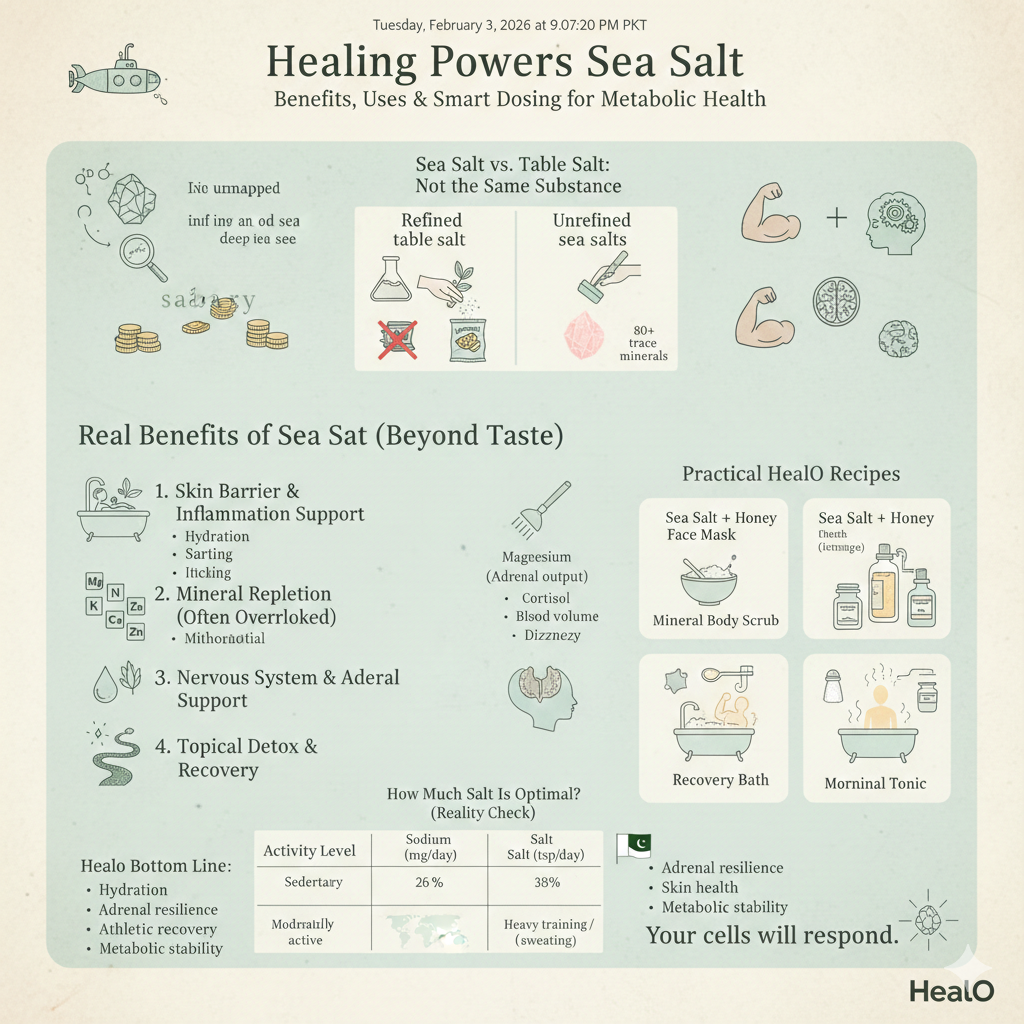
Sea Salt vs. Table Salt: Not the Same Substance
Refined table salt:
Unrefined sea salts retain 80+ trace minerals that support enzymatic reactions and electrolyte balance.
Notable types:
Celtic sea salt – hand-harvested, mineral-dense, moist
Himalayan pink salt – ancient seabed, iron-rich
Hawaiian red salt – volcanic clay, iron oxide
Flavour improves—but more importantly, physiology does too.
Real Benefits of Sea Salt (Beyond Taste)
1. Skin Barrier & Inflammation Support
Mineral-rich salt solutions improve hydration, strengthen the skin barrier, and reduce inflammatory signaling. Clinical trials using salt-water baths showed reduced scaling, itching, and redness in psoriasis with 3–4 baths/week.
Salt works by:
2. Mineral Repletion (Often Overlooked)
Unrefined sea salt contains 2–10× more trace minerals than refined salt, including magnesium, calcium, potassium, sulfur, iron, and zinc.
Why this matters:
Magnesium supports insulin sensitivity
Sodium + potassium regulate adrenal output
Trace minerals support thyroid and mitochondrial enzymes
Low salt intake + high stress = cortisol dysregulation for many people.
3. Nervous System & Adrenal Support
Sodium is required for:
Many people labeled with “adrenal fatigue” are simply underelectrolyted, especially on low-carb, fasting, or whole-food diets.
4. Topical Detox & Recovery
Used externally, sea salt:
Think of it as mechanical detox, not magic.
Practical HealO Recipes
Sea Salt + Honey Face Mask
Hydration + gentle exfoliation
2 tsp fine sea salt
4 tsp raw Manuka honey
Apply 10–15 minutes. Remove with a warm, steamed cloth.
Supports barrier repair without stripping oils.
Mineral Body Scrub
Skin renewal + lymphatic support
Use on wet skin. Rinse well.
Recovery Bath
Muscle relaxation + nervous system reset
1–2 cups sea salt
Warm (not hot) water
Optional lavender oil
Soak 20 minutes post-training or during high stress.
Morning Adrenal Tonic
Electrolyte balance without sugar
Useful for fasting, low-carb diets, or morning fatigue.
How Much Salt Is Optimal? (Reality Check)
The myth: “All salt is dangerous.”
The data: Both too little and too much increase risk.
Large population studies consistently show lowest mortality at ~4–6 g sodium/day, especially in physically active populations.
| Activity Level | Sodium (mg/day) | Salt (tsp/day) |
|---|
| Sedentary | 3000–4000 | 1.5–2 |
| Moderately active | 4000–6000 | 2–3.5 |
| Heavy training / sweating | 5000–7000+ | 3–4+ |
Context matters:
Sweat loss, heat, fasting, and low-carb diets all increase sodium needs.
Important Cautions
Choose low-pollution sources (microplastics are rising)
Avoid pairing salt with ultra-processed foods
If you have kidney disease or uncontrolled hypertension, test and individualize
Salt isn’t the enemy.
Insulin resistance, inflammation, and processed foods are.
HealO Bottom Line
Sea salt is not just seasoning—it’s cellular infrastructure.
Used wisely, it supports:
Hydration
Adrenal resilience
Skin health
Athletic recovery
Metabolic stability
Respect it. Dose it intelligently.
Your cells will respond.
References
- How Much of The Ocean Have We Explored? NOAA. 2018. https://oceanservice.noaa.gov/facts/exploration.html
- A Brief History of Salt TIME Mar. 15, 1982. https://time.com/3957460/a-brief-history-of-salt/
- Proksch E, Nissen HP, Bremgartner M, Urquhart C. Bathing in a magnesium-rich Dead Sea salt solution improves skin barrier function, enhances skin hydration, and reduces inflammation in atopic dry skin. Int J Dermatol. 2005;44(2):151‐157. doi:10.1111/j.1365-4632.2005.02079.x
- DRAKE, S. and DRAKE, M. (2011), COMPARISON OF SALTY TASTE AND TIME INTENSITY OF SEA AND LAND SALTS FROM AROUND THE WORLD. Journal of Sensory Studies, 26: 25-34. doi:10.1111/j.1745-459X.2010.00317.x
- Karami, A., Golieskardi, A., Keong Choo, C. et al. The presence of microplastics in commercial salts from different countries. Sci Rep 7, 46173 (2017). https://doi.org/10.1038/srep46173
- O’Donnell MJ, Yusuf S, Mente A, et al. Urinary Sodium and Potassium Excretion and Risk of Cardiovascular Events. JAMA. 2011;306(20):2229–2238. doi:10.1001/jama.2011.1729
- https://www.theguardian.com/science/2017/aug/08/a-danger-to-public-health-uproar-as-scientist-urges-us-to-eat-more-salt#:~:text=DiNicolantonio%20also%20claims%20that%20we,the%20world?%E2%80%9D%20he%20said.
- https://www.ramsayhealth.co.uk/blog/lifestyle/us-scientist-claims-salt-is-actually-good-for-us#:~:text=Estimated%20Reading%20Time:%204%20minutes,in%20to%20our%20salt%20cravings.
- https://www.westonaprice.org/book-reviews/the-salt-fix-by-james-dinicolantonio/#:~:text=This%20gamble%20came%20with%20significant,isn’t%20adversarial%20but%20advantageous.
- https://www.consultant360.com/exclusives/study-5000-mg-salt-day-wont-hurt-heart#:~:text=Menu-,Main%20navigation,to%20two%20teaspoons%20of%20salt.
- https://www.fda.gov/food/nutrition-education-resources-materials/sodium-your-diet#:~:text=However%2C%20the%20Dietary%20Guidelines%20for,1%20teaspoon%20of%20table%20salt!
- https://www.marquiscompanies.com/blog/those-new-warnings-about-salt/#:~:text=%E2%80%9CUnless%20you’re%20following%20a,teaspoons%20of%20salt%20every%20day.
- https://www.cdc.gov/salt/about/index.html#:~:text=Health%20risks,year%20than%20any%20other%20cause.
- https://www.youtube.com/watch?v=hTLlTSpWUmE
- https://www.youtube.com/watch?v=yogPU4sDrjA#:~:text=KEY:%201%20gram%20sodium%20=%202.5,least%205%20GRAMS%20daily%20thereafter.
- https://cancerletter.com/the-cancer-letter/20191004_1/#:~:text=The%20recommendation%2C%20made%20by%20the%20panel%20of,contrary%20to%20almost%20all%20other%20existing%20guidelines.
One Response