The Missing Nutrient Even “Healthy” Diets Lack
Know someone who eats clean, exercises, takes statins—and still struggles with heart disease?
The missing link is often vitamin K2 deficiency, a silent epidemic affecting ~97% of ultra processed diets. This fat-soluble nutrient plays a central role in preventing arterial calcification, stiffness, inflammation, and metabolic damage—yet remains absent from most nutrition advice.
Here’s how vitamin K2 protects the heart—and how to use it wisely.
Table of Contents
K2 Heart Basics
Vitamin K2 (menaquinones, especially MK-7) activates proteins through γ-carboxylation, a biochemical switch essential for cardiovascular safety.
The most important heart-protective protein is:
Matrix Gla Protein (MGP)
→ Inhibits calcium deposition in arterial walls
→ Keeps calcium in bones and teeth, not arteries
Without adequate K2, MGP remains inactive, allowing vascular calcification—even when calcium intake is “normal.”
⚠️ Statins and warfarin reduce K2 availability.
Populations consuming natto (rich in MK-7) show markedly lower cardiovascular disease rates.
Why Deficiency Hits Hard
Vitamin K2 is rare in modern diets:
Natto: 1,000+ mcg per serving (but rarely eaten outside Japan)
Cheese: ~5–10 mcg per slice → ¼ lb daily just to reach minimum benefit
Grass-fed dairy > grain-fed > ultra-processed
Result: ~97% of people fail to meet heart-protective K2 levels.
Even “healthy” diets rich in vegetables supply K1, not K2, and conversion is poor.
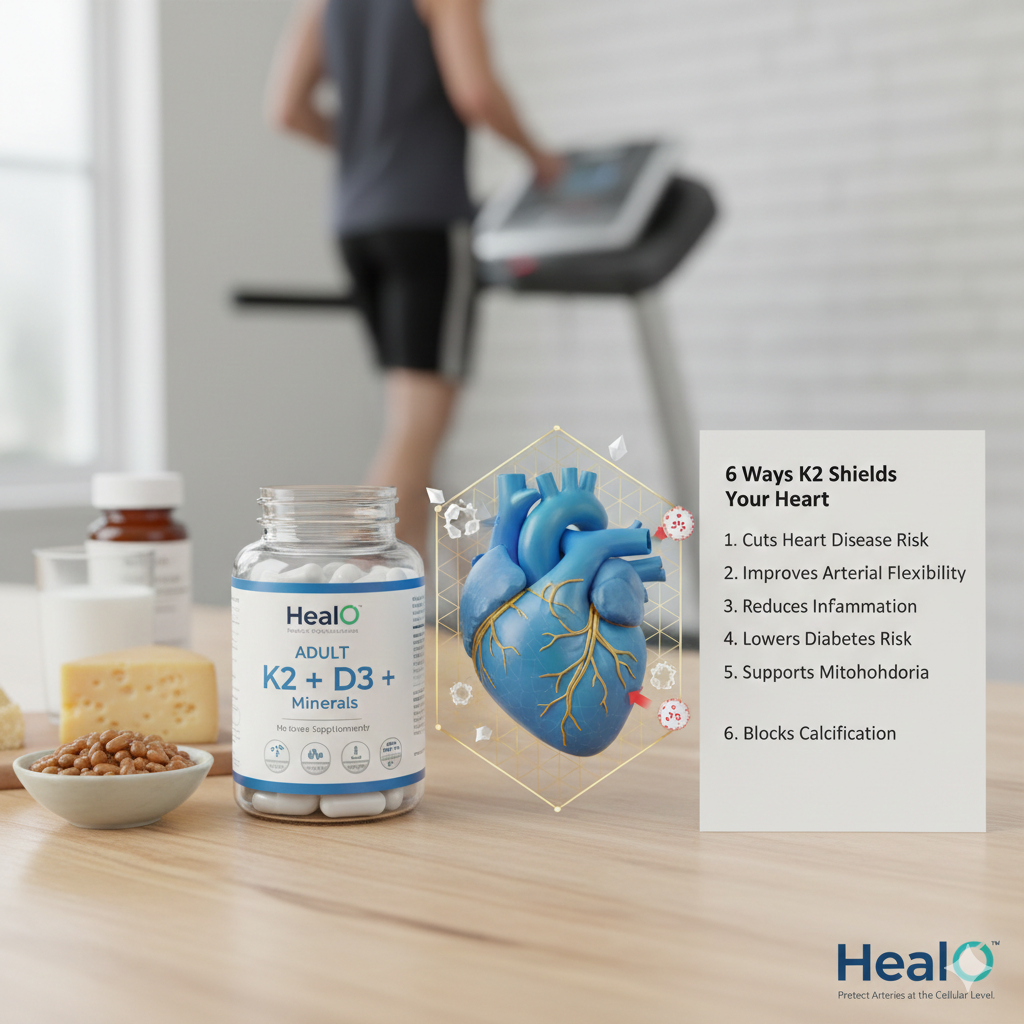
6 Ways Vitamin K2 Shields Your Heart
1. Cuts Heart Disease & Mortality Risk
K1 showed no such benefit.
2. Improves Arterial Flexibility
In a 3-year randomized trial of 244 postmenopausal women:
180 mcg/day MK-7 (MenaQ7®)
Significant reduction in arterial stiffness (PWV, ultrasound)
Greatest benefit in those with worst baseline stiffness
Arterial stiffness strongly predicts heart attacks and cardiovascular death.
3. Reduces Inflammatory Load
MK-7 suppresses pro-inflammatory cytokines:
(Shown dose-dependently in mechanistic studies; human trials emerging.)
Chronic inflammation accelerates atherosclerosis and plaque instability.
4. Lowers Type 2 Diabetes Risk
40,000+ participants, 10-year follow-up
Each 10 mcg increase in K2 intake → ~5% lower diabetes risk
Associated with lower CRP levels
Diabetes and heart disease share calcification and inflammation pathways—K2 targets both.
5. Supports Cardiac Mitochondria
Vitamin K2 functions as an electron carrier in mitochondria:
Failing hearts show mitochondrial dysfunction—K2 helps preserve cellular energy where the heart needs it most.
6. Blocks Vascular Calcification at the Source
By activating MGP, K2 directly inhibits calcification—critical for:
Diabetes
Chronic kidney disease
Obesity
Smokers
Aging populations
This mechanism is unique to vitamin K2, not K1 or calcium restriction.
Supplement Smart (HealO Guidance)
Safety
Vitamin K2 has no known toxicity, even at high doses in animal and long-term human studies.
What to Use
Natural MK-7 (all-trans form)
Prefer MenaQ7® (chickpea-fermented, clinically validated)
Avoid synthetic or cis-MK forms (largely inactive)
Dose
Synergy
Always pair with vitamin D3 for optimal calcium regulation.
Medication Interactions
Warfarin:
Medications that deplete K2:
Statins
Broad-spectrum antibiotics
Anticonvulsants (e.g., phenytoin)
Estrogen therapy
Orlistat, bile-acid sequestrants
Mineral oil, BHT
Newer anticoagulants (DOACs):
Additional risk groups: obesity, liver disease, GI malabsorption.
Key Takeaway
Vitamin K2 fills a critical blind spot in heart health—even for those eating “right” or taking medications.
By activating protective proteins, K2 reduces calcification, stiffness, inflammation, diabetes risk, and mitochondrial decline.
HealO principle:
Don’t just manage cholesterol.
Protect arteries at the cellular level.
Test status where possible, supplement wisely, include natto or quality cheeses—and always coordinate changes with your healthcare provider.
References
- https://www.ncbi.nlm.nih.gov/pmc/articles/PMC3255495
- https://www.ncbi.nlm.nih.gov/pubmed/16869104
- https://www.ncbi.nlm.nih.gov/pubmed/24296867
- https://www.ncbi.nlm.nih.gov/pubmed/17349078
- https://www.ncbi.nlm.nih.gov/pubmed/17349078
- https://www.ncbi.nlm.nih.gov/pubmed/19450370
- https://www.ncbi.nlm.nih.gov/pmc/articles/PMC3178021/
- https://www.ncbi.nlm.nih.gov/pubmed/27200471
- https://www.ncbi.nlm.nih.gov/books/NBK209820/
- https://academic.oup.com/jn/article/148/suppl_3/1567S/5026326
- https://www.ncbi.nlm.nih.gov/pubmed/6885274
- https://www.ncbi.nlm.nih.gov/pubmed/29617314
- https://www.ncbi.nlm.nih.gov/pubmed/30371151
- https://www.ncbi.nlm.nih.gov/pubmed/21781006
- https://www.ncbi.nlm.nih.gov/pubmed/18279558
- https://www.nutraceuticalsworld.com/contents/view_breaking-news/2019-01-11/vitamin-k2-status-linked-to-brain-and-eye-health/991
- https://www.ncbi.nlm.nih.gov/pubmed/24089220
- https://www.ncbi.nlm.nih.gov/pubmed/15514282
- https://www.ncbi.nlm.nih.gov/pubmed/18722618
- https://www.ncbi.nlm.nih.gov/pubmed/25694037
- https://www.ncbi.nlm.nih.gov/pubmed/24402301
- https://www.ncbi.nlm.nih.gov/pubmed/24845468
- https://www.ncbi.nlm.nih.gov/pubmed/20424220
- https://www.ncbi.nlm.nih.gov/pubmed/29724016
- https://www.ncbi.nlm.nih.gov/pubmed/439009
- https://www.ncbi.nlm.nih.gov/pubmed/29882816
- https://www.ncbi.nlm.nih.gov/pubmed/30618350
- https://pubmed.ncbi.nlm.nih.gov/17874826/
- https://www.ncbi.nlm.nih.gov/pmc/articles/PMC2730374/
- https://www.mdpi.com/1422-0067/24/3/2986
- https://www.ncbi.nlm.nih.gov/pubmed/17158229?dopt=Abstract
- https://www.ncbi.nlm.nih.gov/pmc/articles/PMC4566462/
- https://www.ncbi.nlm.nih.gov/pmc/articles/PMC2169349/
- https://www.ncbi.nlm.nih.gov/pmc/articles/PMC3255495
- https://www.ncbi.nlm.nih.gov/pubmed/16869104
- https://www.ncbi.nlm.nih.gov/pubmed/17349078
- https://www.ncbi.nlm.nih.gov/books/NBK209820/

2 Responses