
Personalized nutrition designed for your unique health goals.
Iron is essential for life — but like many powerful nutrients, balance matters.
In coaching practice, I increasingly see clients with:
Fidgety legs or inner restlessness
Chronic pain or fibromyalgia-like symptoms
Low mood despite “normal” labs
Brain fog and poor motivation
And surprisingly, their iron markers are “within range.”
Could excess iron — even inside conventional reference intervals — be contributing?
Let’s unpack this carefully.
Iron: Essential, But Potentially Reactive
Iron plays a central role in:
Hemoglobin (oxygen transport)
Tyrosine hydroxylase → dopamine production
Tryptophan hydroxylase → serotonin production
Without iron, neurotransmitter synthesis suffers.
However, iron is also a redox-active metal. In excess, it participates in the Fenton reaction, generating reactive oxygen species (ROS).
Excess ROS can:
Damage mitochondria
Oxidize lipids in neurons
Disrupt dopamine signaling
Promote neuroinflammation
The result?
Fatigue. Mood instability. Cognitive dullness. Pain sensitivity.
Iron is both builder and burner.
Restless Legs & the Iron Paradox
Restless Legs Syndrome (RLS) is traditionally linked to iron deficiency — especially low brain iron.
But observation shows something more nuanced:
Some clients experience symptoms even with ferritin in the “normal” range (50–300 ng/mL).
Iron regulation in the brain differs from serum markers.
Iron dysregulation — not just deficiency — may impair dopamine signaling.
Dopamine imbalance is central to RLS.
Too little signaling = motor restlessness.
The key insight: iron metabolism is more complex than a single ferritin number.
Dopamine & Serotonin: When Iron Becomes Disruptive
1️⃣ Dopamine Disruption
Iron is required for dopamine synthesis.
But oxidative stress from excess iron can:
Impair tyrosine hydroxylase activity
Damage dopaminergic neurons
Alter receptor sensitivity
Clinically, this may present as:
ADHD-like restlessness
Low drive
Anhedonia
“Restless mind”
Neurodegenerative research shows abnormal iron accumulation in dopaminergic regions (e.g., Parkinson’s disease), reinforcing iron’s delicate balance in the brain.
2️⃣ Serotonin Vulnerability
Serotonin pathways are sensitive to oxidative stress.
Chronic oxidative load may:
Reduce tryptophan availability
Increase inflammatory cytokines
Shift metabolism toward kynurenine pathways
Low serotonin states correlate with:
Anxiety
Depression
Irritability
Sleep disturbance
Again — not always from deficiency, but from dysregulation.
Iron & Chronic Pain
Excess oxidative stress can:
Sensitize peripheral nerves
Amplify inflammatory signaling
Contribute to central sensitization
Patients with fibromyalgia or unexplained chronic pain sometimes show altered iron handling.
Pain is often an oxidative and mitochondrial story — not just a mechanical one.
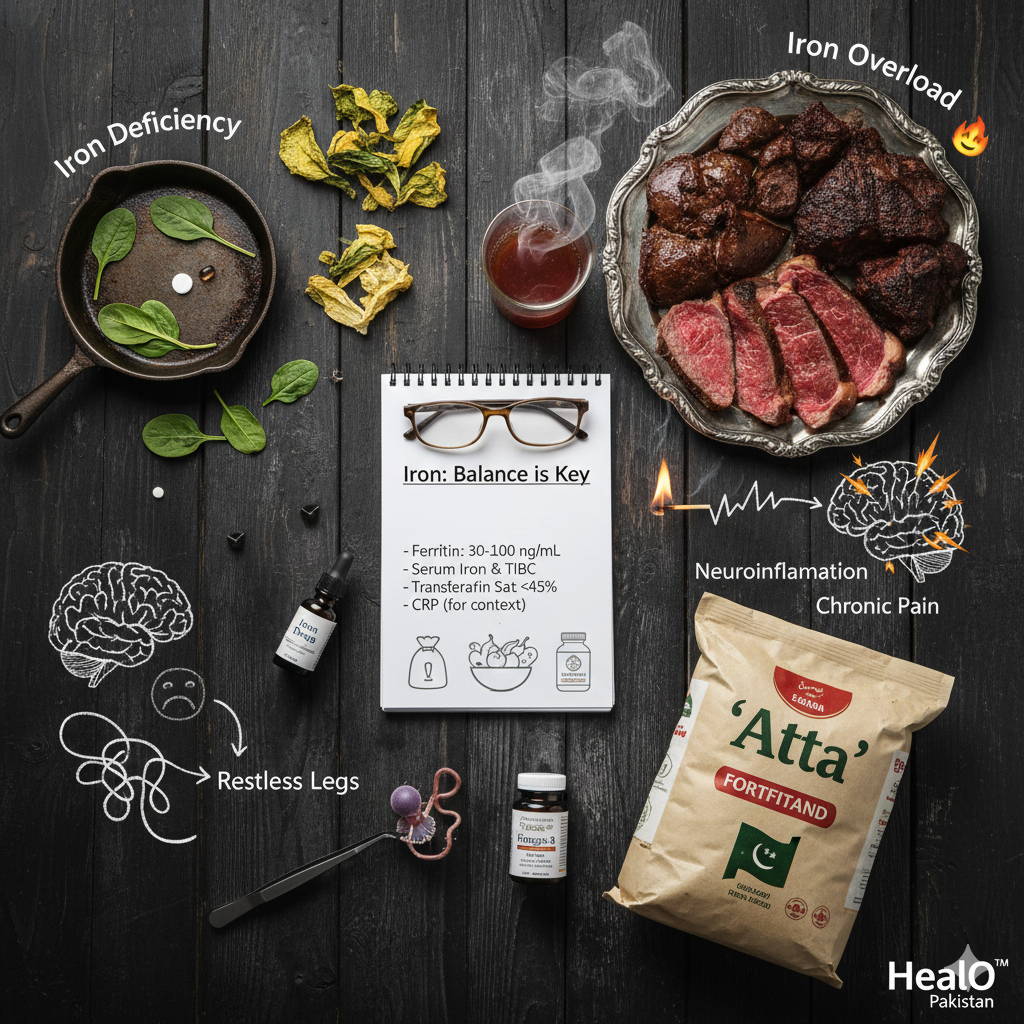
The Pakistani Context: Why This Matters
In Pakistan, several factors may increase iron exposure:
High intake of heme iron (nihari, kaleji, red meat-heavy diets)
Fortified atta
Over-the-counter iron supplementation
Multivitamins containing iron
Limited routine ferritin screening
Heme iron is highly bioavailable and less regulated by intestinal control mechanisms compared to plant iron.
For some individuals — especially men and postmenopausal women — accumulation can occur gradually.
Symptoms may include:
Fidgety legs
“Restless mind”
Unexplained fatigue
Low mood
Diffuse body pain
Not everyone with high meat intake has overload. Genetics, inflammation, liver health, and metabolic status all influence iron storage.
What Should You Test?
If symptoms align, consider discussing with your physician:
Key Markers:
Ferritin
Functional clinical range often considered: 30–100 ng/mL (context dependent)Serum iron
TIBC
Transferrin saturation (ideal <45%)
CRP (to interpret ferritin properly, since ferritin rises in inflammation)
Important:
Ferritin is also an acute-phase reactant. High ferritin does not always equal iron overload.
Can Lowering Iron Help?
In individuals with confirmed high iron stores:
Blood donation (if medically eligible) can reduce iron burden.
Avoid unnecessary iron supplementation.
Reduce excess fortified or supplemental iron exposure.
Increase antioxidant intake (vitamin C from food, polyphenols, olive oil, etc.).
Never attempt aggressive iron reduction without testing.
What About Carnivore or Meat-Based Diets?
A meat-based diet increases heme iron intake.
However:
Satiety often reduces overall food volume.
Intermittent fasting may improve iron regulation.
Individual variability is significant.
The key is personalization — not blanket restriction or blind supplementation.
The Bigger Message
Iron deficiency is common — especially in menstruating women.
But iron excess is under-discussed — especially in men and metabolic patients.
Both extremes impair:
Dopamine
Serotonin
Mitochondria
Pain thresholds
Cognitive clarity
Optimal health lives in balance.
If You’re Experiencing:
Fidgety legs
Chronic unexplained pain
Low motivation despite normal labs
Mood swings without clear cause
It may be worth evaluating iron metabolism — not just assuming deficiency.
Test intelligently. Interpret contextually. Treat precisely.
HealO Perspective:
Iron is not “good” or “bad.”
It is powerful.
And powerful nutrients demand respect.
References
https://pmc.ncbi.nlm.nih.gov/articles/PMC4253901/
- https://pmc.ncbi.nlm.nih.gov/articles/PMC6353229/
- https://parkinsonsnewstoday.com/news/serotonin-levels-linked-iron-buildup-substantia-nigra-study-finds/
- https://www.youtube.com/watch?v=vf7ol8mpZjk
- https://hemeoncall.com/low-iron-and-mental-health/
- https://www.cochrane.org/evidence/CD007834_iron-treatment-restless-legs-syndrome
- https://pmc.ncbi.nlm.nih.gov/articles/PMC9828900/
- https://pubs.acs.org/doi/10.1021/tx0497144
- https://pmc.ncbi.nlm.nih.gov/articles/PMC11961303/
- https://pmc.ncbi.nlm.nih.gov/articles/PMC3014724/
- Recent Post