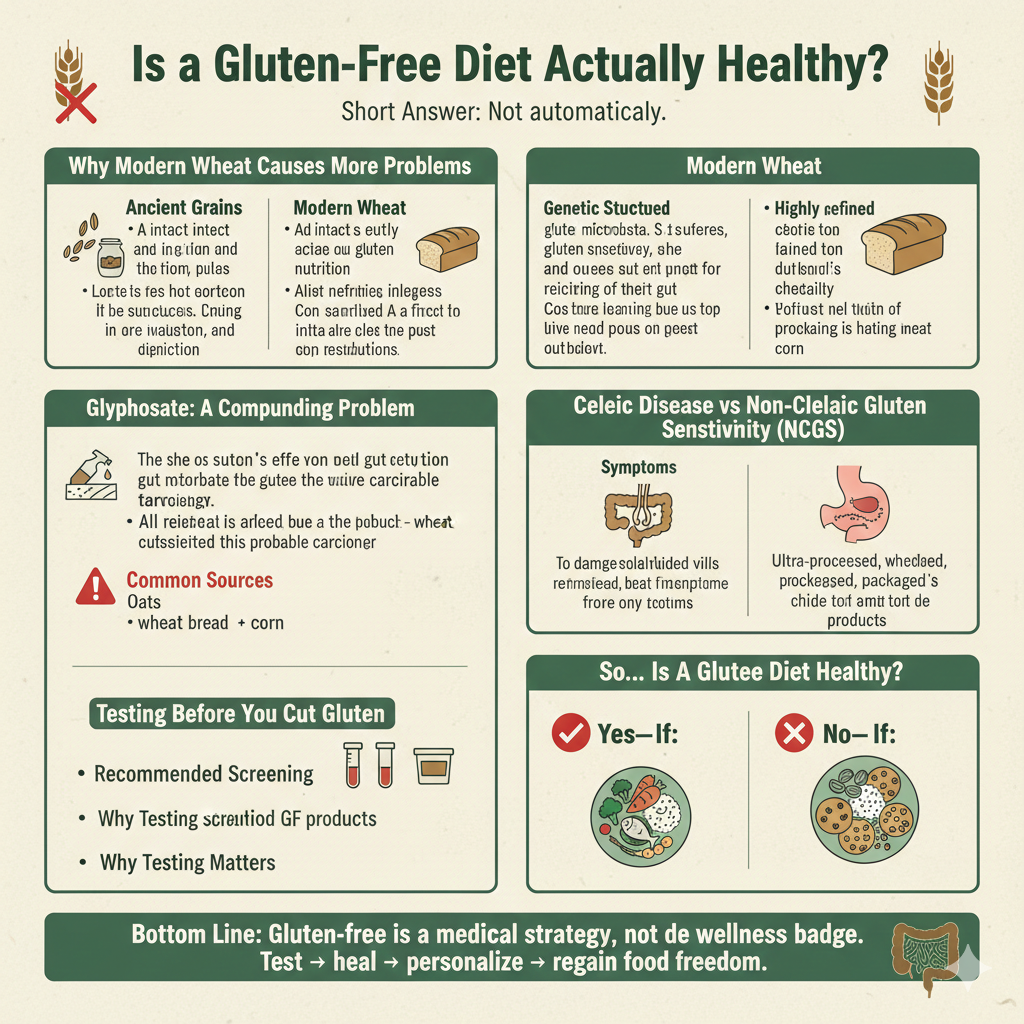
Short Answer
Not automatically.
A gluten-free (GF) diet helps only when it’s needed—and only when it’s done well.
For many people, the issue isn’t “gluten” in isolation. It’s modern wheat, gut health, and how grains are grown and processed.
Why Modern Wheat Causes More Problems
Modern wheat is biologically different from ancient grains such as einkorn, emmer, spelt, and Kamut. Over the past 50–100 years, selective breeding, hybridization, refining, and chemical agriculture have significantly changed wheat’s structure and digestibility.
Key Differences: Ancient vs Modern Wheat
| Aspect | Ancient Grains (Einkorn, Emmer, Spelt, Kamut) | Modern Wheat (Triticum aestivum) |
|---|
| Genetics | Diploid/tetraploid; stable for 10,000+ years | Hexaploid hybrid (post-1960s Green Revolution) |
| Gluten | Lower quantity; weaker proteins; easier to digest | ↑ Gluten, gliadins & WGA → gut irritation |
| Nutrition | Higher protein, fiber, Zn, Fe, Mg; intact kernel | Refined endosperm; mineral-binding phytates |
| Processing | Traditionally soaked, sprouted, fermented | Fast-rise, no fermentation |
| Glycemic impact | Lower, steadier blood sugar | High amylopectin A → spikes insulin |
| Tolerance | Often better tolerated | Linked to inflammation, obesity, gut symptoms |
What Changed—and Why It Matters
1. Hybridization (Green Revolution)
Wheat bred for yield, pest resistance, and shelf stability
Altered gluten structure, lectins (WGA), and FODMAP content
Result: proteins harder to break down and more immunogenic
2. Refining
Removes bran and germ → loss of fiber, minerals, antioxidants
Leaves starch-heavy flour → blood sugar spikes
3. Processing Speed
Traditional fermentation (e.g., sourdough) breaks down gluten and phytates
Modern baking skips fermentation → poor digestibility
Glyphosate: A Compounding Problem (Not the Only One)
Glyphosate (Roundup) is widely used as a pre-harvest desiccant on wheat, oats, corn, soy, and legumes.
Why It Matters
Disrupts gut microbiota (↓ Lactobacillus/Bifidobacteria)
Associated with gut permeability and inflammation
Classified as a probable carcinogen (IARC)
Animal and occupational studies show endocrine, neurologic, liver, and kidney effects
Important nuance:
Glyphosate is not the sole cause—many people still react to organic modern wheat, suggesting protein structure + processing also matter.
Common Sources
Washing does not remove glyphosate.
Organic grain intake can reduce urinary glyphosate levels by ~70%.
Celiac Disease vs Non-Celiac Gluten Sensitivity (NCGS)
| Condition | What’s Happening | Symptoms |
|---|
| Celiac disease | Autoimmune attack on intestinal villi | Diarrhea, malabsorption, anemia, weight loss |
| NCGS | Immune & gut inflammation without villous damage | Bloating, brain fog, headache, joint pain, skin & mood issues |
NCGS is far more common than celiac disease and frequently underdiagnosed.
Testing Before You Cut Gluten
Recommended Screening (while still eating gluten)
Why Testing Matters
Removing gluten blindly can:
Increase food fear and restriction
Miss the real driver (dysbiosis, immune imbalance)
Complicate future diagnosis
Heal First, Then Decide
As gut inflammation improves, some individuals can reintroduce gluten—especially:
So… Is a Gluten-Free Diet Healthy?
✔ Yes—If:
✖ No—If:
It’s based on ultra-processed GF products
It ignores inflammation, blood sugar, and gut health
Bottom Line
Gluten-free is a medical strategy, not a wellness badge.
The real goal isn’t avoidance—it’s tolerance through gut health.
Test → heal → personalize → regain food freedom.
References
- https://doudlahfarms.com/ancient-grains-vs-modern-wheat-whats-the-difference-and-why-it-matters/
- https://bodymanual.com/blogs/news/the-big-difference-between-modern-wheat-ancient-wheat
- https://pmc.ncbi.nlm.nih.gov/articles/PMC9322029/
- https://thebrotbox.com/blogs/news/the-difference-between-modern-wheat-and-ancient-grains
- https://pmc.ncbi.nlm.nih.gov/articles/PMC5824670/
- https://www.oanz.org/new-blog/glyphosate-understanding-the-risks-and-pushing-for-change-dr-zuzana-oravcova-wheeler
- https://fondregenerative.com/blogs/journal/the-truth-about-glyphosate-health-risks-environmental-impact-and-better-options
- https://nourishfoodclub.com/blogs/news/the-health-consequences-of-glyphosate
- https://foodprint.org/blog/glyphosate-effects/
- https://fondregenerative.com/blogs/journal/the-truth-about-glyphosate-health-risks-environmental-impact-and-better-options
- https://greenschoolsgreenfuture.org/effects-of-glyphosate-in-our-food-system/
- https://greenschoolsgreenfuture.org/effects-of-glyphosate-in-our-food-system/
- https://nourishfoodclub.com/blogs/news/the-health-consequences-of-glyphosate
- https://nourishfoodclub.com/blogs/news/the-health-consequences-of-glyphosate
- https://greenschoolsgreenfuture.org/effects-of-glyphosate-in-our-food-system/
- https://drdavisinfinitehealth.com/2018/10/is-glyphosate-the-real-problem-in-wheat/
- https://doudlahfarms.com/ancient-grains-vs-modern-wheat-whats-the-difference-and-why-it-matters/
- https://bodymanual.com/blogs/news/the-big-difference-between-modern-wheat-ancient-wheat
- https://twobrothersfood.com/blogs/all-blogs/ancient-arains-vs-modern-wheat
- https://pmc.ncbi.nlm.nih.gov/articles/PMC5824670/
- https://drdavisinfinitehealth.com/2018/10/is-glyphosate-the-real-problem-in-wheat/

2 Responses