If you’ve followed standard nutrition advice—eat less, move more, follow the plate—yet still struggle with fatigue, gut issues, inflammation, or stubborn weight, the problem isn’t your discipline.
It’s the model.
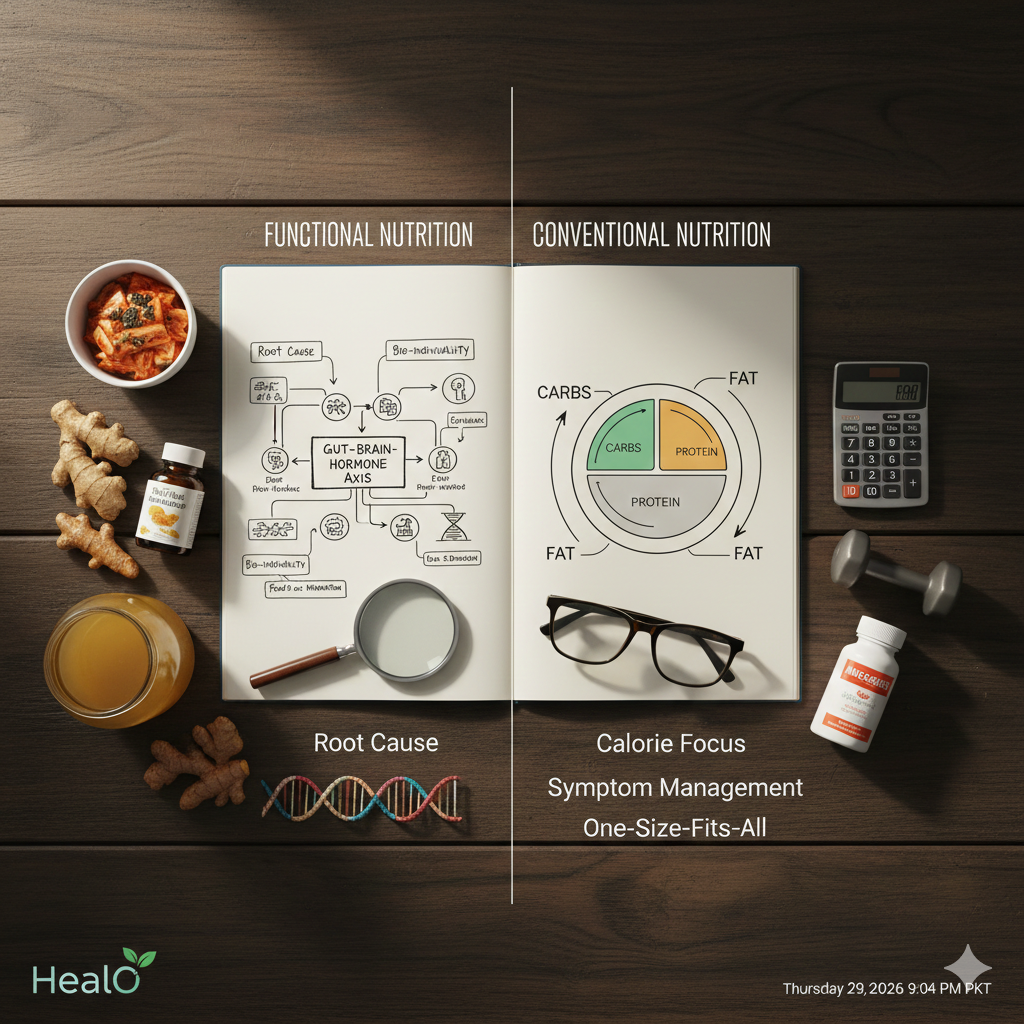
Functional nutrition, rooted in functional medicine, doesn’t treat food as calories alone. It treats food as biological information, tailored to your physiology, biochemistry, gut microbiome, and life stressors.
That’s why it often succeeds where conventional nutrition stalls.
And yes—unlike most functional providers, HealO provides telehealth functional nutrition consults.
Functional vs. Conventional Medicine: The Core Difference
Conventional medicine is excellent at acute care:
But chronic issues often get reduced to symptom management, not root-cause resolution.
Functional medicine—and by extension functional nutrition—asks a different question:
Why is this happening in the first place?
Example: Chronic Gut Pain
Conventional approach:
Scope → “Everything looks normal” → antacids or antispasmodics
Functional approach:
Investigates food triggers, nutrient deficiencies, microbiome imbalance, stress load, sleep, toxins, and inflammation drivers
Same patient. Very different outcomes.
Core Principles of Functional Nutrition (HealO Framework)
1. Bio-Individuality: You Are Not a Template
No two people digest, metabolize, or tolerate foods the same way.
Functional nutrition considers:
Genetics (e.g., methylation, carb tolerance)
Labs (nutrient status, inflammation, insulin markers)
Gut health
Medical and stress history
Food reactions—not just “food rules”
No universal diet works for everyone.
2. Food Is Medicine (and Information)
Food sends molecular signals that:
Reduce or increase inflammation
Heal or damage the gut lining
Support or impair hormone balance
Regulate brain chemistry and mood
This is not philosophy—it’s nutritional biochemistry.
3. Patient-Centered, Not Protocol-Centered
Functional nutrition visits are longer (often 60–90 minutes) because:
Contrast that with 15-minute checklists.
4. Science-Driven, Not Trend-Driven
Functional nutrition uses:
It is rigorous, not alternative.
How Functional Dietitians Apply This in Practice
At HealO, functional nutrition means integrating:
Stool testing → microbiome balance, inflammation, digestion
Bloodwork → nutrient deficiencies, insulin resistance, thyroid markers
Genetic SNPs → carb handling, detox pathways, neurotransmitter needs
Diet + lifestyle + targeted supplementation → layered, not random
This is precision nutrition—not guesswork.
When Functional Nutrition Makes the Biggest Difference
Functional nutrition complements your physician’s care and is especially effective for:
IBS, SIBO, bloating, reflux
Autoimmune conditions
Chronic fatigue, low energy
Migraines, brain fog
Mood disorders
Hormonal imbalance
Skin conditions
Metabolic dysfunction
In today’s ultra-processed, chemically exposed world, almost everyone benefits from a functional approach—even before disease develops.
Real-World Healing: What This Looks Like
Functional nutrition rebuilds health from the gut up:
Foundational Strategies
Remove triggers: inflammatory oils, refined sugars, personal sensitivities
Restore the gut: fermented foods (sauerkraut, kimchi), prebiotic fibers, yoghurt, kefir
Replenish nutrients: vitamin D, magnesium, B-complex, iron when indicated
Heal with food: ginger, turmeric, fennel seeds, broccoli sprouts, fatty meat, fatty fish, fatty milk
Support resilience: sleep, stress regulation, circadian rhythm
Case Snapshot
A client with chronic fatigue and brain fog:
Labs revealed low B12 and iron
Removed inflammatory grains
Added gut-healing broths and targeted micronutrients
Introduced adaptogenic support
Energy returned within weeks—not years.
Why Functional Nutrition Works (The Big Picture)
Functional nutrition succeeds because it:
Identifies root causes, not labels
Treats systems, not isolated symptoms
Uses food and lifestyle as daily medicine
Works with conventional care—not against it
Prevents disease before it becomes irreversible
This is preventive, restorative, and sustainable healthcare.
HealO Takeaway
If you’re still struggling despite “doing everything right,” the issue isn’t willpower—it’s biology being ignored.
Functional nutrition restores what modern life disrupts:
Gut integrity
Metabolic flexibility
Hormonal balance
Brain resilience
Food is not just fuel.
It’s instruction.
Book a HealO Telehealth Functional Nutrition Consult
✔ Accessible-online
✔ Evidence-based
✔ Root-cause focused
References
- Jones DS, Quinn S.
20th-century medicine and the rise of functional medicine.
Journal of the American Medical Association, 2020. - Kharrazian D.
Why Isn’t My Brain Working?
Elephant Press, 2013. - Bland JS, Scheinman ML.
Functional medicine: a model for clinical practice.
Journal of Applied Nutrition, 2010. - Turnbaugh PJ et al.
The human gut microbiome and metabolic disease.
Nature, 2006. - Sonnenburg JL, Bäckhed F.
Diet–microbiota interactions in health and disease.
Cell, 2016. - Calder PC et al.
Dietary factors and inflammation.
British Journal of Nutrition, 2011. - Gibson PR, Shepherd SJ.
Food choice as a key management strategy for IBS.
Journal of Gastroenterology and Hepatology, 2012. - Jacka FN et al.
Diet quality and mental health.
American Journal of Psychiatry, 2010. - Mullin GE et al.
Integrative gastroenterology and nutrition therapy.
Nutrients, 2020. -

One Response