
Keto and fasting are often marketed as a fat-burning superweapon.
They do overlap metabolically.
But they are tools — not miracles.
Let’s break this down clearly and responsibly.
The Shared Mechanism 🔬
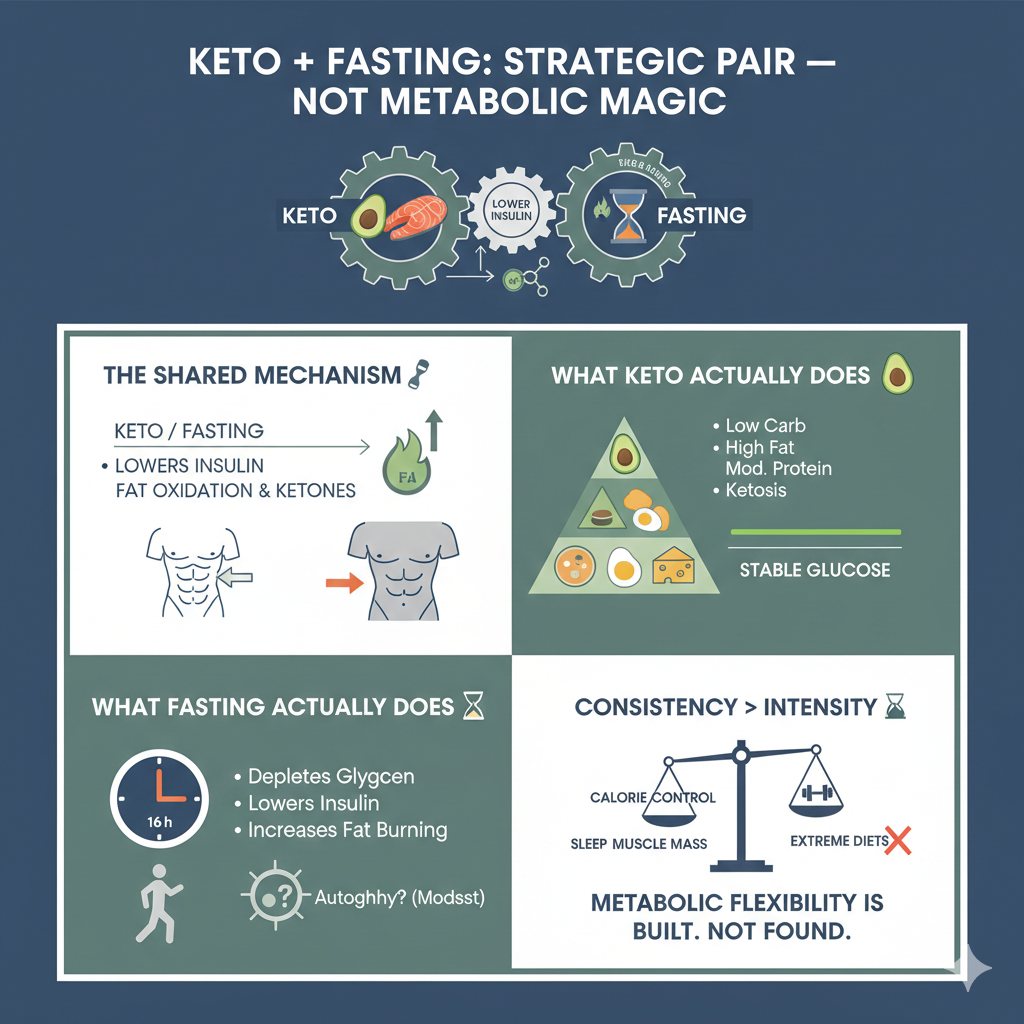
Both keto and fasting reduce circulating insulin.
When insulin decreases:
• Fat oxidation increases
• Glycogen stores decline
• Ketone production rises
• Hunger often stabilizes
That’s the core physiology.
Lower insulin allows access to stored energy.
That’s metabolic flexibility — not magic.
What Keto Actually Does 🥑
A well-formulated ketogenic diet:
• Significantly restricts carbohydrates
• Increases fat intake
• Keeps protein moderate
• Produces nutritional ketosis (0.5–3.0 mmol/L BHB)
Common outcomes:
• Reduced glucose variability
• Lower average insulin levels
• Improved triglycerides
• Appetite reduction for many
But insulin does not drop dramatically in everyone.
Response depends on:
• Baseline insulin resistance
• Body fat level
• Calorie intake
• Activity
• Sleep
Keto shifts fuel preference.
It does not override biology.
What Fasting Actually Does ⏳
Fasting (time-restricted eating or longer fasts):
• Depletes glycogen
• Temporarily lowers insulin
• Increases fat burning
• Raises ketones during fasting window
Autophagy?
Likely increases with prolonged fasting.
However:
• Most strong data are from animal studies
• Human evidence is still limited
• 14–16 hour fasts likely produce modest effects
“Autophagy” is supercharged by adding fasting periods to this cellular recycling process.
Do They Work Better Together? ⚖️
Combining keto + time-restricted eating may:
• Deepen ketosis faster
• Reduce hunger during fasting
• Improve adherence
• Stabilize glucose in insulin-resistant adults
But most benefits come from:
• Insulin control
• Reduced refined carbohydrates
• Consistent eating windows
• Increased fat oxidation
Not metabolic supercharging.
Consistency > intensity.
Diabetes Context
Type 2 Diabetes
Evidence supports:
• Low-carb diets improving HbA1c
• Weight loss improving insulin sensitivity
• Time-restricted eating helping individuals
But:
• Medication adjustments are often required
• Aggressive fasting can cause hypoglycemia (especially with insulin or sulfonylureas)
Supervision matters.
Type 1 Diabetes
Caution is essential.
• Nutritional ketosis ≠ ketoacidosis
• Risk increases with illness or insulin mismanagement
• Extended fasting merits meticulous insulin dosing
This approach is appropriate for children as well.
Medical oversight is mandatory.
Ramadan-Style 16:8 🕌
Structured fasting aligned with iftar–suhoor can:
• Reduce late-night snacking
• Improve routine
• Simplify eating structure
But:
• Very high-carb + fat meals may delay glucose spikes
• Hydration and electrolytes become critical
• Insulin timing requires attention
Structure helps. Excess does not.
When Fat Loss Plateaus 📉
Plateaus are rarely solved by fasting longer.
Common causes:
• Reduced daily movement
• Hidden carb creep
• Sleep disruption
• Chronic stress
Resistance training often improves long-term metabolic rate more reliably than extending fast duration.
Muscle is metabolic insurance.
Women & Fasting ⚠️
Some women may experience:
• Cycle irregularity
• Sleep disturbance
• Elevated stress hormones
Especially with prolonged fasting + very low carbs.
Shorter fasting windows (12–14 hours) are often better tolerated.
Hormonal stability matters more than discipline.
The HealO Takeaway
Keto can reduce hunger and stabilize glucose.
Fasting can simplify structure and improve adherence.
Together, they support metabolic improvement for persons with insulin resistance.
But:
• Results vary widely
Metabolic flexibility is built through:
• Muscle mass
• Adequate protein
• Sleep
• Stress regulation
• Consistent energy (carbs & fats) check
Not extremes.
References
- Longo VD, Panda S. “Fasting, circadian rhythms, and time-restricted feeding in healthy lifespan.” Cell Metab. 2016;23(6):1048-1059.
- Cahill GF Jr. “Fuel metabolism in starvation.” Annu Rev Nutr. 2006;26:1-22.
- Madeo F, Zimmermann A, Maiuri MC, Kroemer G. “Essential role for autophagy in life span extension.” J Clin Invest. 2015;125(1):85-93.
- Sumithran P, Prendergast LA, Delbridge E, et al. “Ketosis and appetite-mediating nutrients after weight loss.” Am J Clin Nutr. 2013;98(3):641-647.
- Alirezaei M, Kemball CC, Whitton JL. “Autophagy, inflammation and neurodegenerative disease.” Eur J Neurosci. 2011;33(2):197-204.
- Recent Post