Can a Low-Carb Diet Improve VO2 Max?
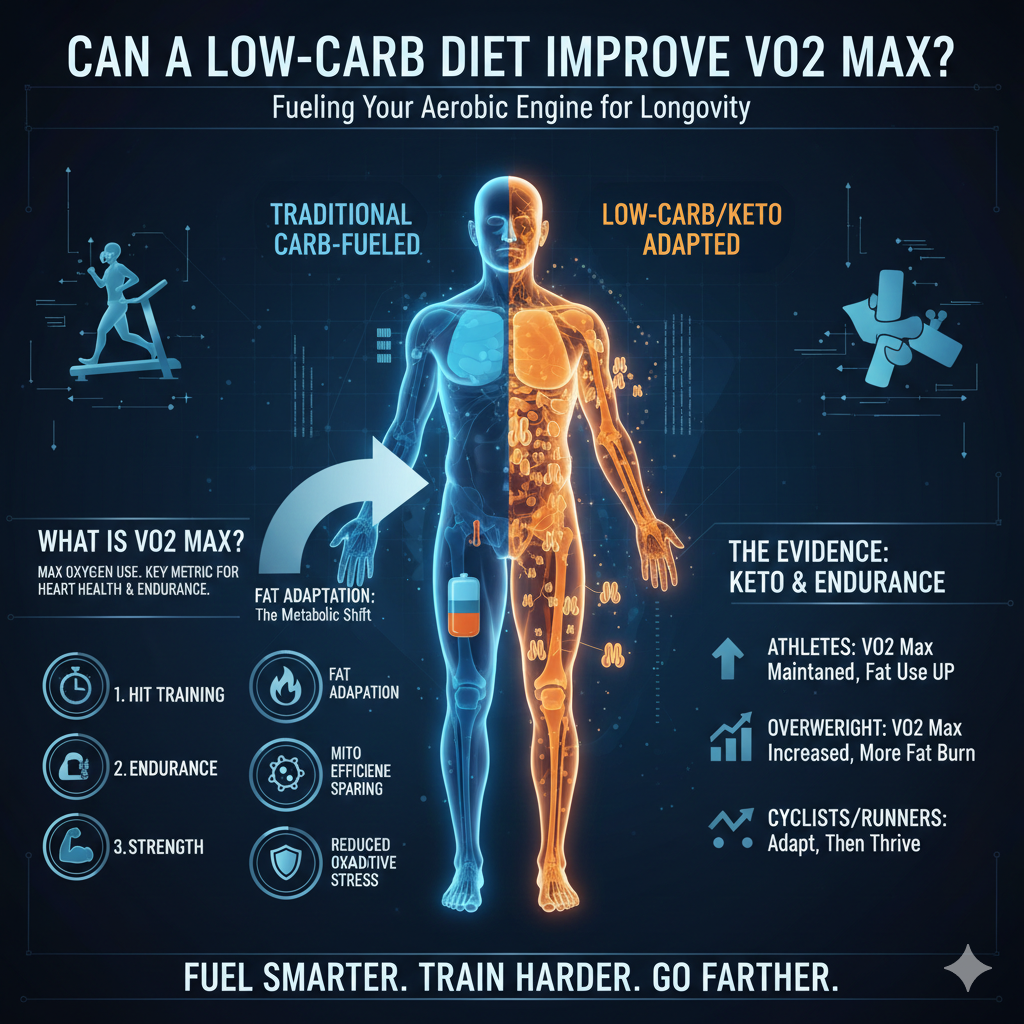
VO2 max is a cornerstone metric for cardiovascular fitness and aerobic endurance. It’s not just for athletes—this measure of your body’s oxygen delivery and utilization is closely linked to heart health, metabolic function, and even longevity. While high-intensity training and endurance exercise are standard for raising VO2 max, new research suggests that what you eat—specifically, adopting a low-carb diet—may also play a significant role.
What is VO2 Max and Why Does it Matter?
VO2 max is the maximum amount of oxygen your body can use during intense exercise, measured in milliliters per minute per kilogram of body weight (ml/kg/min).
Higher VO2 max = greater aerobic capacity and cardiovascular health
Lower VO2 max levels are associated with a higher risk of cardiovascular disease and even all-cause mortalityyoutube
VO2 max is modifiable—with training, nutrition, and even lifestyle adjustments
Best Strategies to Boost VO2 Max
1. High-Intensity Interval Training (HIIT):
Alternates sprints with recovery, pushing the heart and lungs to adapt faster.
HIIT boosts VO2 max significantly more than moderate, steady exercise (9.1% vs 5.6% increase in one large meta-analysis)
2. Continuous Endurance Training:
Works for beginners and seasoned exercisers; long runs, cycling, and swimming all build cardiovascular capacity
3. Strength Training:
Helps indirectly by improving muscle efficiency; combining strength and endurance yields even bigger gains
Can a Low-Carb Diet Improve VO2 Max?
The Evidence:
Traditionally, endurance athletes favored carb-loading. But low-carb (and specifically ketogenic) diets may offer unique metabolic adaptations that enhance aerobic performance and VO2 max.
Key Mechanisms:
Fat Adaptation:
On a low-carb diet, your body primarily uses fat—rather than glycogen—for energy. This “fat adaptation” helps delay fatigue by sparing glycogen stores for the highest-intensity portions of a workout.
Improved Mitochondrial Efficiency:
Research shows ketogenic diets boost mitochondrial function and density—leading to more efficient oxygen use during sustained workouts.
Glycogen Sparing:
Fat-adapted bodies become more strategic with their glycogen, saving it for moments of maximal effort.
Reduced Oxidative Stress:
Ketones (produced on a low-carb diet) have antioxidant effects and may reduce inflammation, which supports faster recovery and better endurance.
The Research: Low-Carb Diets and VO2 Max
Athletes on Keto:
In one study, endurance athletes who switched to a ketogenic diet maintained VO2 max but used significantly more fat for fuel, resulting in greater oxygen efficiency.
Overweight Individuals:
A six-week ketogenic diet led to increased VO2 max, improved fat oxidation, and greater endurance vs. a higher-carb diet.
Cyclists, Runners, Combat Athletes:
Studies are mixed—some show VO2 max staying steady while others report improved aerobic performance after adaptation. Short-term dips may occur, but after several weeks, performance levels usually return or exceed baseline.
Practical Takeaways
HIIT and Endurance Training remain top tools to boost VO2 max—don’t skip structured workouts.
A well-planned low-carb diet may further enhance aerobic capacity, especially if you engage in long-duration sports or want to rely less on rapid sugar fueling.
Expect a transition/adaptation phase:
The first 2–4 weeks on a low-carb diet can feel tougher as your body adjusts, but with patience, fat oxidation and oxygen efficiency may climb.
Caveats
Some athletes performing brief, all-out efforts may still prefer a higher-carb approach.
Individual responses vary—track your own progress and consider consulting a nutritionist or trainer.
The Bottom Line
Yes—a low-carb diet can support or, for some, even improve VO2 max and endurance. The secret lies in the diet’s ability to improve fat burning, mitochondrial efficiency, and metabolic flexibility. Paired with smart training, low-carb may help you go farther and feel better, both in competition and long-term health.
References:
- Blair, S. N., Kohl, H. W., & Paffenbarger, R. S. (1996). Physical fitness and all-cause mortality: A prospective study of healthy men and women. JAMA, 276(3), 205-210. doi:10.1001/jama.1996.03540030039029.
- Kokkinos, P., Myers, J. (2010). Exercise and physical activity: Clinical outcomes and applications. Circulation, 122(16), 1637–1648. doi:10.1161/CIRCULATIONAHA.110.948349.
- Milanović, Z., Sporiš, G., & Weston, M. (2015). Effectiveness of High-Intensity Interval Training (HIIT) and Continuous Endurance Training for VO2max Improvements: A Systematic Review and Meta-Analysis. Sports Medicine, 45(10), 1469-1481. doi:10.1007/s40279-015-0365-0.
- Ferketich, A. K., Kirby, T. E., & Alway, S. E. (1998). Cardiovascular and muscular adaptations to combined endurance and strength training in elderly women. Acta Physiologica Scandinavica, 164(3), 259–267. doi:10.1046/j.1365-201X.1998.00418.x.
- Phinney, S. D., & Volek, J. S. (2011). The art and science of low carbohydrate performance. Beyond Obesity LLC.
- Volek, J. S., & Phinney, S. D. (2012). Ketogenic diets and physical performance. Nutrition & Metabolism, 9(1), 1-17. doi:10.1186/1743-7075-9-1.
- Volek, J. S., et al. (2015). Influence of a low-carbohydrate diet on markers of endurance performance and blood lipids. Journal of the American College of Nutrition, 34(4), 311-324. doi:10.1080/07315724.2014.976847.
- Zajac, A., Poprzecki, S., Maszczyk, A., Czuba, M., Michalczyk, M., & Zydek, G. (2014). The effects of a ketogenic diet on exercise metabolism and physical performance in off-road cyclists. Journal of Sports Science & Medicine, 13(2), 381–389.
- Rhyu, H. S., & Cho, S. Y. (2014). The effect of weight loss by ketogenic diet on the body composition, performance-related physical fitness factors, and cytokines of Taekwondo athletes. Journal of Exercise Rehabilitation, 10(5), 326–331.