Melatonin—the “sleep hormone” produced by your pineal gland—does more than help you drift off. It regulates your circadian rhythm, fights inflammation, and acts as a powerful antioxidant. Levels peak at night and drop by morning, but factors like age, blue light, and stress disrupt this cycle. Here’s how melatonin links sleep to metabolic health, plus smart ways to optimize it.
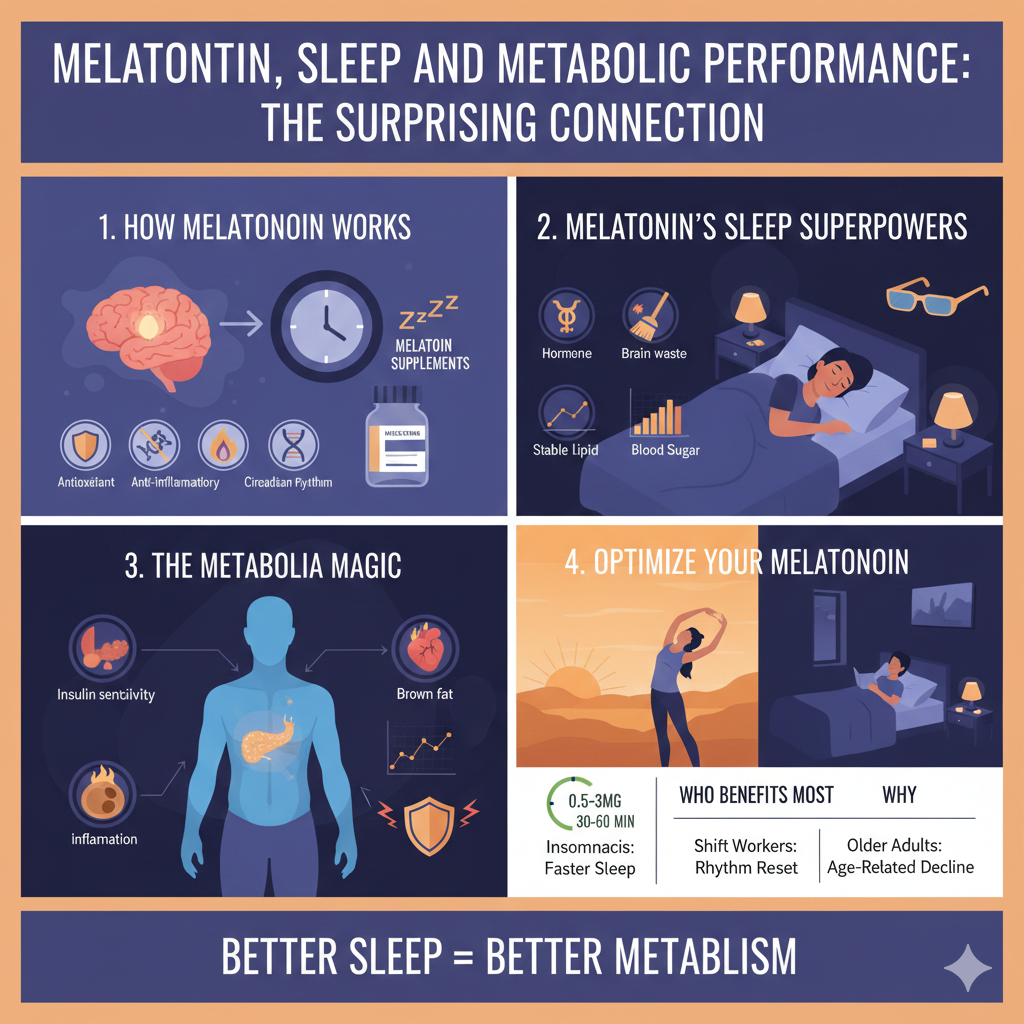
How Melatonin Works
Your body synthesizes melatonin from tryptophan through serotonin. Supplements mimic this process, available as tablets, capsules, or liquids. Discovered in the 1950s (via frog skin lightening experiments!), it’s now studied for sleep, aging, and disease prevention.
Melatonin’s Sleep Superpowers
Quality sleep is metabolic gold—restores hormones, clears brain waste, and stabilizes blood sugar. Melatonin shines here:
Improves sleep onset and duration for insomniacs or shift workers
Counters age-related decline (levels drop sharply after 40)
Reduces daytime fatigue in older adults
Blue light from screens suppresses natural production—block it with glasses 2 hours before bed for better results.
The Metabolic Magic
Poor sleep wrecks metabolism: spikes insulin resistance, hunger hormones, and fat storage. Melatonin steps in:
Boosts insulin sensitivity: Lowers fasting glucose and improves cell response
Regulates lipids: Cuts triglycerides and cholesterol
Activates brown fat: Triggers calorie-burning BAT for thermogenesis
Fights inflammation: Shields against oxidative stress tied to diabetes/heart disease
Studies show supplementing helps metabolic syndrome patients, hinting at broader benefits.
Dosage, Safety, and Tips
Start low: 0.5–3mg, 30–60 minutes before bed
Timing matters: Evening only—don’t take daytime
Side effects: Rare (headache, dizziness); avoid with blood thinners
Natural boosts: Morning sun, evening dim lights, no screens
| Who Benefits Most | Why |
|---|
| Insomniacs | Faster sleep onset |
| Shift workers | Rhythm reset |
| Metabolic issues | Insulin/glucose control |
| Older adults | Age-related decline |
Bottom Line
Melatonin bridges sleep and metabolism—poor sleep tanks performance; quality rest (aided by melatonin) unlocks fat burning, stable blood sugar, and vitality. Prioritize natural production first, supplement wisely. Better sleep = better metabolism.
References
Melatonin to treat sleep disorders, insomnia and jet lag:
- Rondanelli M, Opizzi A, Monteferrario F, Antoniello N, Manni R, Klersy C. The effect of melatonin, magnesium, and zinc on primary insomnia in long-term care facility residents in Italy: a double-blind, placebo-controlled clinical trial. J Am Geriatr Soc. 2011;59(1):82–90. doi:10.1111/j.1532-5415.2010.03232.x -> https://www.ncbi.nlm.nih.gov/pubmed/21226679
- Cardinali DP, Srinivasan V, Brzezinski A, et al. Melatonin and its analogs in insomnia and depression. J Pineal Res. 2012;52(4):365–375. doi:10.1111/j.1600-079X.2012.00979.x -> https://www.ncbi.nlm.nih.gov/pubmed/22449079
- Ferracioli-Oda E, Qawasmi A, Bloch MH. Meta-analysis: melatonin for the treatment of primary sleep disorders. PLoS One. 2013;8(5):e63773. doi:10.1371/journal.pone.0063773 -> https://www.ncbi.nlm.nih.gov/pubmed/23691095
- Buscemi N, Vandermeer B, Pandya R, et al. Melatonin for treatment of sleep disorders. Evid Rep Technol Assess (Summ). 2004;(108):1–7. PMID: 15574200. -> https://www.ncbi.nlm.nih.gov/books/NBK11942/
Circadian Rhythm Regulation:
- Stothard ER, McHill AW, Depner CM, Birks BR, Moehlman TM, Ritchie HK, Guzzetti JR, Chinoy ED, LeBourgeois MK, Axelsson J. Circadian Entrainment to the Natural Light-Dark Cycle across Seasons and the Weekend. Curr Biol. 2017 Jun 19;27(12):1762-1768.e3. doi: 10.1016/j.cub.2017.05.018. Epub 2017 Jun 1. PMID: 28578928; PMCID: PMC5484187 -> https://www.ncbi.nlm.nih.gov/pmc/articles/PMC5335920/
- James SM, Honn KA, Gaddameedhi S, Van Dongen HPA. Shift Work: Disrupted Circadian Rhythms and Sleep-Implications for Health and Well-Being. Curr Sleep Med Rep. 2017 Jun;3(2):104-112. doi: 10.1007/s40675-017-0071-6. Epub 2017 Apr 27. PMID: 29057204; PMCID: PMC5647832. https://www.ncbi.nlm.nih.gov/pmc/articles/PMC5647832/
Improves sleep quality and decreases oxidative stress in elderly people with insomnia
- Lemoine P, Nir T, Laudon M, et al. Prolonged-release melatonin improves sleep quality and morning alertness in insomnia patients aged 55 years and older and has no withdrawal effects. J Sleep Res. 2007;16(4):372–380. doi:10.1111/j.1365-2869.2007.00613.x -> https://onlinelibrary.wiley.com/doi/full/10.1111/j.1365-2869.2007.00613.x
Reducing daytime fatigue and assisting with sleep in elderly individuals
- Abad VC, Guilleminault C. Insomnia in Elderly Patients: Recommendations for Pharmacological Management. Drugs Aging. 2018 Sep;35(9):791-817. doi: 10.1007/s40266-018-0569-8. PMID: 30058034. https://pubmed.ncbi.nlm.nih.gov/30058034/
- Pierce M, Linnebur SA, Pearson SM, Fixen DR. Optimal Melatonin Dose in Older Adults: A Clinical Review of the Literature. Sr Care Pharm. 2019 Jul 1;34(7):419-431. doi: 10.4140/TCP.n.2019.419. PMID: 31383052. https://pubmed.ncbi.nlm.nih.gov/31383052/
Blocking blue light 2 hours before bed time
- Shechter A, Kim EW, St-Onge MP, Westwood AJ. Blocking nocturnal blue light for insomnia: A randomized controlled trial. J Psychiatr Res. 2018 Jan;96:196-202. doi: 10.1016/j.jpsychires.2017.10.015. Epub 2017 Oct 21. PMID: 29101797; PMCID: PMC5703049. https://www.ncbi.nlm.nih.gov/pmc/articles/PMC5703049/
Melatonin can improve insulin sensitivity, reduce fasting blood glucose levels, and lower lipid levels in people with metabolic disorders
- Garaulet M, Qian J, Florez JC, Arendt J, Saxena R, Scheer FAJL. Melatonin Effects on Glucose Metabolism: Time To Unlock the Controversy. Trends Endocrinol Metab. 2020 Mar;31(3):192-204. doi: 10.1016/j.tem.2019.11.011. Epub 2020 Jan 1. PMID: 31901302; PMCID: PMC7349733. https://www.ncbi.nlm.nih.gov/pmc/articles/PMC7349733/
Melatonin can regulate the activity of brown adipose fatty tissue
- Xu Z, You W, Liu J, Wang Y, Shan T. Elucidating the Regulatory Role of Melatonin in Brown, White, and Beige Adipocytes. Adv Nutr. 2020 Mar 1;11(2):447-460. doi: 10.1093/advances/nmz070. PMID: 31355852; PMCID: PMC7442421. https://www.ncbi.nlm.nih.gov/pmc/articles/PMC7442421/


6 Responses