
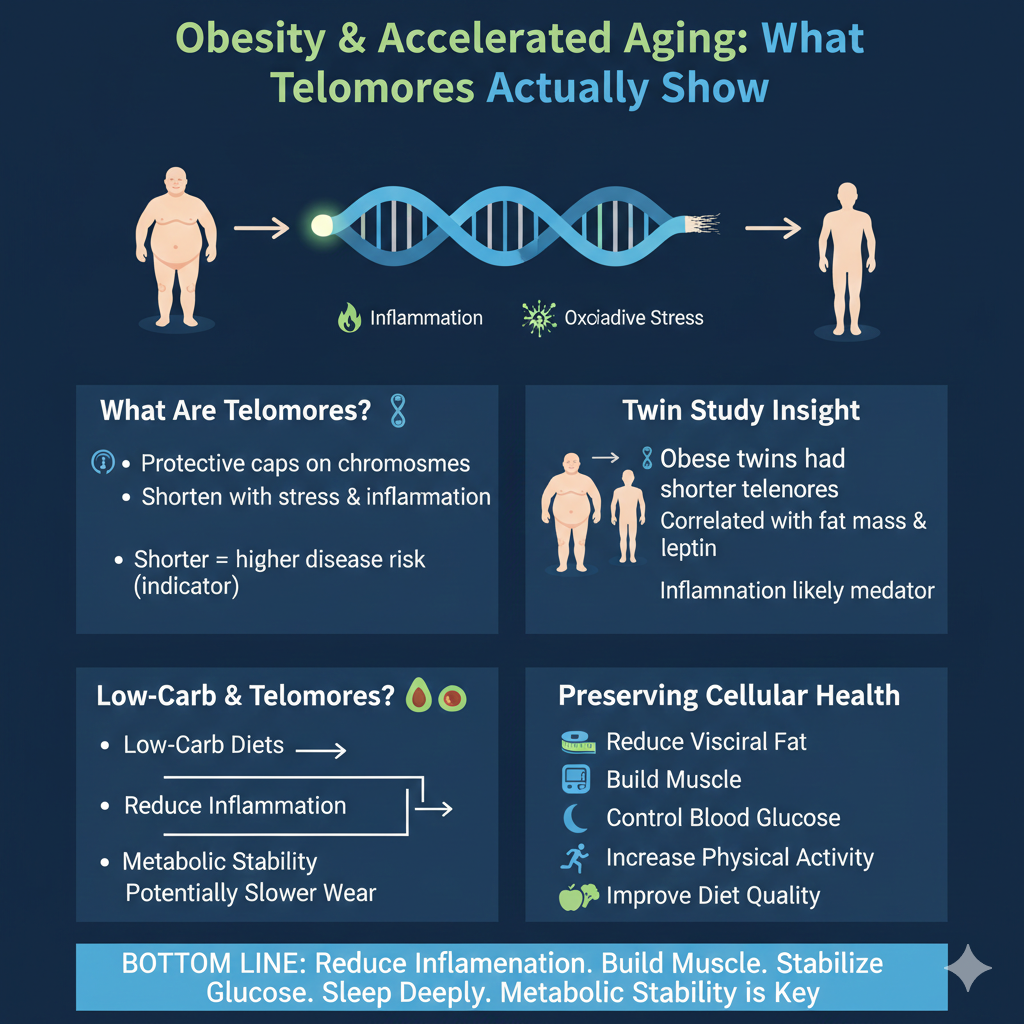
Obesity does not just affect weight.
It is associated with markers of accelerated biological aging.
One of those markers: telomere length.
But let’s separate signal from exaggeration.
What Are Telomeres? 🧬
Telomeres are protective caps at the ends of chromosomes.
They:
• Shorten with cell division
• Shorten with oxidative stress
• Shorten with chronic inflammation
Shorter telomeres are associated with:
• Higher cardiometabolic disease risk
• Increased mortality
• Greater biological aging markers
They are indicators — not destiny.
The Twin Study Insight
A well-known twin study published in The Lancet compared lean and obese twins.
Key findings:
• Obese twins had shorter telomeres than their lean siblings
• Telomere shortening correlated with fat mass and leptin levels
• Inflammation and oxidative stress were likely mediators
Estimated biological age differences were modest but measurable.
Important:
This shows association — not guaranteed lifespan subtraction.
Leptin, Fat Mass & Inflammation
Leptin rises with increased fat mass.
Chronically elevated leptin is linked to:
• Systemic inflammation
• Oxidative stress
• Insulin resistance
These factors may accelerate telomere shortening.
The driver is not body weight alone.
It is chronic metabolic stress.
Smoking vs Obesity Comparisons 🚬
Some studies estimate:
• Smoking accelerates telomere shortening
• Obesity shows similar magnitude associations
But these “years lost” estimates are statistical modeling — not direct clocks.
They illustrate risk intensity, not guaranteed timelines.
Childhood Obesity & Aging
Research suggests:
• Higher BMI in childhood is associated with shorter telomeres
• Early metabolic dysfunction may compound lifetime risk
However:
Growth, nutrition, environment, and genetics all interact.
No single factor determines aging speed.
Pakistan Context
In regions with high rates of:
• Obesity
• Type 2 diabetes
• Sedentary lifestyle
• Ultra-processed carbohydrate intake
Chronic inflammation and insulin resistance become common.
These are the true biological accelerators.
Not just body fat — but metabolic instability.
Does Low-Carb Protect Telomeres? 🥑
Here’s where precision matters.
Low-carb diets can:
• Reduce insulin levels
• Lower triglycerides
• Reduce visceral fat
• Improve inflammatory markers
• Improve glucose variability
Fat loss itself reduces inflammatory burden.
Reduced inflammation may support healthier cellular aging.
But:
There is no strong human evidence proving ketogenic diets directly “extend telomeres.”
The protective mechanism is indirect:
Metabolic stability → lower inflammation → potentially slower biological wear.
What Actually Preserves Cellular Health
Evidence-supported levers:
• Reduce visceral fat
• Build muscle mass
• Control blood glucose
• Improve sleep quality
• Stop smoking
• Increase physical activity
• Improve diet quality
Low-carb can be one effective strategy — especially for insulin-resistant adults.
It is not the only one.
Type 1 & Telomere Stress
For families managing type 1 diabetes:
• Chronic hyperglycemia increases oxidative stress
• Glucose variability increases inflammatory burden
Stable glucose control likely reduces cellular stress load.
That is protective.
But diet adjustments must remain medically supervised.
The HealO Takeaway
Obesity is associated with accelerated biological aging.
The likely mechanism:
Chronic inflammation + oxidative stress + insulin resistance.
Low-carb approaches can:
• Reduce visceral fat
• Improve metabolic markers
• Lower inflammatory burden
That may reduce aging pressure.
But telomeres are influenced by:
• Stress
• Sleep
• Smoking
• Environment
• Genetics
• Activity
• Diet quality overall
The goal is not fear.
The goal is metabolic stability.
Reduce inflammation.
Build muscle.
Stabilize glucose.
Sleep deeply.
That is how you slow biological wear — sustainably.
References
- http://www.thelancet.com/journals/lancet/article/PIIS0140673605666305/abstract
- Recent Post