Tame the Hormonal Storm
1 in 5–10 women of reproductive age live with PCOS—acne, fatigue, irregular cycles, belly fat, infertility, hirsutism, mood dips.
This isn’t a “cyst problem.” It’s metabolic + stress driven.
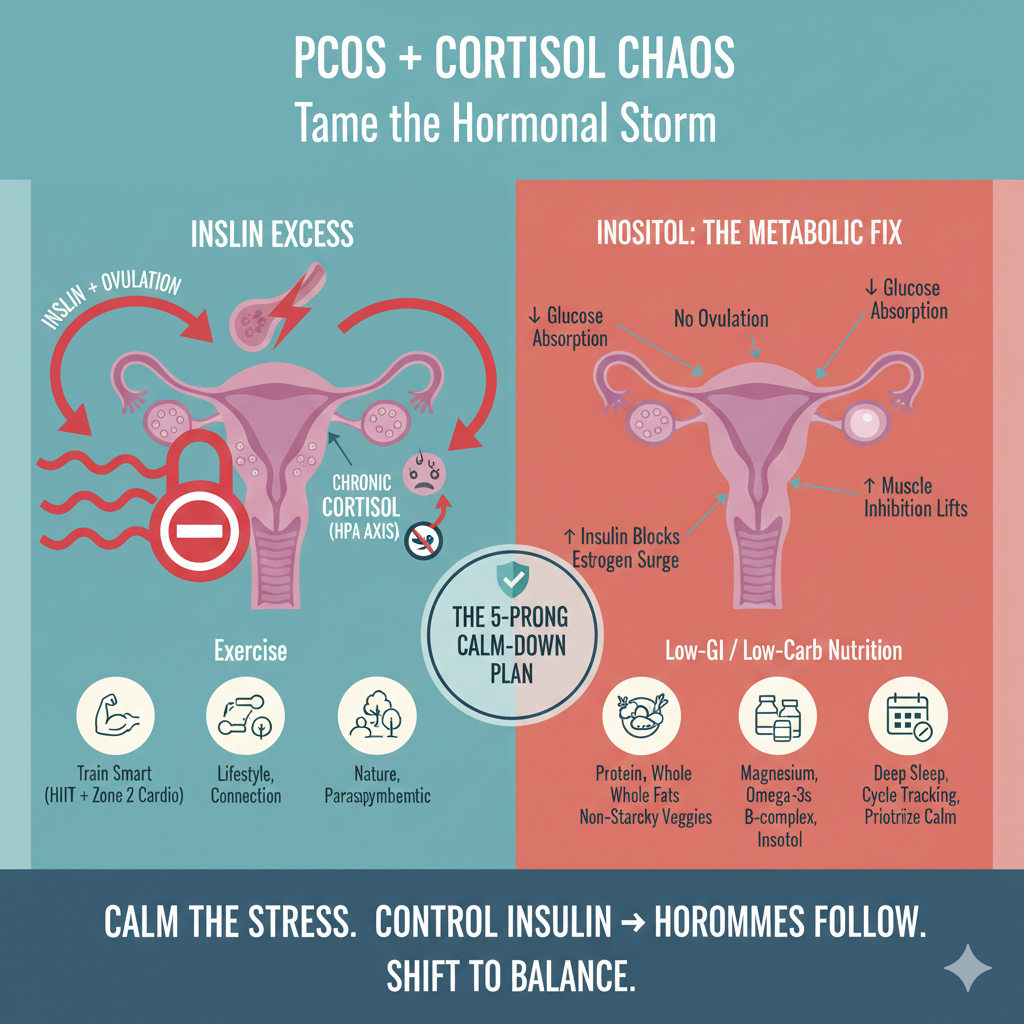
The Core Loop (Why PCOS Spirals)
Insulin excess → blocks aromatase
↓
Testosterone can’t convert to estrogen
↓
No estrogen surge → no ovulation
↓
Follicles stall → cysts
Now add stress:
Chronic cortisol (HPA axis) → adrenal DHEA + androgens ↑
↓
More acne, hair growth, cycle disruption
↓
Inflammation + insulin resistance worsen
↓
Even more cortisol
That’s the chaos loop.
Cortisol’s Hidden Role in PCOS
Chronic stress keeps cortisol elevated
Cortisol pushes adrenal androgen production
Androgens worsen insulin resistance
Insulin resistance feeds cortisol again
PCOS is part metabolic, part stress physiology.
The 5-Prong Calm-Down Plan
1. Exercise: Train Smart, Not Fragile
PCOS does not need “only gentle” movement—it needs strategic stress.
Resistance + HIIT (2–3×/week)
↓ androgens, ↑ insulin sensitivity
Zone 2 cardio (most days)
Easy, conversational pace → fat burn without cortisol spikes
2. Lifestyle & Mindset (Underrated Medicine)
Social connection + nature → oxytocin ↓ cortisol
Progress over perfection
PCOS traits = “thriver genes” (efficient fuel storage, stress resilience)
Parasympathetic activators
Slow breathing, humming, mindful eating, massage, prayer/meditation, creative hobbies
3. Low-GI / Low-Carb Nutrition (The Baseline Fix)
Non-starchy vegetables
Adequate protein (eggs, fish, meat, legumes if tolerated)
Whole fats (olive oil, ghee, butter, nuts, seeds)
Results seen in studies:
✔ Improved cycles & ovulation
✔ Reduced acne & hair growth
✔ Better insulin sensitivity
Low-carb doesn’t just help PCOS—it makes cortisol easier to control.
4. Targeted Supplements (Evidence-Backed)
| Supplement | Why It Helps PCOS |
|---|
| Magnesium (320–500 mg) | Calms HPA axis, improves sleep & anxiety |
| Omega-3s (EPA/DHA) | Lowers inflammation, improves lipids |
| Ashwagandha | Regulates cortisol, improves stress tolerance |
| Activated B-complex (methylfolate, P5P, B12) | ↓ homocysteine, insulin resistance, androgens |
| Inositol (2–4 g) | Improves insulin signaling, restores ovulation |
(Always individualize and clear with a doctor.)
5. Sleep + Stress Stack (Non-Negotiable)
Deep, regular sleep = HPA axis reset
Track cycles, energy, cravings, mood—not just weight
If symptoms worsen, stress is too high → pull back
The Low-Carb Bonus
Lower insulin = less cortisol demand
Less cortisol = fewer androgens
Fewer androgens = cycles can restart
Everything works faster when insulin is handled first.
Final Reframe
PCOS doesn’t mean you’re broken.
It’s a modern mismatch—ancient biology in a high-stress, high-insulin world.
Shift from sympathetic overdrive → parasympathetic balance
And the system remembers how to work again.
Calm the stress. Control insulin.
Hormones follow.
References
- https://pubmed.ncbi.nlm.nih.gov/36291122/
- https://pubmed.ncbi.nlm.nih.gov/20943790/
- https://www.mdpi.com/2411-5142/5/2/35
- https://www.nature.com/articles/s44184-022-00015-6
- https://pmc.ncbi.nlm.nih.gov/articles/PMC8254750/
- https://pubmed.ncbi.nlm.nih.gov/31001682/
- https://pmc.ncbi.nlm.nih.gov/articles/PMC8001092/
- https://www.sciencedirect.com/science/article/abs/pii/S1472648310611844
- https://rep.bioscientifica.com/view/journals/rep/169/4/REP-25-0021.xml
- https://pmc.ncbi.nlm.nih.gov/articles/PMC8835454/
- https://www.cdc.gov/diabetes/diabetes-complications/diabetes-immune-system.html
- https://pmc.ncbi.nlm.nih.gov/articles/PMC5334212/
- https://pubmed.ncbi.nlm.nih.gov/34790167/
- https://www.mdpi.com/1420-3049/24/8/1508
- https://www.sciencedirect.com/science/article/pii/S0002916523018841?via%3Dihub
- https://pmc.ncbi.nlm.nih.gov/articles/PMC3198864/
- https://www.mdpi.com/2072-6643/12/12/3672
- https://pmc.ncbi.nlm.nih.gov/articles/PMC9798963/
- https://www.mdpi.com/2072-6643/16/17/2961
- https://pubmed.ncbi.nlm.nih.gov/29580250/
- https://www.mdpi.com/2072-6643/16/17/2961
- https://pmc.ncbi.nlm.nih.gov/articles/PMC10671406/
- https://www.sciencedirect.com/science/article/pii/S2161831322000163
- https://pmc.ncbi.nlm.nih.gov/articles/PMC7682539/
- https://pmc.ncbi.nlm.nih.gov/articles/PMC5067314/
- https://pubmed.ncbi.nlm.nih.gov/23336594/

2 Responses