Reclaim Your 40s
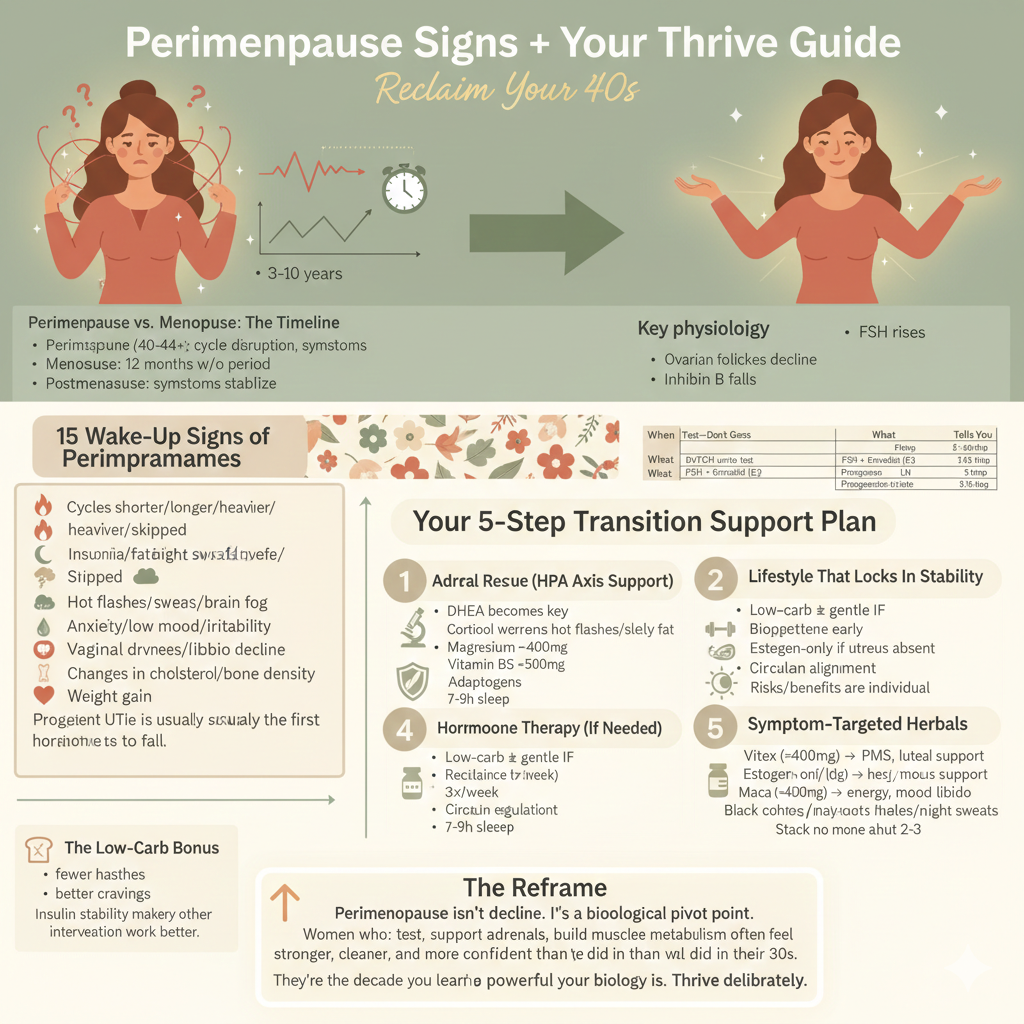
Your 40s are a milestone decade—and for most women, the start of perimenopause.
Every woman transitions. It lasts 3–10 years. And it’s not a disease.
What’s happening is a natural estrogen rollercoaster paired with an early, steady drop in progesterone. Chaos isn’t inevitable—but ignoring biology makes it feel that way.
Perimenopause vs. Menopause: The Timeline
Perimenopause (often ages 40–44+): hormone volatility, cycle disruption, symptoms begin
Menopause: a single point in time—12 consecutive months without a period
Postmenopause: the year after; symptoms may persist or stabilize
Key physiology
Menopause ends fertility.
Perimenopause is the transition—and where most symptoms live.
15 Wake-Up Signs of Perimenopause
Cycles that are shorter, longer, heavier, lighter—or skipped
Hot flashes and night sweats
Insomnia, fatigue, brain fog
Anxiety, low mood, irritability
Vaginal dryness, libido decline
Weight gain (especially with rising insulin resistance)
Headaches and joint pain
Recurrent UTIs
Changes in cholesterol or bone density
Progesterone is usually the first hormone to fall.
Its loss removes protection against inflammation, cardiovascular disease, neurodegeneration, and estrogen overdrive.
Your 5-Step Transition Support Plan
1. Test—Don’t Guess
| Test | When | What It Tells You |
|---|
| DUTCH urine test | Any time | Sex hormones + adrenal metabolites |
| FSH + Estradiol (E2) | Cycle day 3 | Ovarian reserve & ovulatory signaling |
| LH | Cycle day 3 | Cycle regulation |
| Progesterone | Day 21 (or 7 days post-ovulation) | Luteal phase sufficiency |
Symptoms without data lead to confusion. Testing brings clarity.
2. Adrenal Rescue (HPA Axis Support)
As ovarian estrogen declines, adrenals take on more hormonal responsibility.
DHEA becomes a key estrogen precursor post-menopause
Cortisol dysregulation worsens hot flashes, sleep, and belly fat
Support stack:
You can’t out-supplement a fried nervous system.
3. Lifestyle That Locks In Stability
Low-carb ± gentle IF
→ stabilizes insulin → reduces estrogen swings & hot flashes
Resistance training (3×/week)
→ protects bone, muscle, metabolism, confidence
Circadian alignment
→ morning sunlight, dark nights, optional cold exposure
Stress regulation
→ breathwork, humming, vagus-nerve stimulation
This is where symptoms often improve before meds.
4. Hormone Therapy (If Needed)
HRT isn’t failure—it’s a tool.
Bioidentical progesterone early is often better tolerated than synthetic progestins
Estrogen-only therapy is appropriate only if the uterus is absent
Risks and benefits are individual—not one-size-fits-all
Informed choice > fear or avoidance.
5. Symptom-Targeted Herbals
Used strategically, not casually.
Vitex (~400 mg) → prolactin balance, PMS, luteal support
Maca (~2 g) → energy, mood, libido
Black cohosh (~40 mg) → hot flashes, night sweats
Stack no more than 2–3. Track for 6–8 weeks.
The Low-Carb Bonus
Stable blood sugar =
fewer hot flashes
fewer cravings
better sleep
calmer mood
Insulin stability makes every other intervention work better.
The Reframe
Perimenopause isn’t decline.
It’s a biological pivot point.
Women who:
test instead of guessing
support adrenals
build muscle
stabilize metabolism
often feel stronger, clearer, and more confident than they did in their 30s.
Your 40s aren’t the beginning of the end.
They’re the decade you learn how powerful your biology really is.
Thrive deliberately.
References
- https://www.menopause.org/for-women/menopause-glossary#P
- https://www.mountsinai.org/health-library/report/menopause
- https://www.sciencedirect.com/science/article/pii/S0378512214003004
- https://journals.lww.com/grh/fulltext/2018/06000/the_etiology_of_menopause__not_just_ovarian.1.aspx
- https://www.imsociety.org/wp-content/uploads/2020/08/statement-2001-07-23.pdf
- https://www.imsociety.org/wp-content/uploads/2020/08/statement-2001-07-23.pdf
- https://www.ncbi.nlm.nih.gov/pmc/articles/PMC8997425/
- https://www.ncbi.nlm.nih.gov/books/NBK558960/
- https://www.ncbi.nlm.nih.gov/books/NBK558960/
- https://www.ncbi.nlm.nih.gov/books/NBK558960/
- https://www.sciencedirect.com/science/article/abs/pii/S0039128X13000202
- https://www.yourhormones.info/hormones/dehydroepiandrosterone/
- https://www.ncbi.nlm.nih.gov/pmc/articles/PMC4513660/
- https://journals.lww.com/menopausejournal/fulltext/2020/11000/perimenopausal_vasomotor_symptoms_and_the_cortisol.18.aspx

2 Responses