Heal the Root, Not Just the Symptoms
95% of women experience period pain.
20–30% suffer pain severe enough to disrupt work, school, and life.
Common? Yes.
Normal? No.
Pain is a message: inflammation, hormone imbalance, or nutrient depletion—often all three.
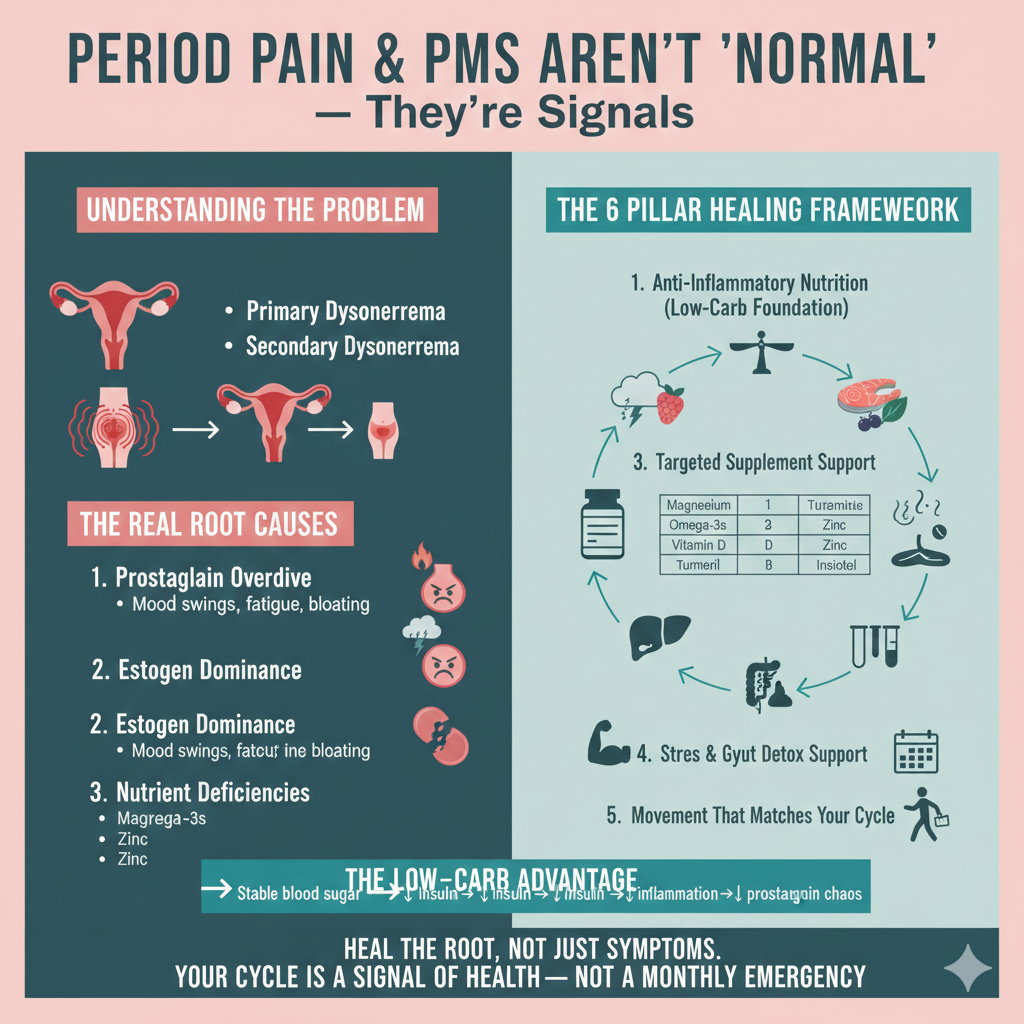
Understanding the Problem
Dysmenorrhea Types
Primary: Crampy pain without disease (prostaglandin excess)
Secondary: Pain from conditions like endometriosis, fibroids, adenomyosis, IBD (often later onset, worsening over time)
PMS Reality
Over 75% of women experience PMS:
Mood swings, fatigue, bloating, breast tenderness, headaches, cravings.
These are biochemical imbalances, not personality flaws.
The Real Root Causes
1. Prostaglandin Overdrive (Luteal Phase)
Prostaglandins trigger uterine contractions to shed the lining.
Too much →
Chronic inflammation keeps this loop active every cycle.
2. Estrogen Dominance
When estrogen outweighs progesterone:
Progesterone is the natural anti-inflammatory.
Low progesterone = louder cramps.
3. Nutrient Deficiencies
Modern diets + stress drain the very nutrients that control inflammation and muscle relaxation:
Magnesium
Omega-3s
Zinc
B vitamins
Vitamin D
Calcium
Iodine
Deficiency = amplified pain signals.
The 6-Pillar Healing Framework
1. Anti-Inflammatory Nutrition (Low-Carb Foundation)
Lower glucose = lower inflammation = fewer prostaglandins.
Prioritize
Wild salmon, sardines, chia, flax, walnuts (omega-3s)
Colorful above-ground vegetables, fiber, herbs
Quality protein (fatty cuts), eggs + healthy fats, full fat dairy, butter, ghee, EVOO, coconut oil
Remove
Refined sugar
Ultra-processed foods
Seed oils
2. Targeted Supplement Support (Test First)
| Nutrient | Benefit |
|---|
| Magnesium | Relaxes uterine muscle, reduces cramps & migraines |
| Omega-3s | Lowers prostaglandins & PMS severity |
| Vitamin D | Hormone modulation & immune balance |
| B-complex | Neurotransmitters & estrogen metabolism |
| Zinc | Ovarian signaling & inflammation control |
| Calcium | Muscle contraction regulation |
| Turmeric / Cramp Bark | Prostaglandin suppression |
| DIM | Supports estrogen detox |
3. Stress → Cycle Alignment
Chronic stress = high cortisol.
Cortisol steals progesterone.
Daily non-negotiables (10–15 min):
Calm is hormonal medicine.
4. Liver & Gut Detox Support
If estrogen isn’t exiting, it’s recirculating.
Support clearance with:
Garlic, onions, berries, leafy greens
Quality protein + Healthy fats and hydration (electrolytes)
Regular bowel movements
Track symptoms across your cycle—patterns reveal causes.
5. Luteal Phase Testing
Test day 21–23 (or 7 days post-ovulation):
Estradiol (E2)
Progesterone
Low progesterone is one of the most missed causes of pain and PMS.
6. Movement That Matches Your Cycle
Follicular phase: Strength training, higher intensity
Luteal phase: Walking, yoga, mobility, recovery
Training with—not against—your hormones reduces pain.
The Low-Carb Advantage
Stable blood sugar →
↓ insulin
↓ inflammation
↓ prostaglandin chaos
This is why dietary change often brings rapid cycle relief.
Final Truth
Painful periods and PMS are not rites of passage.
They are correctable signals.
When you:
Reduce inflammation
Balance estrogen and progesterone
Replete nutrients
Support liver, gut, and stress physiology
Relief isn’t luck—it’s biology responding to the right inputs.
Test. Track. Nourish. Calm. Heal.
Your cycle is meant to be a signal of health—not a monthly emergency.
References
- https://bmcwomenshealth.biomedcentral.com/articles/10.1186/s12905-021-01532-w
- https://www.ncbi.nlm.nih.gov/books/NBK560834/
- https://www.acog.org/womens-health/faqs/dysmenorrhea-painful-periods
- https://pmc.ncbi.nlm.nih.gov/articles/PMC7045079/
- https://www.ncbi.nlm.nih.gov/books/NBK560698/
- https://www.ncbi.nlm.nih.gov/books/NBK560698/
- https://link.springer.com/article/10.1007/s00737-022-01261-5
- https://www.sciencedirect.com/science/article/abs/pii/S0165614712000302
- https://pmc.ncbi.nlm.nih.gov/articles/PMC10178419/
- https://pmc.ncbi.nlm.nih.gov/articles/PMC7068519/
- https://pmc.ncbi.nlm.nih.gov/articles/PMC5311461/
- https://www.sciencedirect.com/science/article/abs/pii/S1130862119303158
- https://pubmed.ncbi.nlm.nih.gov/23642943/
- https://pubmed.ncbi.nlm.nih.gov/35266254/
- https://pmc.ncbi.nlm.nih.gov/articles/PMC6835660/
- https://www.sciencedirect.com/science/article/abs/pii/S0946672X14001503
- https://www.sciencedirect.com/science/article/abs/pii/S1084952120301713
- https://pmc.ncbi.nlm.nih.gov/articles/PMC6943485/
- https://pmc.ncbi.nlm.nih.gov/articles/PMC4070857/
- https://pmc.ncbi.nlm.nih.gov/articles/PMC11013220/
- https://pmc.ncbi.nlm.nih.gov/articles/PMC9928757/
- https://pubmed.ncbi.nlm.nih.gov/28392498/
- https://pmc.ncbi.nlm.nih.gov/articles/PMC5476783/
- https://pmc.ncbi.nlm.nih.gov/articles/PMC10973707/
- https://pmc.ncbi.nlm.nih.gov/articles/PMC3048776/
- https://pmc.ncbi.nlm.nih.gov/articles/PMC7614476/
- https://www.asrm.org/practice-guidance/practice-committee-documents/diagnosis-and-treatment-of-luteal-phase-deciency-a-committee-opinion-2021/
- https://www.ncbi.nlm.nih.gov/books/NBK560698/

2 Responses