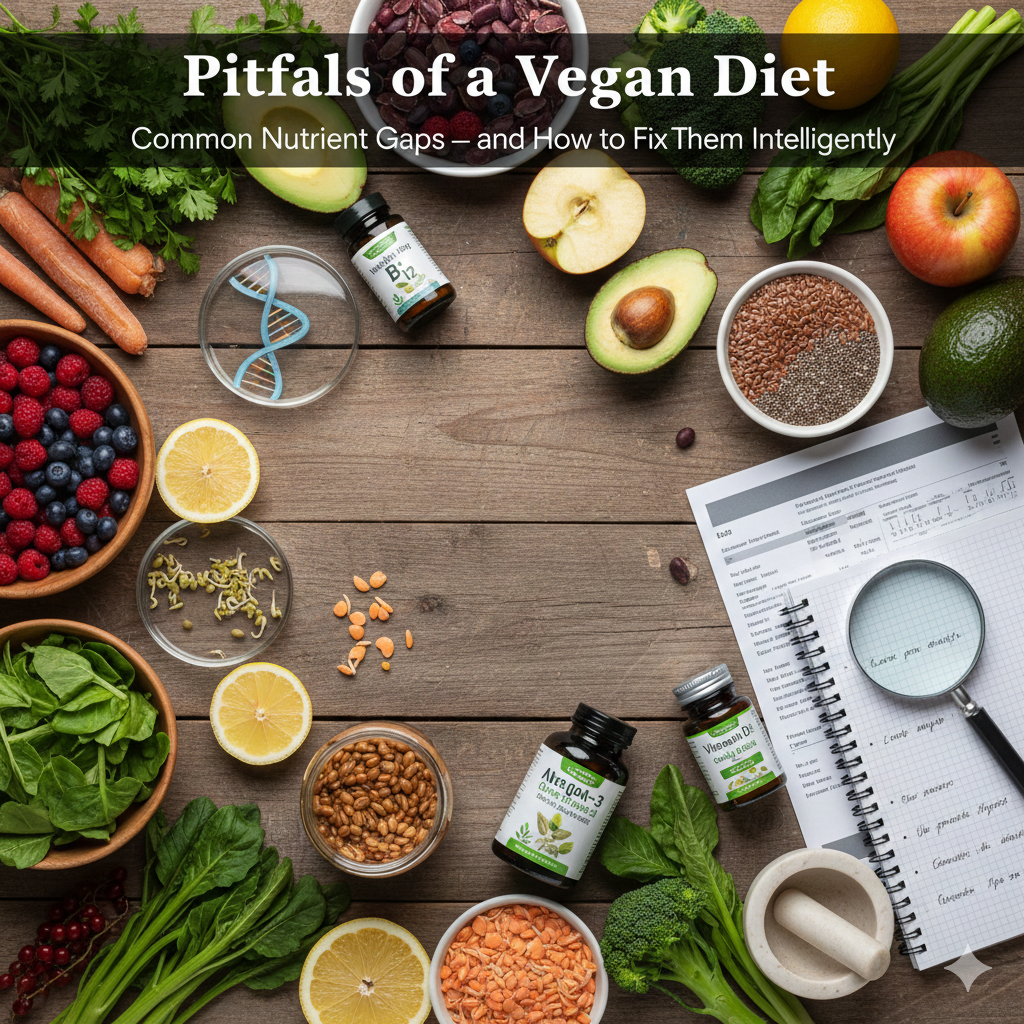
Common Nutrient Gaps — and How to Fix Them Intelligently
I adopted a vegan diet during childhood as a family trend who believed that eating vegetables is best healthcare. On paper, it made sense: fewer animals harmed, lower emissions, cleaner eating.
And initially, it was an upgrade from processed food.
But over time, subtle symptoms crept in—low energy, brain fog, skin flare-ups, digestive issues. After nearly a decade and functional medicine testing, it became clear: veganism wasn’t inherently “bad,” but it wasn’t optimal for my biology.
Genetics (MTHFR), gut health, and nutrient bioavailability all played a role.
This isn’t an argument against veganism. Some people thrive long-term. But nutrition is not one-size-fits-all. Below is a science-based look at common vegan diet pitfalls—and practical ways to address them if you eat plant-forward.
Early Warning Signs I Missed (and What They Taught Me)
1️⃣ Digestive Function Declined
A high intake of grains and legumes with low dietary fat contributed to:
Digestion requires fat, minerals, and adequate stomach acid—often underestimated in vegan diets.
2️⃣ Detox Capacity Slowed
Functional labs revealed an MTHFR variant, increasing my need for:
Vitamin B12
Choline
Bioavailable folate
These nutrients are limited or absent in plants, especially in absorbable forms.
3️⃣ Skin and Vision Suffered
I relied heavily on beta-carotene, assuming it converted efficiently to vitamin A.
In reality, conversion to retinol averages ~3%, and less in some individuals.
4️⃣ Brain Fog and Fatigue
Omega-3 intake came mostly from ALA (flax, chia). Conversion to DHA/EPA is typically 5–10%, often lower under stress or inflammation.
5️⃣ Immune Resilience Dropped
Low intake of vitamin K2, zinc, and anti-inflammatory fats affected recovery and inflammation control.
Eventually, in my college days I transitioned to a plant-strong, low-carb, nutrient-dense hybrid approach (often called “ketotarian”; by the way, I further transitioned to animal based carnivore diet in 2019)—plants as a base, with selective animal foods. Energy, skin, and cognition improved markedly.
As Dr. Terry Wahls (formerly vegetarian) puts it:
“Humans eat from nature—we are part of the cycle.”
Common Vegan Diet Pitfalls (and Evidence-Based Fixes)
1️⃣ Excess Carbohydrates & Blood Sugar Swings
Issue: Replacing animal protein with grains and legumes often leads to high glycemic load.
Modern humans have consumed refined starches for only ~10,000 years—metabolically recent.
Effects:
Fixes:
Prioritize protein, healthy fats, non-starchy vegetables and berries
Time complex carbohydrates around physical activity
Balance meals with fermented salads and fermented dairy
2️⃣ Gluten & Grain Sensitivities
Issue: Millions have non-celiac gluten sensitivity with neurological and systemic symptoms—not just gut complaints.
Fixes:
3️⃣ Anti-Nutrients (Lectins, Phytates, Saponins)
Issue: These compounds can reduce mineral absorption and irritate the gut lining.
Fixes:
Soak, sprout, or ferment legumes
Pressure-cook beans and lentils
Rotate foods instead of daily repetition
4️⃣ Key Nutrient Deficiencies to Watch
| Nutrient | Why It’s a Challenge on Vegan Diets | Practical Fix |
|---|
| Vitamin B12 | Only in animal foods | Methylcobalamin supplement |
| DHA/EPA | Poor ALA conversion | Algae-based omega-3 |
| Vitamin A (retinol) | Low beta-carotene conversion | Zinc support; consider flex sources |
| Vitamin D | Limited plant sources | Vegan D3 + sun exposure |
| Iron | Non-heme iron poorly absorbed | Pair with vitamin C; monitor ferritin |
| Zinc | Blocked by phytates | Seeds + acidic foods |
| Vitamin K2 | Rare in plants | Natto or MK-7 supplement |
Clinical note: Always assess storage markers (e.g., ferritin, omega-3 index), not just serum levels.
A Smarter “Plant-Strong” Framework (HealO Approach)
For those who want the benefits of plants without metabolic compromise:
Base (daily):
Leafy greens, cruciferous vegetables
Avocados, olive oil, coconut
Low-glycemic fruits (berries)
Optional flex additions (if tolerated):
Wild fish (1–2×/week)
Eggs
Limit or rotate:
Foundational supplements (context-dependent):
B12
Vitamin D3
Omega-3 (algae or fish)
Magnesium
Track progress with labs, not ideology.
Final HealO Perspective
A vegan diet can reduce processed food intake and improve awareness—but nutrient bioavailability, absorption, and individual genetics matter.
Some people thrive long-term with careful supplementation. Others function better with selective animal nutrients.
The goal isn’t a label.
It’s metabolic health, resilience, and long-term vitality.
Test. Observe. Adjust.
And allow your nutrition to evolve as your body gives feedback.
References
- Moriya Masayuki, et al. “Vitamin K2 ameliorates experimental autoimmune encephalomyelitis in Lewis rats” Journal Of Neuroimmunology VOLUME 170, ISSUE 1-2, P11-20, DECEMBER 30, 2005 doi:https://doi.org/10.1016/j.jneuroim.2005.08.001
- Loren Cordain, S Boyd Eaton, Anthony Sebastian, Neil Mann, Staffan Lindeberg, Bruce A Watkins, James H O’Keefe, Janette Brand-Miller, Origins and evolution of the Western diet: health implications for the 21st century, The American Journal of Clinical Nutrition, Volume 81, Issue 2, February 2005, Pages 341–354, https://doi.org/10.1093/ajcn.81.2.341
- Di Sabatino, Antonio et al. “Small Amounts of Gluten in Subjects With Suspected Nonceliac Gluten Sensitivity: A Randomized, Double-Blind, Placebo-Controlled, Cross-Over Trial.” Clinical gastroenterology and hepatology : the official clinical practice journal of the American Gastroenterological Association vol. 13,9 (2015): 1604-12.e3. doi:10.1016/j.cgh.2015.01.029
- Elli, Luca et al. “Evidence for the Presence of Non-Celiac Gluten Sensitivity in Patients with Functional Gastrointestinal Symptoms: Results from a Multicenter Randomized Double-Blind Placebo-Controlled Gluten Challenge.” Nutrients vol. 8,2 84. 8 Feb. 2016, doi:10.3390/nu8020084
- Cuatrecasas, P, and G P Tell. “Insulin-like activity of concanavalin A and wheat germ agglutinin–direct interactions with insulin receptors.” Proceedings of the National Academy of Sciences of the United States of America vol. 70,2 (1973): 485-9. doi:10.1073/pnas.70.2.485
- Jönsson, T., Olsson, S., Ahrén, B. et al. Agrarian diet and diseases of affluence – Do evolutionary novel dietary lectins cause leptin resistance?. BMC Endocr Disord 5, 10 (2005). https://doi.org/10.1186/1472-6823-5-10
- J. L. Greger, Nondigestible Carbohydrates and Mineral Bioavailability, The Journal of Nutrition, Volume 129, Issue 7, July 1999, Pages 1434S–1435S, https://doi.org/10.1093/jn/129.7.1434S
- Fish Oil Mayo Clinic October 24 2017. https://www.mayoclinic.org/drugs-supplements-fish-oil/art-20364810
- Davis, Brenda C, and Penny M Kris-Etherton. “Achieving optimal essential fatty acid status in vegetarians: current knowledge and practical implications.” The American journal of clinical nutrition vol. 78,3 Suppl (2003): 640S-646S. doi:10.1093/ajcn/78.3.640S
- J. A. Tur*, M. M. Bibiloni, A. Sureda and A. Pons “Dietary sources of omega 3 fatty acids: public health risks and benefits” British Journal of Nutrition (2012), 107, S23–S52
- Magdalena S Rosell, Zouë Lloyd-Wright, Paul N Appleby, Thomas AB Sanders, Naomi E Allen, Timothy J Key, Long-chain n–3 polyunsaturated fatty acids in plasma in British meat-eating, vegetarian, and vegan men, The American Journal of Clinical Nutrition, Volume 82, Issue 2, August 2005, Pages 327–334, https://doi.org/10.1093/ajcn/82.2.327
- Craig, Winston John. “Nutrition concerns and health effects of vegetarian diets.” Nutrition in clinical practice : official publication of the American Society for Parenteral and Enteral Nutrition vol. 25,6 (2010): 613-20. doi:10.1177/0884533610385707
- Hedrén, E et al. “Estimation of carotenoid accessibility from carrots determined by an in vitro digestion method.” European journal of clinical nutrition vol. 56,5 (2002): 425-30. doi:10.1038/sj.ejcn.1601329
- Watanabe, Fumio et al. “Vitamin B₁₂-containing plant food sources for vegetarians.” Nutrients vol. 6,5 1861-73. 5 May. 2014, doi:10.3390/nu6051861
- Herrmann, Wolfgang et al. “Vitamin B-12 status, particularly holotranscobalamin II and methylmalonic acid concentrations, and hyperhomocysteinemia in vegetarians.” The American journal of clinical nutrition vol. 78,1 (2003): 131-6. doi:10.1093/ajcn/78.1.131
- Keen, C L, and M E Gershwin. “Zinc deficiency and immune function.” Annual review of nutrition vol. 10 (1990): 415-31. doi:10.1146/annurev.nu.10.070190.002215
- Simmer, K, and R P Thompson. “Zinc in the fetus and newborn.” Acta paediatrica Scandinavica. Supplement vol. 319 (1985): 158-63. doi:10.1111/j.1651-2227.1985.tb10126.x
- Janet R Hunt, Bioavailability of iron, zinc, and other trace minerals from vegetarian diets, The American Journal of Clinical Nutrition, Volume 78, Issue 3, September 2003, Pages 633S–639S, https://doi.org/10.1093/ajcn/78.3.633S

2 Responses