
Personalized nutrition designed for your unique health goals.
Lessons from The Stress Prescription
Chronic stress quietly drains health, mood, metabolism, and longevity. But the goal isn’t to eliminate stress—that’s neither realistic nor healthy. The real win is learning how to work with stress, not against it.
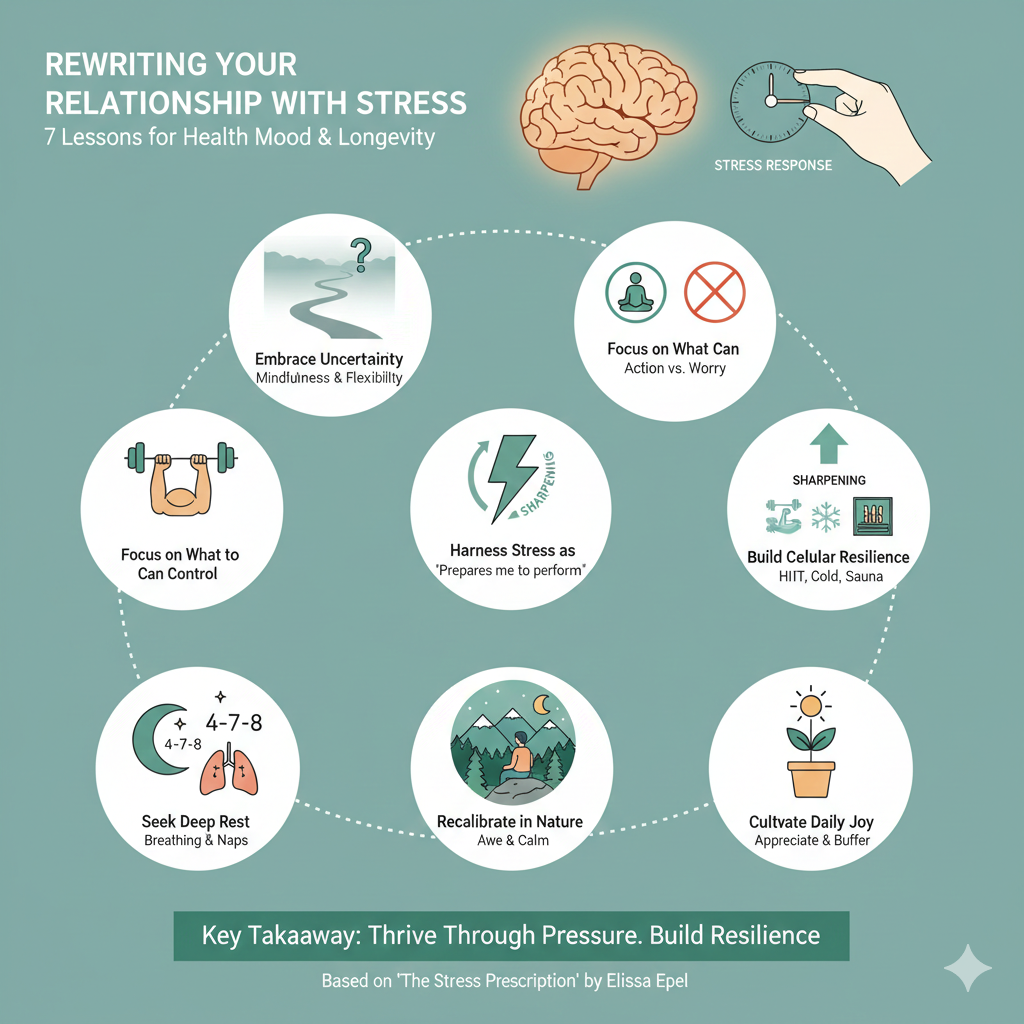
Here are seven evidence-based practices that reshape how stress affects your body, brain, and aging—down to the cellular level.
1. Embrace Uncertainty Instead of Fighting It
Rigid expectations create anxiety. Life is unpredictable; resisting that truth keeps cortisol elevated.
What helps:
Loosen mental rules about how things “should” go
Practice mindfulness to stay anchored in the present
Interrupt worst-case mental loops before they spiral
Letting go of certainty builds trust, adaptability, and emotional flexibility.
2. Focus on What You Can Control
Stress explodes when energy is wasted on what’s outside your influence—other people’s reactions, global events, or past decisions.
Shift your focus to:
Self-care choices
Rest and boundaries
Dropping non-essential tasks
Self-compassion in hard moments
This distinction dramatically reduces rumination, especially during crises like illness or caregiving.
3. Harness Stress as Energy, Not a Threat
Stress isn’t always harmful—your interpretation determines the physiological response.
Reframing stress as energizing rather than damaging:
Lowers fear hormones
Improves focus and confidence
Increases persistence after setbacks
Try reframes like:
👉 “This stress is sharpening me.”
👉 “My body is preparing me to perform.”
Studies show this mindset shift reduces negative emotions and improves outcomes.
4. Build Cellular Resilience With Controlled Stress
Your cells become stronger when exposed to brief, tolerable stress followed by recovery—a concept called hormesis.
Effective options:
| Practice | Benefit | How |
|---|---|---|
| HIIT | Mitochondrial strength | 20s sprint + 40s rest × 8 |
| Cold exposure | Mood & inflammation | 2–3 min end of shower |
| Sauna | Heat-shock proteins | 15 min, 3× weekly |
Always scale to your health status and get medical clearance if needed.
5. Recalibrate in Nature
Natural environments restore mental bandwidth drained by screens and noise.
Benefits include:
Lower stress hormones
Improved attention
Feelings of awe and perspective
No park nearby? Even looking at the night sky or nature videos can trigger similar calming effects.
6. Seek Deep Rest (Not Just Distraction)
Scrolling or binge-watching isn’t true recovery.
Deep rest means:
Naps
Quiet retreats
Intentional breathing practices
Try 4-7-8 breathing:
Inhale 4 seconds
Hold 7 seconds
Exhale 8 seconds
This activates the parasympathetic nervous system—the body’s true “reset” mode.
7. Cultivate Daily Joy (Without Forcing Positivity)
Joy isn’t ignoring stress—it’s buffering against it.
Simple practices:
Morning question: “What am I looking forward to today?”
Evening reflection: 1–2 things you appreciated
Joy builds meaning, perspective, and emotional flexibility—key ingredients for long-term resilience.
The Big Picture
Stress isn’t the enemy. Unmanaged stress is.
These research based practices—on stress, telomeres, and aging—compound over time, improving:
Longevity
Metabolic health
Emotional resilience
You don’t need to do all seven.
Start with one today.
Thriving isn’t about avoiding pressure—it’s about learning to grow stronger through it.
- Recent Post