
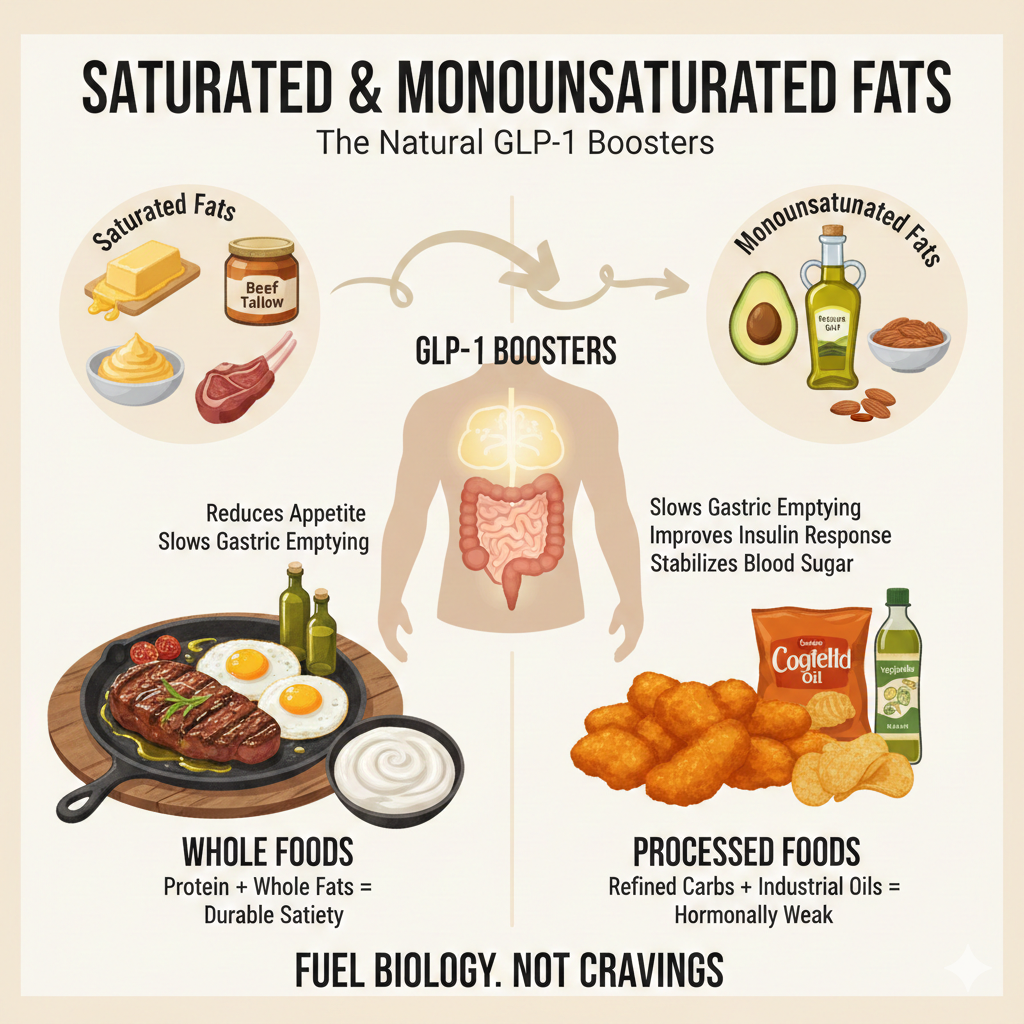
GLP-1 medications like Ozempic® and Wegovy® have exploded in popularity.
Why?
Because GLP-1 works.
It:
Reduces appetite
Slows gastric emptying
Improves insulin response
Stabilizes blood sugar
But here’s what rarely gets discussed:
Your body already makes GLP-1.
And certain whole-food fats stimulate it naturally.
No injections required.
Understanding GLP-1
Glucagon-like peptide-1 (GLP-1) is a hormone released from L-cells in the small intestine after eating.
Its job is metabolic regulation:
Signals fullness to the brain
Slows stomach emptying
Enhances insulin secretion (when glucose is present)
Reduces glucagon output
Improves post-meal glucose control
Pharmaceutical GLP-1 agonists amplify this system.
But food composition determines how much you release on your own.
Not All Fats Signal Satiety Equally
Saturated Fats
Found in:
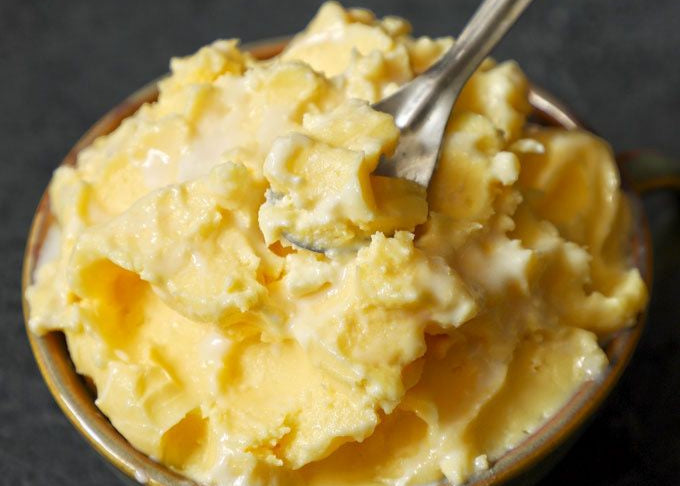
Butter
Ghee
Beef tallow
Lamb fat
Whole-fat dairy
These fats robustly stimulate gut hormone signaling, including GLP-1 and PYY, particularly when combined with protein.
Monounsaturated Fats
Found in:
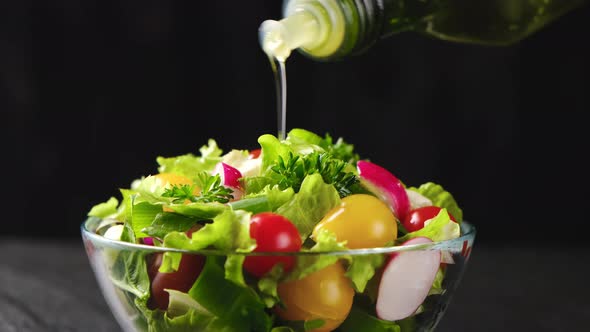
Extra virgin olive oil
Avocado
Certain nuts
Monounsaturated fats are consistently associated with:
Improved insulin sensitivity
Better postprandial glucose control
Increased satiety signaling
Polyunsaturated Seed Oils
Found in:
Soybean oil
Corn oil
Sunflower oil
Canola oil
While not “fatally toxic,” these highly refined industrial oils oxidize easily when exposed to light, oxygen or heat that produces toxic aldehydes. Moreover, these are:
Easily overconsumed
Often paired with refined carbohydrates
Less consistently linked to strong satiety hormone responses
Satiety is not just about calories.
It’s about hormonal signaling.
Why This Matters for Appetite Control
When a meal triggers stronger GLP-1 release:
Gastric emptying slows
Blood sugar rises more gradually
Insulin response is better matched
Hunger returns later
When meals lack sufficient protein and rely heavily on refined carbs plus industrial oils:
Glucose spikes quickly
Insulin surges
Satiety fades sooner
Cravings increase
This is one reason ultra-processed foods are easier to overeat.
They’re calorie dense.
But hormonally weak.
The Fat + Protein Synergy
Fat alone isn’t magic.
The strongest GLP-1 responses occur when:
Protein + whole-food fats are consumed together.
Examples:
Eggs cooked in butter
Steak finished with olive oil
Salmon with avocado
Lamb with yogurt
Protein provides the amino acid trigger.
Fat amplifies hormonal signaling.
Fiber slows absorption.
Together, they create durable satiety.
What About Blood Sugar?
GLP-1 improves glucose regulation by:
Enhancing glucose-dependent insulin release
Suppressing inappropriate glucagon
Slowing carbohydrate absorption
In insulin-resistant individuals, meals richer in protein and monounsaturated fats often show:
Lower post-meal glucose excursions
Improved satiety
Reduced need for frequent snacking
This doesn’t replace medication when needed.
But it supports metabolic stability.
Practical Implementation
Instead of fearing fat, focus on quality and structure.
Prioritize:
Whole cuts of meat
Eggs
Full-fat fermented dairy
Extra virgin olive oil
Traditionally rendered animal fats
Reduce reliance on:
Deep-fried processed foods
Refined seed oils used in packaged snacks
Low-protein, high-carb meals
Cook simply.
Pair fats with protein.
Include non-starchy vegetables.
Let physiology work for you.
A Critical Clarification
This is not an argument to “eat unlimited saturated fat.”
It is a reminder that:
Natural fats in whole foods behave differently than industrial formulations
Satiety is hormonally mediated
Appetite control is biological, not purely willpower
GLP-1 drugs mimic a natural pathway.
Whole foods activate it.
The HealO Principle
Stop chasing calorie math.
Start respecting hormonal biology.
When meals contain:
Adequate protein
Intact natural fats
Minimal refined carbohydrates
Hunger becomes quieter.
Blood sugar becomes steadier.
Food decisions become easier.
Not because of restriction.
Because of regulation.
References
- https://www.ncbi.nlm.nih.gov/pmc/articles/PMC3213865/