
Personalized nutrition designed for your unique health goals.
In recent years, seed oils have become one of the most debated topics in nutrition.
You’ve likely heard claims that they:
Cause inflammation
Drive obesity
Increase heart disease
Damage mitochondria
Disrupt hormones
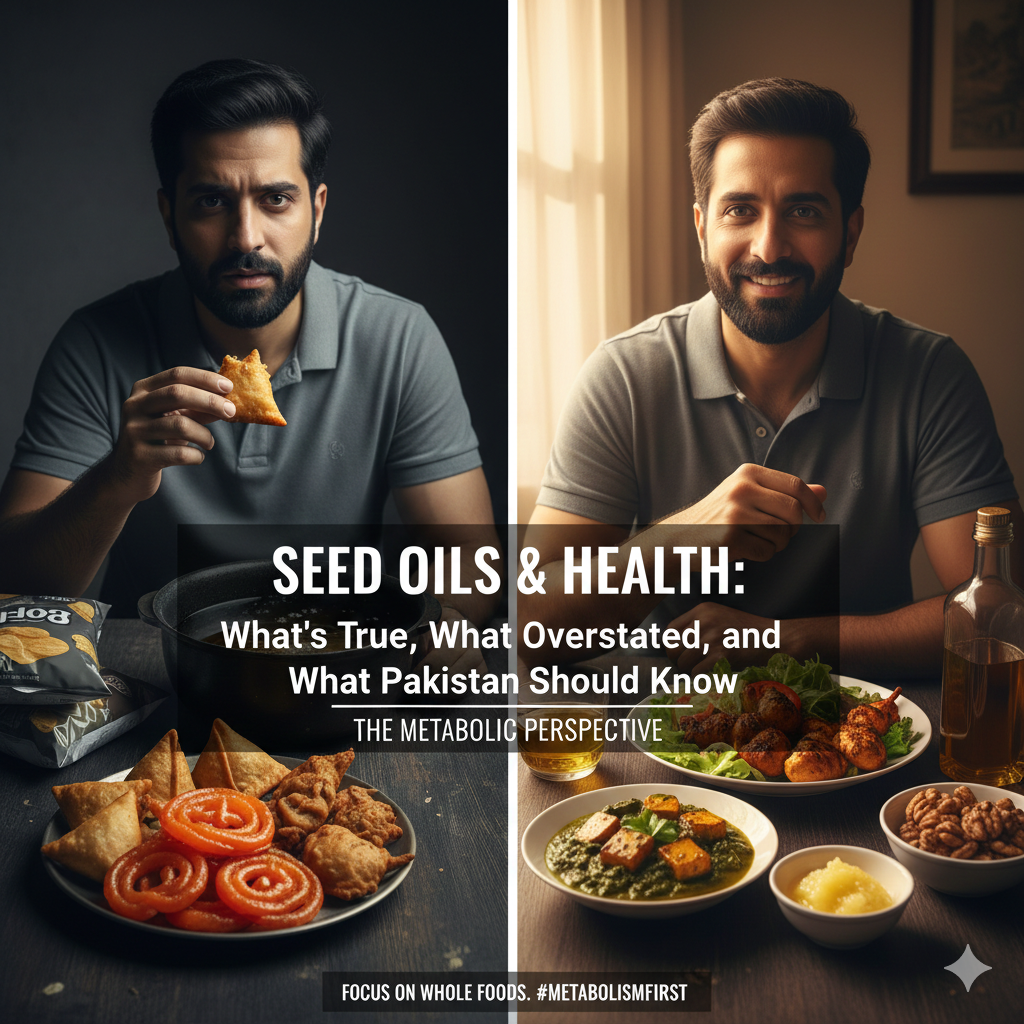
But what does evidence actually say — and what matters for Pakistani households?
Let’s break it down clearly.
What Are Seed Oils?
Common industrial seed oils include:
Canola oil
Soybean oil
Sunflower oil
Corn oil
Cottonseed oil
Safflower oil
Grapeseed oil
Rice bran oil
They are extracted using:
Mechanical pressing
Heat processing
Sometimes chemical solvents (like hexane, later removed)
They became popular in the 20th century as replacements for animal fats, especially during the “low saturated fat” era of dietary guidelines.
Today, they make up a large percentage of global cooking oils.
The Core Concern: Omega-6 Overload
Seed oils are high in linoleic acid, an omega-6 polyunsaturated fatty acid (PUFA).
Omega-6 is not inherently bad.
It is essential.
The issue is balance.
Historically:
Humans likely consumed omega-6 to omega-3 ratios closer to 1:1 to 4:1.
Today:
Many modern diets reach 15–20:1.
Excess omega-6 relative to omega-3 may:
Promote pro-inflammatory signaling (via arachidonic acid pathways)
Contribute to metabolic dysfunction in some contexts
However, inflammation is multifactorial.
Sugar, excess calories, obesity, smoking, sleep deprivation, and inactivity play much larger roles.
Oxidation & Heat Stability
Polyunsaturated fats (PUFAs) have multiple double bonds.
This makes them:
More prone to oxidation
Less stable at high frying temperatures
When repeatedly heated (e.g., deep frying pakoras or samosas in reused oil), they can form:
Lipid peroxides
Aldehydes
Oxidative byproducts
These compounds may contribute to oxidative stress if consumed frequently.
Important distinction:
Occasional home cooking is different from:
Reheated commercial frying oil
Street food oils used repeatedly at high temperatures
The latter is far more concerning.
What About Heart Disease?
Some older trials replacing saturated fat with vegetable oils showed mixed results.
However:
Modern large-scale meta-analyses generally show that replacing saturated fat with polyunsaturated fat lowers LDL cholesterol.
Lower LDL is not strongly associated with reduced cardiovascular risk.
- Triglycerides to HDL ratio is bigger predictor of CHD.
That said:
Lower LDL does not automatically equal improved metabolic health if Triglycerides to HDL ratio and overall diet quality is poor.
Context matters.
Do Seed Oils Cause Obesity?
Obesity has risen dramatically over the last century.
But this correlates more strongly with:
Ultra-processed food intake
Increased sugar consumption
Sedentary lifestyles
Higher calorie availability
Seed oils are calorie-dense — like all fats (9 kcal per gram).
Excess calories drive weight gain, regardless of source.
There is no strong human evidence that seed oils uniquely cause obesity independent of calorie excess.
Where Problems Likely Arise in Pakistan
The issue is not simply “seed oils.”
It’s:
Deep-fried street foods
Reheated oils
Ultra-processed snacks
High sugar + high refined flour + high oil combination
Low omega-3 intake
Chips, biscuits, packaged nimko, bakery items, and commercial frying contribute more risk than modest home cooking.
Comparing Cooking Fats (Practical Perspective)
| Fat | Heat Stability | Omega-6 Load | Best Use |
|---|---|---|---|
| Ghee | High | Low | High-heat cooking |
| Tallow | High | Low | Frying, curries |
| Coconut Oil | High | Very low | Curries |
| Olive Oil (extra virgin) | Medium | Moderate | Low-medium heat, drizzling |
| Sunflower/Canola | Medium | High | Moderate use, avoid repeated reheating |
A Balanced Pakistani Approach
Instead of fear-based elimination, consider:
1. Stop Reheating Oil
Never reuse deep-frying oil multiple times.
2. Reduce Deep Frying
Pakoras, samosas, chips → occasional, not daily.
3. Rotate Fats
Use:
Ghee for high heat
Olive oil for finishing
Moderate seed oils if needed, not excessive
4. Increase Omega-3 Intake
Add:
Fatty fish (if accessible)
- Eggs
- Butter, ghee
Walnuts
Flaxseed (ground)
5. Focus on Bigger Problems First
Cut:
Sugar
Refined flour
Ultra-processed snacks
These drive far more metabolic damage.
Are Animal Fats Automatically Superior?
Animal fats like ghee and tallow are:
More heat-stable
Lower in polyunsaturated fats
But they are still calorie-dense.
Overconsumption can raise LDL in some individuals, however, Triglycerides to HDL ratio improves as more HDL is formed.
Moderation and total dietary pattern matter more than demonizing one fat source.
The HealO™ Position
Seed oils are not poison but not recommended either.
But:
Excessive omega-6 without omega-3 balance may contribute to inflammation.
Reheated industrial frying oils are problematic.
Ultra-processed food patterns are the bigger threat.
Health is rarely about one ingredient.
It’s about:
Total metabolic load
Blood sugar control
Body fat levels
Sleep
Movement
Stress
Start Here
In your kitchen:
Reduce packaged snacks.
Avoid reheated frying oil.
Cook more whole foods.
Use stable fats for high heat.
Balance omega-6 with omega-3.
Small corrections > extreme ideology.
Your metabolism responds to patterns — not internet headlines.
- Recent Post