
Personalized nutrition designed for your unique health goals.
If your goal is:
Better blood sugar control
Lower insulin levels
Fat loss
Diabetes management
Reduced cravings
Then potatoes may not fit easily into your plan.
But let’s approach this intelligently — not emotionally.
Why Potatoes Raise Blood Sugar Quickly
Potatoes are primarily starch.
Starch = long chains of glucose.
When digested, it rapidly breaks down into glucose, raising blood sugar — especially in insulin-resistant individuals.
A medium potato contains roughly:
25–30g net carbohydrates
That equals about 5–7 teaspoons of glucose equivalent entering circulation.
Your bloodstream normally holds about one teaspoon of glucose at any time.
So the pancreas must release insulin quickly to manage the surge.
For metabolically healthy individuals, this is manageable.
For those with:
Type 2 diabetes
Prediabetes
Fatty liver
PCOS
Central obesity
Repeated spikes may worsen insulin resistance over time.
Glycemic Index & Context
Potatoes are high on the glycemic index (GI), especially when:
Mashed
Baked
Fried
Eaten alone
However:
Cooling and reheating potatoes increases resistant starch.
Eating them with protein and fat slows glucose rise.
Portion size matters greatly.
Resistant starch supports gut bacteria — but it does not eliminate the carbohydrate load.
For insulin-resistant South Asians, even moderate portions can cause significant spikes.
Pakistan Context
Pakistan has among the highest rates of type 2 diabetes in the region.
Common dishes include:
Aloo sabzi
Aloo in biryani
Aloo paratha
Mixed sabzi heavy in potatoes
If someone already consumes:
Roti or rice
Plus potatoes
Plus sugary chai
The cumulative carb load becomes excessive.
Reducing potatoes may help stabilize glucose without increasing medications.
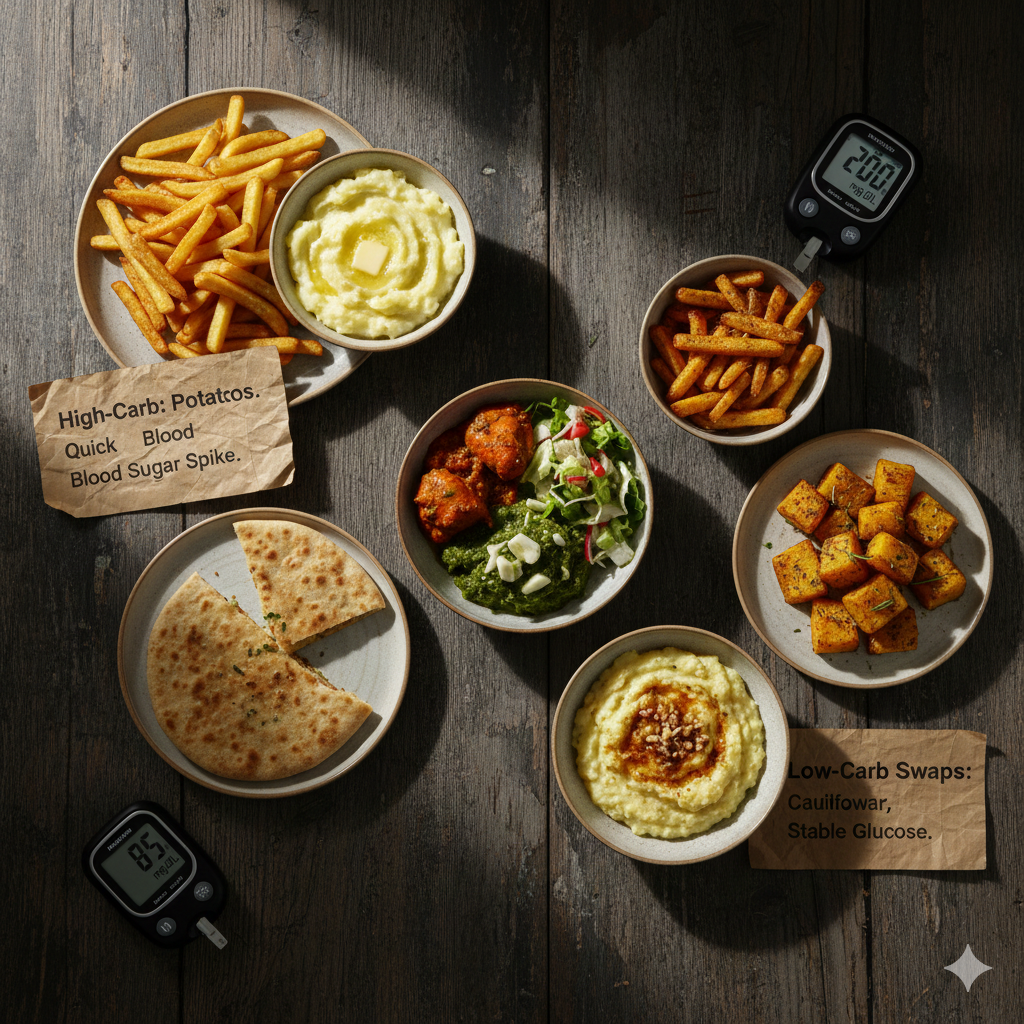
Low-Carb Swaps (Desi Friendly)
If you enjoy the texture of potatoes, try these lower-carb alternatives:
| Potato Dish | Lower-Carb Swap | Approx Net Carbs | Desi Adaptation |
|---|---|---|---|
| French fries | Air-fried radish | ~5g | Ghee + cumin |
| Mashed potatoes | Cauliflower mash | ~6g | Garlic tadka |
| Hash browns | Shredded zucchini | ~4g | Chili + coriander |
| Roasted potatoes | Turnip cubes | ~7g | Rosemary sabzi |
| Home fries | Sautéed cabbage | ~5g | Smoked paprika |
Above-ground vegetables generally contain far fewer digestible carbs.
Simple Recipe Ideas
Cauliflower “Fries”
Slice into sticks, coat lightly with olive oil or ghee, season with garlic + paprika.
Air fry until crisp.
Ghee Mashed Cauliflower
Steam, drain well, blend with butter/ghee + cream + salt.
Add roasted garlic for depth.
Zucchini Hash Browns
Grate, squeeze out water, pan fry in ghee until golden.
Add cumin and chili flakes for a Pakistani twist.
Paneer “Hasselback”
Slice paneer thick, brush with garlic-ghee, bake until golden.
Protein-rich and zero starch spike.
Pro-Metabolic Perspective
“Pro-metabolic” does not mean high carb for everyone.
For insulin-resistant individuals:
Lowering carbs lowers insulin demand
Lower insulin improves fat burning
Stable glucose reduces cravings
Energy becomes more consistent
Fat adaptation allows the body to shift from glucose dependency to mixed fuel use.
However:
Athletes and metabolically healthy individuals may tolerate potatoes well.
Children and underweight individuals do not need carb restriction.
Persons with Type 1 diabetes lower their insulin requirements through reducing carbs.
Important Clarification
Potatoes are not “toxic.”
They are:
Nutrient-rich (potassium, vitamin C)
Inexpensive
Satiating for some people
The issue is metabolic context and total carb load.
If your HbA1c is elevated, fasting glucose is high, or waist circumference is increasing — reducing potatoes may be beneficial.
Practical Rule
If you are insulin resistant:
Try removing potatoes for 3–4 weeks and monitor:
Fasting glucose
Post-meal glucose
Energy levels
Cravings
Waist measurement
Data > ideology.
Final Thought
Low-carb is not about fear.
It’s about reducing unnecessary glucose spikes in a population genetically prone to insulin resistance.
For many South Asians, cutting potatoes — especially alongside rice and roti — can be a powerful lever for metabolic health.
But personalize. Monitor. Adjust.
References
- https://www.diabetes.org.uk/living-with-diabetes/eating/meal-plans/low-carb
- https://www.ncbi.nlm.nih.gov/books/NBK537084/
- https://www.nutrisense.io/blog/low-carb-diet-benefits-risks-guide
- Recent Post