How Hormones Hijack Fat Loss
Most weight regain isn’t about carbs, calories, or “falling off the plan.”
In coaching, stress is the single most common trigger behind regain—
not just emotional stress, but physiological and physical stress too.
When stress shows up, hormones take over. And hormones don’t negotiate.
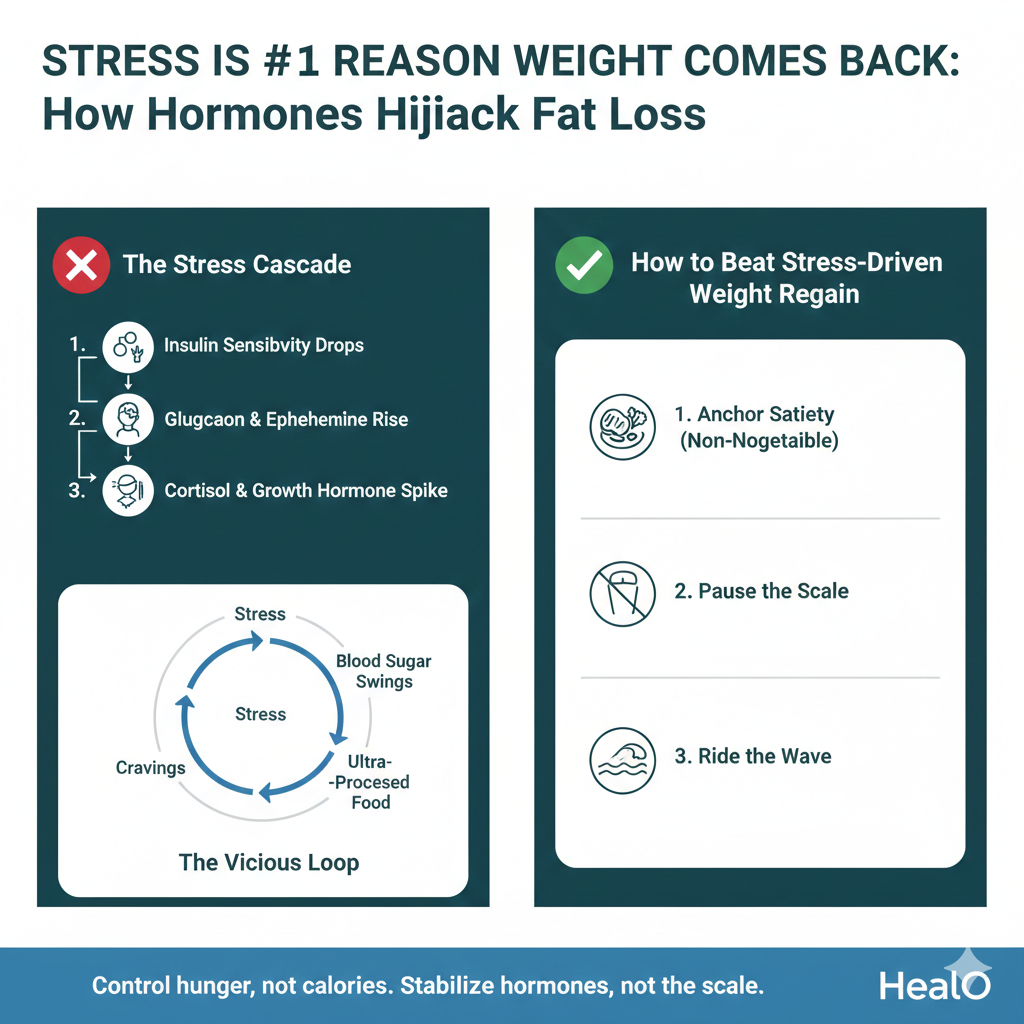
The Stress Cascade (What Actually Happens)
Stress flips your metabolism into survival mode—even if the threat is just routine work, deadlines, or poor sleep.
1. Insulin Sensitivity Drops
Stress mobilizes energy fast.
Cells temporarily stop responding to insulin, keeping glucose circulating instead of stored.
Good for emergencies.
Terrible when chronic.
2. Glucagon & Epinephrine Rise
These hormones:
Blood sugar climbs—even if you haven’t eaten.
3. Cortisol & Growth Hormone Spike
Cortisol signals the liver to dump glucose into the bloodstream
while simultaneously making tissues more insulin resistant.
This creates huge blood sugar swings.
The Real Problem: Hunger Without Need
After a stress spike:
You’re not low on calories.
You’re low on metabolic safety.
This is why people say:
“I just ate… why do I still want something?”
The Double Whammy: Willpower Goes Offline
Stress also shuts down the prefrontal cortex—the part responsible for:
Self-control
Planning
Saying “no”
Meanwhile, the reward system is screaming for:
Sugar
Fat + carbs
Ultra-palatable food
That’s not weakness.
That’s neurobiology.
The Vicious Loop
Stress →
Blood sugar swings →
Cravings →
Ultra-processed food →
More swings →
More hunger →
Regain
Repeat.
How to Beat Stress-Driven Weight Regain
1. Anchor Satiety (Non-Negotiable)
During stress, don’t diet harder—eat smarter.
Base meals around:
Satiety is protection.
2. Pause the Scale
Weight fluctuations during stress are mostly water, glycogen, and cortisol, not fat.
Chasing the scale adds more stress → worsens the cycle.
Maintain habits. Let physiology settle.
3. Ride the Wave
Stress is temporary.
Hormonal chaos is not permanent—unless you panic-react to it.
Hold satiety. Hold routine.
When stress passes, weight follows.
The Takeaway
Weight regain isn’t a discipline failure.
It’s a stress response.
Control hunger, not calories.
Stabilize hormones, not the scale.
Calm the system—and the body remembers how to lean out.
References
- https://www.ncbi.nlm.nih.gov/books/NBK549820/
- https://pmc.ncbi.nlm.nih.gov/articles/PMC10241186/
- https://pubmed.ncbi.nlm.nih.gov/29389509/
- https://pubmed.ncbi.nlm.nih.gov/29927688/
- https://www.ncbi.nlm.nih.gov/books/NBK603747/
- https://pubmed.ncbi.nlm.nih.gov/27345309/
- https://www.ncbi.nlm.nih.gov/books/NBK242443/
- https://pubmed.ncbi.nlm.nih.gov/19521353/

One Response