The Addiction Science Most People Never Learn
Refined sugar and flour don’t just feed the body.
For many people, they hijack the brain.
If foods like mithai, naan, sheer khurma, or chai-with-sugar trigger:
• loss of control
• intense cravings
• mood swings
• brain fog
• relapse cycles
This isn’t a discipline problem.
It’s neurobiology.
Some brains are simply more sensitive to sugar’s drug-like effects—and South Asians appear disproportionately affected.
The Sugar-Sensitive Brain
Why “One Bite” Turns Into a Spiral
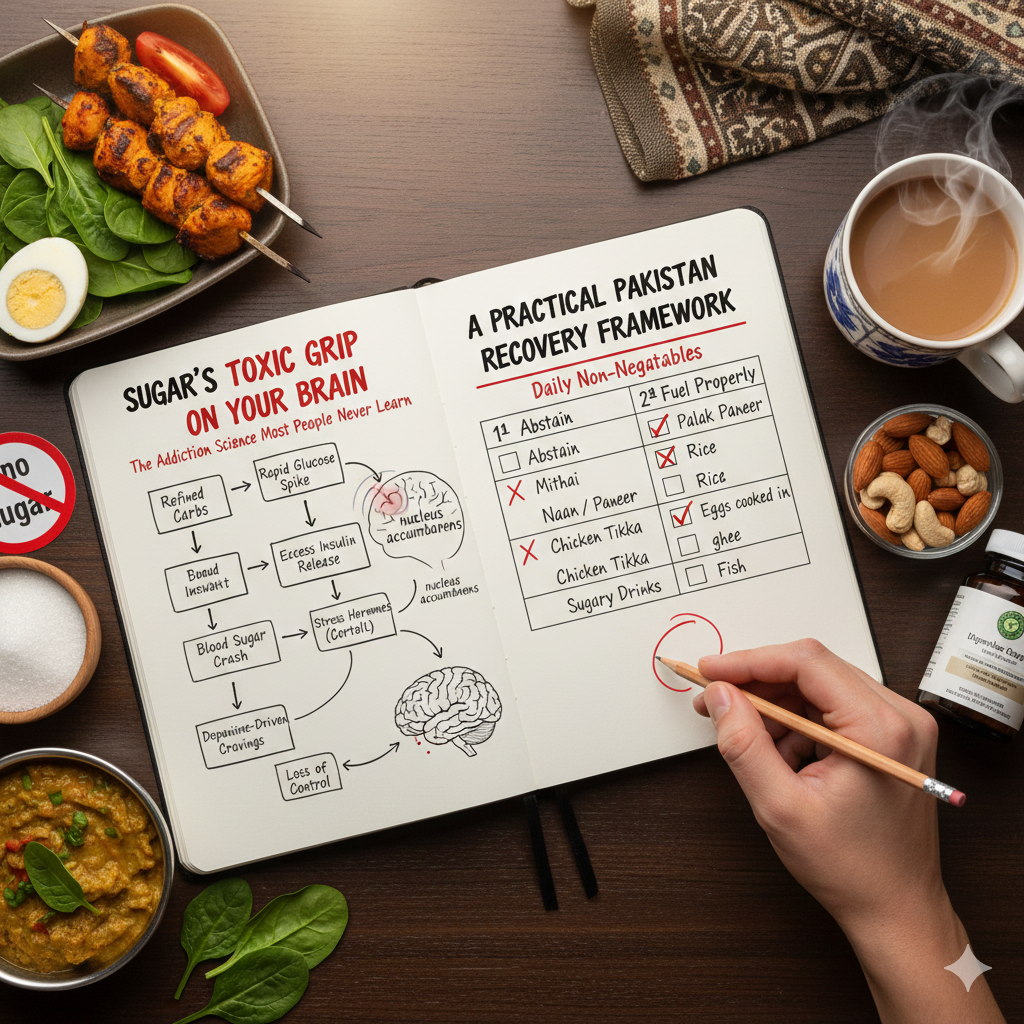
In sugar-sensitive individuals, refined carbs trigger a predictable loop:
Rapid glucose spike
→ Excess insulin release
→ Blood sugar crash
→ Stress hormones (cortisol, adrenaline)
→ Dopamine-driven cravings
The result feels like emotional whiplash:
• energized and confident one moment
• irritable, low, or anxious the next
Stopping at one gulab jamun doesn’t fail because of weakness.
It fails because the brain is chemically pushed to seek more.
Over time, repeated insulin spikes lead to hyperinsulinemia, blocking fat burning and promoting abdominal weight gain—while the brain still feels under-fueled.
Telling someone in this state to “just eat less” or “exercise more” isn’t motivation.
It’s misunderstanding.
Dopamine: Sugar’s Shortcut to the Reward System
Refined sugar activates the brain’s reward circuitry (including the nucleus accumbens) in ways that resemble addictive substances:
• Fast dopamine surge → immediate pleasure
• Strong memory encoding → powerful food cues
• Tolerance development → larger amounts needed
• Withdrawal symptoms → low mood, restlessness, shakiness
Natural rewards (relationships, purpose, achievement) release dopamine slowly and sustainably.
Sugar releases it fast and repeatedly.
That’s why cravings feel urgent—and why willpower collapses under stress.
This Isn’t Just “In the Head”
Sugar’s Whole-Body Fallout
Chronic high sugar intake is associated with wide-ranging physiological stress:
Metabolic & Hormonal
• Insulin resistance
• Mineral depletion (e.g., chromium, magnesium)
• Fat-storage signaling dominance
Gut
• Dysbiosis & candida overgrowth
• Increased gut permeability
• Inflammatory bowel vulnerability
Cardiovascular
• Elevated triglycerides
• Blood pressure dysregulation
• Arterial inflammation
Brain & Mood
• Depression and anxiety risk
• ADHD-like focus issues
• Impaired sleep architecture
Aging & Repair
• Glycation → skin aging
• Enzyme interference
• Slower tissue recovery
None of this requires extreme intake.
For sensitive brains, repeated moderate exposure is enough.
The Way Out: Recovery, Not Moderation
For sugar-sensitive individuals, recovery usually starts with abstinence, not balance.
“Just for today, no drug meals.”
This isn’t forever.
It’s long enough to calm the nervous system and repair signaling.
A Practical Pakistani Recovery Framework
Daily Non-Negotiables
1️⃣ Abstain
No sugar or refined flour:
• Mithai
• Naan / roti / paratha
• Rice
• Sugary drinks
• Biscuits & bakery
2️⃣ Fuel Properly
Every meal =
Vegetables + protein + fat
Examples:
• Palak paneer
• Chicken tikka + sabzi
• Eggs cooked in ghee
• Fish/meat with gobhi or bhindi
3️⃣ Move Gently
• Daily walks
• Light strength work
Movement improves insulin signaling—without stressing the brain.
4️⃣ Support Repair (Guided)
Early withdrawal often reflects:
• Low stomach acid
• Enzyme insufficiency
• Electrolyte imbalance
• Neurotransmitter depletion
Targeted support (digestive, mineral, gut, nervous system) can dramatically ease the transition.
What Most People Notice
Week 1:
Cravings peak… then drop
Week 2:
Energy steadies, hunger calms
Week 3:
Clearer thinking, better mood, fat loss resumes
Not through force.
Through biochemical stabilization.
Why People Relapse Alone—and Succeed With Structure
Food change is only part of recovery.
Lasting freedom usually requires:
• Education about addiction biology
• Clear structure
• Daily accountability
• Community normalization
• Nervous system regulation
This is why guided programs outperform solo attempts.
Final Truth
Sugar addiction isn’t a moral failure.
It’s a brain–metabolism mismatch.
If sugar controls your mood, appetite, or thoughts—
it’s not food for you right now.
Healing is possible.
Stability is learnable.
Freedom is biochemical.
One day at a time.
References
- https://pubmed.ncbi.nlm.nih.gov/29772560/
- https://pmc.ncbi.nlm.nih.gov/articles/PMC10780393/
- https://pmc.ncbi.nlm.nih.gov/articles/PMC10780393/
- https://pmc.ncbi.nlm.nih.gov/articles/PMC5003688/
- https://pmc.ncbi.nlm.nih.gov/articles/PMC6080735/
- https://pubmed.ncbi.nlm.nih.gov/38201905/
- https://pubmed.ncbi.nlm.nih.gov/25879513/
- https://pubmed.ncbi.nlm.nih.gov/30094113/
- https://pmc.ncbi.nlm.nih.gov/articles/PMC2235907/
- https://pubmed.ncbi.nlm.nih.gov/40654193/
- https://pubmed.ncbi.nlm.nih.gov/31125634/
- https://pubmed.ncbi.nlm.nih.gov/28835408/