
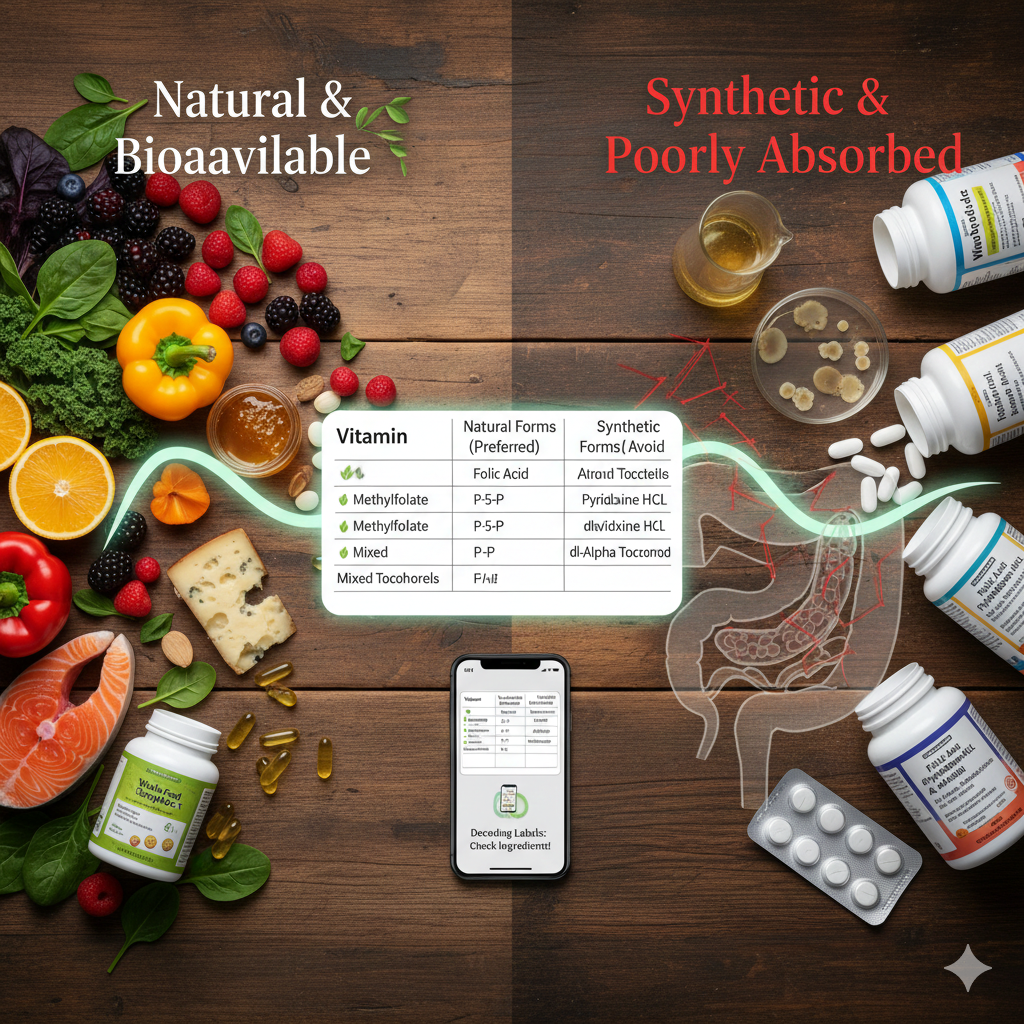
Factory-made synthetic vitamins promise convenience but often fall short—especially for gut health. They can’t replicate nature’s complexity, potentially causing digestive upset or poor absorption. The good news? Whole-food-based supplements shine for bioavailability and belly-friendliness (Nutrients, 2015).
Prioritize food sources first, then choose cultured or food-derived vitamins. This guide breaks down synthetics to dodge, safer options, and label-reading tips.
Table of Contents
Natural vs. Synthetic Vitamins Table
Decoding Labels
Vitamin D Special Note
Why Avoid Synthetics?
Low-Risk Synthetics
High-Risk Synthetics to Skip
When Synthetics Make Sense
Quick Summary
Natural vs. Synthetic Vitamins Table
| Vitamin | Natural Forms (Preferred) | Synthetic Forms (Avoid/Limit) |
|---|---|---|
| A | Retinol, retinyl acetate/palmitate from food/cod liver oil, cultured | Vitamin A palmitate (solvent-processed) |
| B1 (Thiamine) | From food, cultured | Thiamine mononitrate, thiamine HCl |
| B2 (Riboflavin) | From food, riboflavin-5-phosphate, FMN, cultured | Riboflavin |
| B3 (Niacin) | From food, niacinamide, nicotinic acid, cultured | Niacin, nicotinic acid, niacinamide |
| B5 (Pantothenic Acid) | From food, pantethine, cultured | D-pantothenic acid, dexpanthenol, calcium pantothenate |
| B6 | Pyridoxal-5-phosphate (P5P), from food, cultured | Pyridoxine HCl, pyridoxamine |
| B9 (Folate) | Methylfolate (5-MTHF), folinic acid, from food | Folic acid |
| B12 | Methylcobalamin, adenosylcobalamin, from food | Cyanocobalamin |
| C | From acerola/rose hips/food, liposomal, cultured | Ascorbic acid, sodium ascorbate, ascorbyl palmitate (often GMO) |
| D | Cholecalciferol (D3 from lanolin/algae), ergocalciferol | Prescription analogs only |
| E | Mixed tocopherols/tocotrienols (d-alpha), from food | dl-alpha tocopherol (synthetic mix) |
| K | Phylloquinone, menaquinone (MK-4/MK-7), from food | Menadione |
Decoding Labels
Natural vitamins list “from food,” “cultured” (e.g., via Saccharomyces cerevisiae probiotics), or active forms like 5-MTHF. Synthetics have chemical names (e.g., pyridoxine HCl). Front labels may scream “natural”—check ingredients. Brands with “nature” in the name? Still verify.
Vitamin D Special Note
Sun-derived D3 (cholecalciferol) is ideal. Supplements often use irradiated lanolin (natural) or algae (vegan). Synthetics are prescription-only for issues like kidney disease—fine then.
Why Avoid Synthetics?
Cheap to mass-produce with petroleum, solvents, or formaldehyde, synthetics lack cofactors for absorption. They may disrupt gut bacteria, accumulate unmetabolized, or displace natural nutrients—worse for sensitive systems.
Low-Risk Synthetics
Budget tight? These are safer bets:
Vitamin C (ascorbic acid): No proven harm; effective, but GMO-sourced—opt natural if possible.
Vitamin B12 (cyanocobalamin): Trace cyanide is negligible (B12 binds it safely (Clin Toxicol, 2006)).
Vitamin A (palmitate): Identical to natural, but solvent-made—food sources better.
High-Risk Synthetics to Skip
Steer clear—these harm more than help:
Folic Acid (Synthetic B9)
Up to 40-90% can’t convert it due to MTHF variants (Nutrients, 2021; J Nutr, 2014). It builds up unused. Choose methylfolate—safe for pregnancy too (Nutrients, 2020).
Pyridoxine HCl (Synthetic B6)
Lowers active B6 levels (PLoS One, 2017), risks neuropathy. P5P supports gut bacteria sans issues (Microorganisms, 2020; safer for epilepsy (Epilepsia, 1998)).
dl-Alpha Tocopherol (Synthetic E)
Absorbs poorly, exits fast via urine, displaces natural E in cells. Natural protects gut barrier better (World J Gastroenterol, 2014).
When Synthetics Make Sense {#whensynthetic}
Allergies to food bases? Synthetics win. Otherwise, naturals boost gut health and efficacy.
Quick Summary
Print the table for shopping. Whole-food vitamins safeguard your microbiome—nature trumps lab for absorption and safety. Ditch synthetics where possible; your gut will thank you.