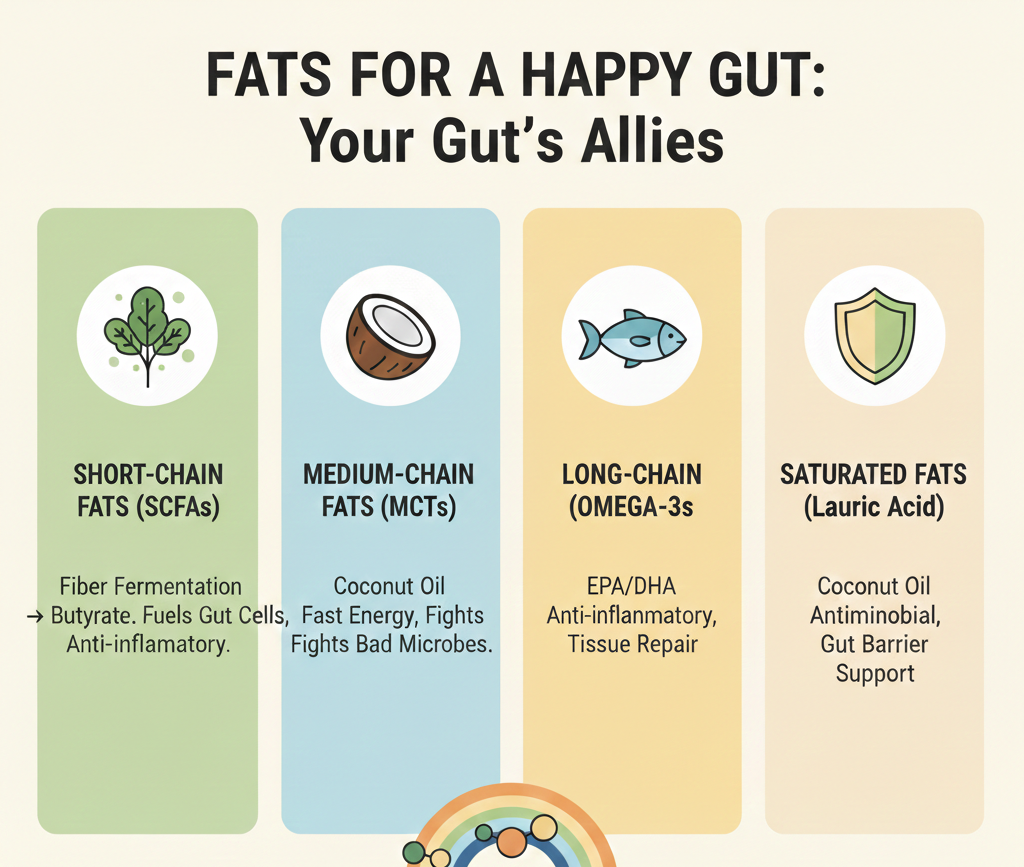
In the last decade, the world of gut health has revolutionized our understanding of nutrition and wellness. Among all the nutrients influencing gut vitality, the diverse world of dietary fats is now recognized as a major player. Once maligned, the right fats can help nurture a balanced gut, reduce inflammation, and boost overall resilience. Here’s why fats—short-, medium-, long-chain, and even saturated!—are great for your gut.
Short-Chain Fats: The Gut Lining’s Best Friends
Short-chain fatty acids (SCFAs), mainly acetate, propionate, and butyrate, are produced by your gut microbes as they ferment fiber from your diet. These SCFAs are star energy sources for colon cells and maintain the gut lining’s strength and integrity. Butyrate, in particular, stands out for:
Its anti-inflammatory effects that protect against conditions like IBD and ulcerative colitis.
Helping the immune system balance defense with tolerance, fending off pathogens but preserving healthy microbes.
Medium-Chain Fats: Fast Fuel with Microbial Muscle
Medium-chain triglycerides (MCTs)—abundant in coconut oil and some dairy—are quickly absorbed and metabolized, offering instant energy. But their benefits do not end there:
MCTs exhibit antimicrobial action, fighting harmful bacteria like E. coli and C. difficile.
They help shape a healthier microbiome by encouraging “good” bacterial growth and suppressing invaders, fostering a balanced gut environment.
Long-Chain Fats: Omega-3s as Gut Guardians
Long-chain fatty acids, especially omega-3s (EPA, DHA), are essential for building cell membranes and supporting whole-body health. For the gut, they:
Deliver powerful anti-inflammatory properties, defending the intestines from inflammatory stress and diseases such as IBD.
Act as precursors to molecules (SPMs) that resolve inflammation and repair the intestinal tissue, fostering ongoing healing and homeostasis.
Saturated Fats: Not Just a Villain
The reputation of saturated fats is rapidly evolving. While excess processed sources remain problematic, naturally occurring forms—such as lauric acid in coconut oil—have a different impact:
Lauric acid offers antimicrobial effects that help maintain a healthy microbial balance.
Saturated fats also help sustain the gut lining, preventing “leaky gut” and preserving the barrier that keeps toxins out and nutrients in.
Bottom Line: Embrace a Spectrum of Fats
Eating a colorful variety—“the whole rainbow of fats”—offers these multifaceted gut benefits:
Fuels gut cells and supports tissue repair.
Fosters a balanced, health-promoting microbiome.
Resolves inflammation and maintains a strong intestinal barrier.
As science evolves, the message is clear: Don’t fear fats—choose and combine them wisely for a happy gut and improved total well-being. Redefining fats as your gut’s allies unlocks new paths to better digestion, resilience, and everyday vitality.
References
- Smith PM, Howitt MR, Panikov N, et al. The microbial metabolites, short-chain fatty acids, regulate colonic Treg cell homeostasis. Science. 2013;341(6145):569-573.
- Arpaia N, Campbell C, Fan X, et al. Metabolites produced by commensal bacteria promote peripheral regulatory T-cell generation. Nature. 2013;504(7480):451-455.
- Peng L, He Z, Chen W, et al. Medium-chain triglyceride enhances intestinal mucosal integrity through the regulation of intestinal mucosal immune response and microbiota composition in weaning piglets. ACS Omega. 2020;5(10):5154-5162.
- Deng X, Yan X, Han D, et al. Characterization of the gut microbiota in the golden takin (Budorcas taxicolor bedfordi). AMB Express. 2021;11(1):36.
- Ananthakrishnan AN, Khalili H, Konijeti GG, et al. Long-term intake of dietary fat and risk of ulcerative colitis and Crohn’s disease. Gut. 2014;63(5):776-784.
- Serhan CN. Pro-resolving lipid mediators are leads for resolution physiology. Nature. 2014;510(7503):92-101.
- Shilling M, Matt L, Rubin E, et al. Antimicrobial effects of virgin coconut oil and its medium-chain fatty acids on Clostridium difficile. J Med Food. 2013;16(12):1079-1085.
- Desai MS, Seekatz AM, Koropatkin NM, et al. A dietary fiber-deprived gut microbiota degrades the colonic mucus barrier and enhances pathogen susceptibility. Cell. 2016;167(5):1339-1353.e21.