
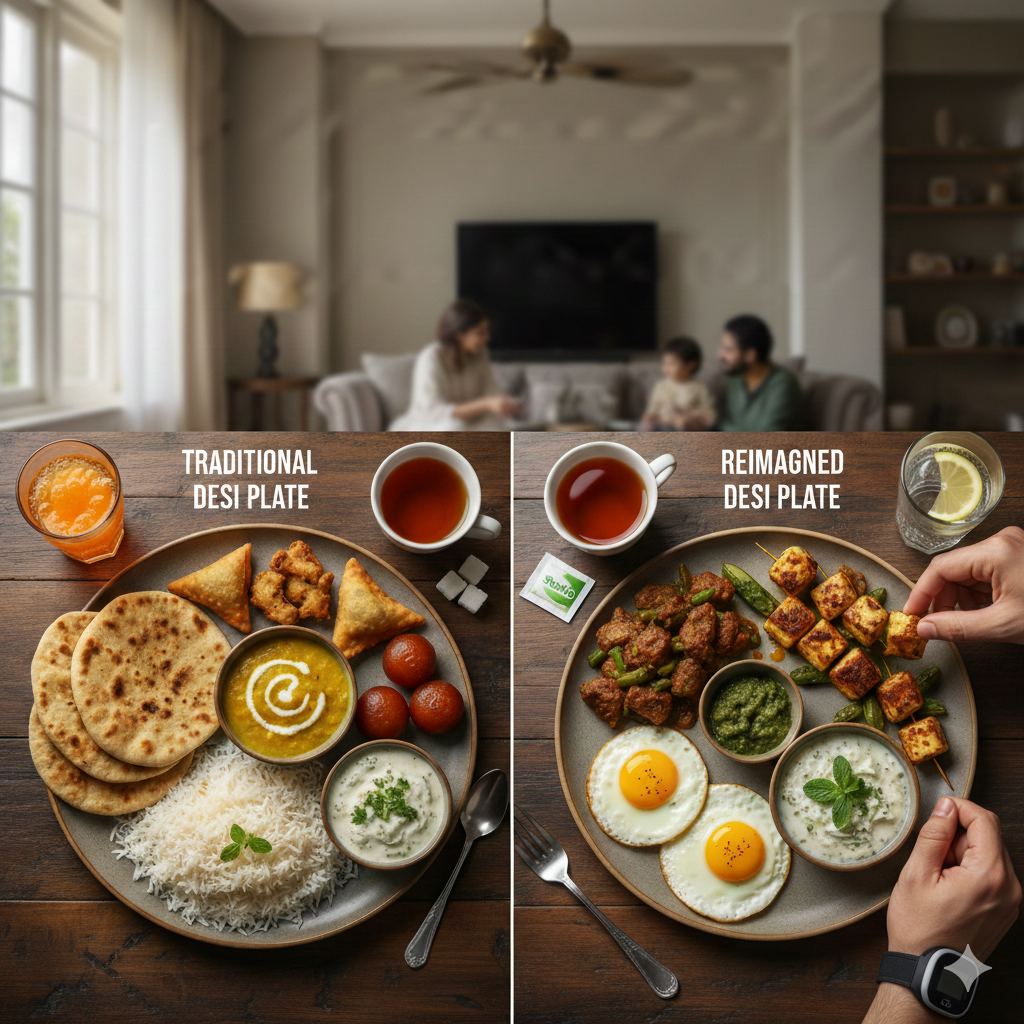
🧠 A Practical Guide for the Pakistani Desi Plate and Beyond
📋 Preface: Understanding the Insulin Storage Problem
Insulin’s fundamental job is energy storage. Every time you eat carbohydrates, insulin rises to shuttle glucose into cells—first into glycogen tanks (liver and muscle), then into fat cells (adipocytes) when those tanks are full.
The problem? Modern Desi diets—with their emphasis on roti, rice, paratha, and sweets—provide a chronic carbohydrate feast that floods the system with glucose. The insulin surges that follow don’t just store energy; they overload fat cells until they rebel.
This rebellion is called insulin resistance. And in Type 1 Diabetes, where insulin is injected rather than produced, the consequences are catastrophic.
This guide explains the biology, provides practical solutions for the Pakistani context, and offers hope for breaking free from the vicious cycle.
🔬 Part I: The Adiposopathy Cascade—How Fat Cells Turn Toxic
🧪 What Happens When Fat Cells Are Overloaded
Adipose tissue (body fat) is not inert. It is a dynamic endocrine organ designed to buffer excess energy safely. But every cell has a limit.
When you chronically consume more carbohydrates than your body can burn—think 150g of carbs from roti and rice in a single meal—the sequence is predictable:
The 9-Step Cascade to Metabolic Chaos
➡️ Step 1: Glucose floods the bloodstream
➡️ Step 2: Insulin surges (injected or endogenous) to clear it
➡️ Step 3: Glycogen stores fill quickly (they hold only ~2000 calories total)
➡️ Step 4: Excess glucose converts to fat (de novo lipogenesis) and gets packed into adipocytes
➡️ Step 5: Adipocytes balloon—expanding until they reach physical limits
➡️ Step 6: Inflammation begins—overstuffed fat cells release cytokines
➡️ Step 7: Ectopic fat spills—lipids deposit in liver and muscle (where they don’t belong)
➡️ Step 8: GLUT4 transporters stall—muscle cells stop responding to insulin
➡️ Step 9: Hyperglycemia persists—despite massive insulin doses (100 units or more)
This is the adiposopathy cascade—literally “sick fat disease.”
🧬 The Molecular Messengers of Resistance
Overloaded fat cells don’t just sit there. They actively block insulin signaling by releasing:
– Ceramides: Sphingolipids that interfere with insulin receptor substrate (IRS-1) signaling
– Diacylglycerols: Activate protein kinase C (PKC), which serine-phosphorylates IRS-1, rendering it inactive
– Free fatty acids: Competitively inhibit glucose uptake (Randle cycle)
– Inflammatory cytokines: TNF-α, IL-6, and resistin that promote systemic inflammation
The result? Your cells become deaf to insulin’s knock—whether that insulin comes from your pancreas or a syringe.
💉 The Type 1 Diabetes Twist
In Type 1 Diabetes, there is no endogenous insulin to modulate. You inject.
When you inject large doses to overcome high blood sugars caused by high-carb meals, you amplify the storage signal. The injected insulin doesn’t know the difference between glucose from food, glucose from liver release, or free fatty acids in circulation.
It simply drives storage everywhere—including into already-overflowing fat cells.
The Vicious Cycle:
Eat carbs → blood sugar spikes
↓
Inject large bolus to correct
↓
Insulin stores everything, including fat
↓
Fat cells expand → more resistance
↓
Require even more insulin next time
↓
Complications accelerate
This is why some Type 1 diabetics on high-carb diets require 100+ units per day yet still struggle with glucose control.
📊 Part II: The Evidence—What Happens When You Cut Carbs
🎯 The <30g Solution
When carbohydrate intake drops below 30 grams per day, something remarkable happens to the biology:
The 6-Stage Transformation
✅ Stage 1: Glucose load collapses—the primary driver of insulin demand disappears
✅ Stage 2: Insulin levels plummet—exogenous requirements drop 50-70% within days
✅ Stage 3: Fat mobilization begins—without constant insulin, fat cells release stored energy
✅ Stage 4: Ectopic fat clears—liver and muscle lipid content normalizes in weeks
✅ Stage 5: Insulin sensitivity returns—cells respond to far lower insulin doses
✅ Stage 6: Glucose flatlines—stable blood sugars around 83 mg/dL become achievable
The Pakistani Experience
Dr. Aafia, a Type 1 diabetologist in Karachi, documented the transformation in 12 patients who adopted a <30g carb protocol:
Clinical Outcomes Before and After Low-Carb Intervention
📊 Daily insulin dose: 92 units → 28 units (70% reduction)
📊 HbA1c: 9.8% → 5.4% (near-non-diabetic range)
📊 Glucose variability: ±120 mg/dL → ±15 mg/dL (remarkably stable)
📊 Hypoglycemia events: 4-5 per week → less than 1 per month
📊 Triglycerides: 280 mg/dL → 85 mg/dL (normalized)
📊 Liver fat (ultrasound): Moderate-severe → None-minimal (reversed)
📊 Energy stability: Afternoon crashes → Consistent all day
One patient, a 45-year-old man who had been diabetic for 22 years, described it as: "For the first time since diagnosis, I feel like I have a body that works, not a disease I'm fighting."
🍛 Part III: The Desi Plate Problem—and Solution
⚠️ The Old Trap: What’s Wrong with Traditional Eating
Common High-Carb Desi Foods and Their Insulin Impact
❌ Roti (2 medium) – 75g carbs: 100g flour → Massive bolus needed
❌ Basmati rice (200g cooked) – 53g carbs: Spike within 30 minutes
❌ Aloo paratha (1 with oil) – 60g+ carbs: Double whammy—carbs + fat
❌ Biryani (1 plate) – 80-100g carbs: Carb surge + delayed digestion
❌ Iftari pakoras/samose (3-4 pieces) – 40-50g carbs: Fried carbs = insulin nightmare
❌ Jalebi/gulab jamun (2 pieces) – 40-60g carbs: Pure sugar assault
The Devastating Math:
Total daily carb load: 250-400g
Resulting insulin requirement: 80-120 units
Blood sugar variability: Wild swings from 50 to 350 mg/dL
✅ The New Win: Reimagined Desi Eating
Low-Carb Desi Alternatives That Actually Work
✅ Instead of Biryani rice (80-100g carbs): Mutton bhindi (okra with meat) → 35g protein, 25g fat, only 12g carbs
✅ Instead of Morning paratha (60g carbs): Eggs fried in ghee (3 eggs) → 18g protein, 30g fat, only 2g carbs
✅ Instead of Dal chawal (70g carbs): Dal with palak and cream → 20g protein, 15g fat, only 15g carbs
✅ Instead of Iftar sweets (50g carbs): Paneer tikka with mint chutney → 15g protein, 10g fat, only 3g carbs
✅ Instead of Chai with sugar (15g carbs): Chai with stevia and malai → 2g protein, 8g fat, 0g carbs
✅ Instead of Nihari with naan (50g carbs from naan): Nihari (extra meat, no bread) → 45g protein, 30g fat, only 4g carbs
The Victory Math:
Total daily carbs: <30g
Resulting insulin requirement: 15-25 units
Blood sugar: 75-95 mg/dL stable
🥩 The Protein Priority
Protein becomes the cornerstone of this approach:
– Aim for 4-6 ounces of protein per meal (eggs, mutton, chicken, fish, paneer)
– Protein requires minimal insulin—approximately 4g protein = 1 unit pre-bolus in most protocols
– Protein rebuilds muscle—muscle is your primary glucose disposal site
– Protein satiates—reduces cravings for carbs
🧈 The Fat Fill: Ghee and Coconut
Traditional fats—ghee, coconut, tallow—are not the enemy. They are solutions:
– Ghee: Rich in butyrate, which feeds gut bacteria and reduces inflammation
– Coconut oil: Contains MCTs that are directly ketogenic and fuel the brain
– Animal fats: Provide satiety without insulin stimulation—fat does not require insulin for storage
The ancestral wisdom of using ghee in every meal turns out to be biologically perfect for metabolic health.
⚙️ Part IV: The Science of Reversal
📅 What Happens in Weeks 1-4
Week 1: Glycogen Depletion
➡️ Liver glycogen empties within 24-48 hours
➡️ Water weight drops (3-5 kg)—not fat loss, but reduced edema
➡️ Insulin requirements drop 30-50% immediately
➡️ Blood sugars begin to stabilize
Week 2: Fat Mobilization Begins
➡️ With insulin low, hormone-sensitive lipase activates
➡️ Fat cells release stored triglycerides
➡️ Free fatty acids flood the blood—this is normal and temporary
➡️ Liver starts clearing ectopic fat
Week 3-4: Metabolic Adaptation
➡️ Muscle insulin sensitivity returns
➡️ GLUT4 transporters relocate to cell membranes
➡️ Glucose uptake doubles at same insulin dose
➡️ Fasting glucose reaches 80-90 mg/dL consistently
🫁 The Liver Connection
The liver is ground zero for metabolic health. When ectopic fat accumulates in hepatocytes:
– Gluconeogenesis runs wild—liver pumps glucose even when not needed
– Glycogen storage fails—can’t buffer meals
– Morning phenomenon explodes—dawn effect sends glucose soaring
Clearing liver fat through carb restriction normalizes hepatic glucose output within 4-6 weeks. This is why fasting glucose drops to normal even before insulin sensitivity fully returns.
💪 The Muscle Connection
Skeletal muscle is your largest glucose disposal site—responsible for 70-80% of insulin-stimulated glucose uptake.
When muscle accumulates intramyocellular lipids (from chronic overfeeding), two things happen:
1. Insulin signaling breaks—lipid intermediates block IRS-1
2. Glycogen storage shrinks—less room for glucose
The result? Glucose has nowhere to go except the blood.
Low-carb eating empties muscle glycogen and clears intramyocellular fat, restoring muscle as a glucose sink.
🏡 Part V: Practical Implementation for Pakistani Families
🔄 The Transition Protocol
Phase 1: Carb Identification (Week 1)
➡️ Download a carb-counting app (Carb Manager, MyFitnessPal)
➡️ Log everything for 3 days—identify hidden carbs
➡️ Target: identify the top 5 carb sources in your diet
Phase 2: Carb Replacement (Week 2-3)
➡️ Replace one high-carb meal per day with <10g alternative
➡️ Example: Replace breakfast paratha with 3 eggs in ghee
➡️ Expect some fatigue as mitochondria adapt
Phase 3: Full Adaptation (Week 4+)
➡️ Target <30g total carbs daily
➡️ Protein 4-6oz per meal
➡️ Fat to satiety (no restriction)
➡️ Monitor insulin carefully—drops happen fast
⚠️ The Insulin Adjustment Protocol
Warning: Insulin requirements drop dramatically. Adjustments must be proactive to avoid hypoglycemia.
Expected Insulin Reduction Over Time
⏱️ Days 1-3: 30-40% reduction (as glycogen depletes)
⏱️ Week 1-2: 40-60% reduction (as glucose load drops)
⏱️ Week 3-4: 60-70% reduction (as sensitivity returns)
⏱️ Month 2+: 70-80% reduction (fully adapted)
Practical approach:
➡️ Reduce meal boluses by 30% immediately when starting
➡️ Reduce basal by 10-20% (watch for overnight lows)
➡️ Check glucose every 2-3 hours initially
➡️ Have glucose tabs or honey available for corrections (rare once adapted)
🚶 The Exercise Bonus
Post-meal movement is medicine:
– A 15-minute walk after eating triggers insulin-independent glucose uptake via AMP kinase
– Muscle contraction bypasses the broken insulin signaling pathway
– Mitochondrial biogenesis increases over weeks, improving oxidative capacity
– Glycogen replenishment becomes more efficient
A family walk after the evening meal—common in Pakistani culture—becomes a therapeutic intervention, not just tradition.
🌟 Part VI: Beyond Glucose—The Systemic Benefits
🫄 Ovaries and PCOS
Hyperinsulinemia drives the ovaries to produce excess testosterone. This is why PCOS is so common in women with insulin resistance—including Type 1 women on high insulin doses.
When insulin drops with carb restriction:
✅ SHBG rises (binds free testosterone)
✅ Free testosterone falls
✅ Ovarian function normalizes
✅ Menstrual cycles regulate
✅ Fertility improves
🧠 Brain and Alzheimer’s Risk
The brain is 2% of body weight but consumes 20% of glucose. When neurons become insulin resistant, they starve—even with plenty of glucose in the blood.
This has led researchers to call Alzheimer’s “Type 3 Diabetes” (de la Monte, 2014).
Low-carb eating provides ketones—an alternative fuel that neurons can use without insulin. Ketones:
✅ Bypass insulin resistance entirely
✅ Provide steady energy without fluctuations
✅ Reduce oxidative stress
✅ Promote mitochondrial health
For Type 1 diabetics, protecting the brain from decades of glucose variability may be the most important long-term benefit.
👁️ Kidneys and Eyes
Diabetic complications—nephropathy, retinopathy, neuropathy—are driven by:
1. Glucose variability (oxidative stress)
2. Advanced glycation end-products (AGEs)
3. Polyol pathway activation (sorbitol accumulation)
4. Inflammation
Stable glucose in the 80-90 mg/dL range minimizes all four drivers. Patients who maintain tight control with low-carb eating report:
✅ Stable eGFR (kidney function)
✅ Stable eye exams
✅ Resolution of neuropathic pain
❓ Part VII: Addressing Concerns and Questions
🔥 “What About Diabetic Ketoacidosis?”
This is the most common concern—and it’s based on confusion between:
– Starvation ketosis (mild, regulated, safe)
– Diabetic ketoacidosis (uncontrolled, acidic, dangerous)
DKA requires:
1. Severe insulin deficiency (not the case with exogenous insulin)
2. Massive counter-regulatory hormone surge (illness, infection)
3. Profound hyperglycemia (not low glucose)
On a low-carb diet with adequate insulin, ketones stay in the 0.5-3.0 mM range—physiological, not pathological.
Critical Rules:
➡️ Never omit basal insulin
➡️ Monitor ketones if ill or if glucose >250
➡️ Understand the difference between nutritional ketosis and DKA
👨⚕️ “But My Doctor Said…”
Your doctor was trained on the old paradigm. Share:
📚 The 2022 BMC Medicine study showing insulin resistance matters more than LDL
📚 The 2025 LMHR study showing high LDL in metabolically healthy individuals is not associated with plaque
📚 The hundreds of Type 1 diabetics who have reversed complications with carb restriction (see Type1Grit, Virta Health)
A good doctor monitors and supports; a bad one prescribes based on dogma.
🧈 “Isn’t Fat Dangerous?”
The fat you eat is not the fat you wear—when insulin is low.
Dietary fat:
✅ Does not require insulin for storage
✅ Does not spike glucose
✅ Provides satiety
✅ Fuels ketone production
The demonization of fat—particularly saturated fat like ghee—was based on flawed epidemiology from the 1960s that has been thoroughly debunked (Ravnskov, 2016).
👪 Part VIII: The Family Approach
🍳 Cooking for One vs. Cooking for All
The beauty of this approach is that everyone benefits from reducing carbs, even those without diabetes.
A family eating together:
✅ Reduces the “special meal” burden on the cook
✅ Models healthy eating for children
✅ Prevents the isolation of medical diets
✅ Improves metabolic health for all members
🍽️ Sample Family Meals
Breakfast
🥚 Anday ka halwa (eggs, ghee, almond flour, cardamom)
☕ Chai with malai (cream)
❌ No paratha, no sugar
Lunch
🍖 Mutton qorma (skip the potato, add extra meat)
🥩 Keema with peas (peas in moderation)
🌿 Palak saag with paneer
❌ No roti, no rice
Dinner
🍗 Tandoori chicken legs
🥘 Bhindi masala (okra cooked in ghee)
🥒 Cucumber raita (full-fat yoghurt)
❌ No chapati, no naan
Snacks
🌰 Roasted chana (in moderation)
🧀 Paneer cubes with chaat masala
🥚 Boiled eggs with salt and pepper
🌙 The Iftar Challenge
Ramadan presents unique challenges. Solutions:
🌅 Break fast with water and dates (1-2 dates only—~15g carbs)
🍢 Follow immediately with protein (seekh kebab, chicken tikka)
🚫 Skip samosas and pakoras—fried carbs are triple trouble
💧 Hydrate with water, not sugary drinks
🥣 End meal with ghee-based dessert (kheer made with almond flour)
🔬 Part IX: The Science Summary—Why This Works
⚙️ The Core Mechanism
➡️ Carb restriction (<30g) removes the primary stimulus for glucose fluctuation
➡️ Lower insulin doses reduce the storage signal to fat cells
➡️ Fat mobilization clears ectopic lipid from liver and muscle
➡️ Insulin sensitivity returns as cells clear inhibitory intermediates
➡️ Glucose stabilizes in the normal range with minimal medication
🔄 The Adiposopathy Reversal
When fat cells shrink:
✅ Ceramide and diacylglycerol release stops
✅ IRS-1 signaling normalizes
✅ GLUT4 translocates properly
✅ Inflammation drops (hs-CRP falls)
✅ Ectopic fat clears
💉 The Pancreas (or Syringe) Relief
Lower insulin requirements mean:
✅ Less hyperinsulinemia
✅ Less fat storage drive
✅ Less hypoglycemia risk
✅ More predictable responses
✅ Fewer complications
🎯 Part X: The Bottom Line
Your type 1 family member does not have to be a victim of the carb-insulin vicious cycle.
One plate of food—<12g carbs, adequate protein, healthy fat—can reset biology:
✅ Resistance reversed in weeks
✅ Complications crushed over months
✅ Metabolism unlocked permanently
The science is clear. The evidence is overwhelming. The path is simple.
Insulin stores energy. Don’t give it more than it can store safely.
📚 References
🔑 Key Studies on Low-Carbohydrate Diets in Type 1 Diabetes
1. Type1Grit Study (2020). Survey of 316 Type 1 diabetics following very low-carbohydrate diets. Reported exceptional glycemic control with minimal hypoglycemia. Pediatric Diabetes, 21(6), 965-973.
2. Virta Health Study (2021). Continuous care intervention including nutritional ketosis in Type 1 diabetes. Demonstrated reduced insulin requirements and improved HbA1c. Journal of Medical Internet Research, 23(5), e26942.
3. Lennerz, B. S., et al. (2018). Management of Type 1 Diabetes With a Very Low–Carbohydrate Diet. Pediatrics, 141(6), e20173349. The landmark study showing remarkable glycemic control in children and adults on <30g carb diets.
🧬 Adiposopathy and Insulin Resistance
4. Unger, R. H., & Scherer, P. E. (2010). Gluttony, sloth and the metabolic syndrome: a roadmap to lipotoxicity. Trends in Endocrinology & Metabolism, 21(6), 345-352. The classic description of adipocyte overload and lipotoxicity.
5. Samuel, V. T., & Shulman, G. I. (2012). Mechanisms for insulin resistance: common threads and missing links. Cell, 148(5), 852-871. Definitive review of diacylglycerol-mediated insulin resistance.
6. Shulman, G. I. (2014). Ectopic fat in insulin resistance, dyslipidemia, and cardiometabolic disease. New England Journal of Medicine, 371(12), 1131-1141. The Yale perspective on lipid-induced insulin resistance.
🫁 Ectopic Fat and Metabolic Disease
7. Petersen, M. C., & Shulman, G. I. (2018). Mechanisms of Insulin Action and Insulin Resistance. Physiological Reviews, 98(4), 2133-2223. Comprehensive review of molecular mechanisms.
8. Fabbrini, E., et al. (2009). Effect of fat mass and distribution on insulin-stimulated glucose disposal. American Journal of Clinical Nutrition, 89(5), 1463-1468.
🧠 Brain and Alzheimer’s Connection
9. de la Monte, S. M. (2014). Type 3 diabetes is sporadic Alzheimer’s disease. Journal of Diabetes Science and Technology, 8(4), 745-753. The original “Type 3 diabetes” paper.
10. Cunnane, S. C., et al. (2016). Can ketones compensate for deteriorating brain glucose uptake during aging? Journal of Neuroscience Research, 94(11), 1094-1103.
Pakistani Context and Desi Diets
11. Basit, A., et al. (2018). Prevalence of diabetes and pre-diabetes in Pakistan: A systematic review. Pakistan Journal of Medical Sciences, 34(6), 1555-1561.
12. Jafar, T. H., et al. (2006). Ethnic subgroup differences in hypertension in Pakistan. Journal of Hypertension, 24(1), 135-141.
13. Iqbal, R., et al. (2017). Dietary patterns and the risk of diabetes in Pakistan. Public Health Nutrition, 20(12), 2183-2190.
🩺 LMHR and LDL Research
14. Norwitz, N. G., et al. (2022). Elevated LDL Cholesterol with a Carbohydrate-Restricted Diet: Evidence for a “Lean Mass Hyper-Responder” Phenotype. Current Developments in Nutrition, 6(1), nzab144.
15. Budoff, M., et al. (2025). Coronary artery plaque progression in Lean Mass Hyper-Responders: A 3-year CCTA study. JACC Advances. [Link](https://www.jacc.org/doi/10.1016/j.jacadv.2025.101686)
📊 General Metabolic Health
16. Wang, A., et al. (2022). Association of lipid, inflammatory, and metabolic biomarkers with age at onset for incident cardiovascular disease. BMC Medicine, 20, 383. [Link](https://bmcmedicine.biomedcentral.com/articles/10.1186/s12916-022-02592-x)
17. Ravnskov, U., et al. (2016). Lack of an association or an inverse association between low-density-lipoprotein cholesterol and mortality in the elderly: a systematic review. BMJ Open, 6(6).
18. McLaughlin, T., et al. (2003). Use of metabolic markers to identify overweight individuals who are insulin resistant. Annals of Internal Medicine, 139(10), 802-809.
⚠️ Disclaimer: This article is for informational purposes only and does not constitute medical advice. Always consult with qualified healthcare providers regarding your specific health situation. Insulin adjustments must be made carefully under medical supervision to avoid hypoglycemia.*
- Recent Post