
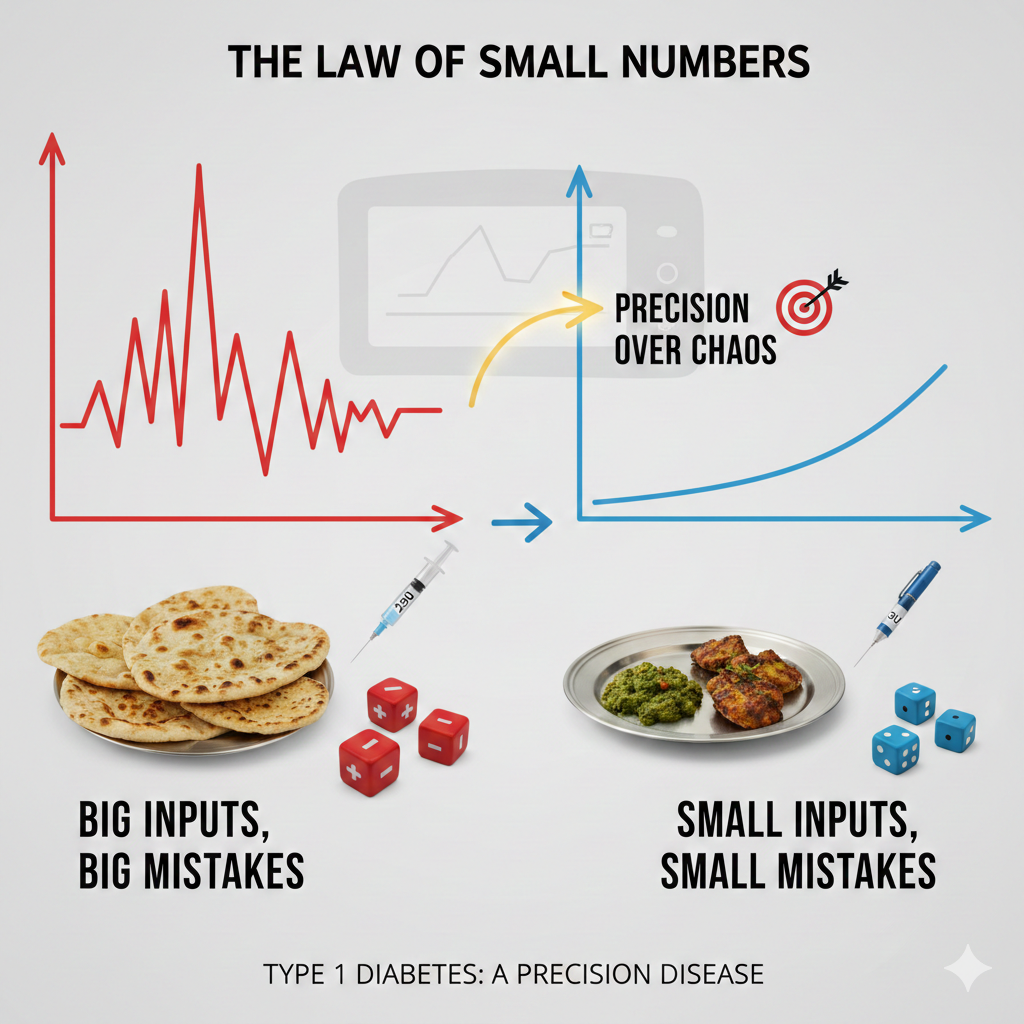
Type 1 diabetes is not a willpower disease.
It’s a precision disease.
When the immune system destroys insulin-producing beta cells, the body loses its glucose regulator. From that moment on, every gram of carbohydrate and every unit of insulin matters.
And this is where Richard K. Bernstein changed the conversation.
His principle is simple:
Big inputs make big mistakes.
Small inputs make small mistakes.
For families navigating type 1 diabetes — especially in carb-heavy cultures — this idea can be life-changing.
🧬 The Autoimmune Reality
Type 1 diabetes develops in stages:
Stage 1: Autoantibodies appear. Glucose still normal.
Stage 2: Glucose intolerance begins silently.
Stage 3: Symptoms — thirst, urination, weight loss, DKA risk.
Genetics (HLA-DR/DQ variants) load the gun.
Environmental triggers pull it.
Once beta cells are destroyed, insulin must be replaced — externally and precisely.
But here’s the problem:
Insulin absorption varies by roughly ~25–30% per injection.
So precision is already imperfect.
Now imagine layering large carb loads on top.
⚖️ The Math Behind the Law
Insulin absorption is not exact.
Example:
Large Dose Scenario
25 units injected
±7 units variability
Potential 100+ mg/dL swing
Small Dose Scenario
3 units injected
±1 unit variability
Minor glucose deviation
The larger the dose, the larger the potential error.
Now apply that to meals.
Roti (≈45g carbs)
→ Requires ~10–12 units insulin
→ Larger variability
→ Bigger swings
Bhindi fry (≈6g carbs)
→ Minimal insulin
→ Minimal error
→ Flat glucose line
It’s engineering logic applied to biology.
🍽 The Carb Equation
Bernstein’s structured approach often limits carbohydrates to approximately:
6g breakfast
12g lunch
12g dinner
The goal isn’t deprivation.
It’s predictability.
When carbohydrates are small:
Insulin doses shrink
Glucose variability narrows
Hypoglycemia risk becomes more manageable
Post-meal spikes rarely outrun insulin action
In carb-heavy environments, this shift is dramatic:
From:
100–150 units daily insulin
To:
30–50 units daily in many cases
Smaller inputs.
Smaller chaos.
🛠 Implementation Blueprint
1️⃣ Keep Individual Boluses Small
Aim for 3–7 units per injection when possible
Split large doses
Use multiple smaller corrections rather than one large one
2️⃣ Time Insulin Carefully
Regular insulin: ~30–45 minutes Fast Acting: ~10-15 minutes pre-meal
Rotate sites consistently
Maintain temperature stability
3️⃣ Account for Protein
Protein converts slowly to glucose (gluconeogenesis).
Some individuals dose for part of protein intake.
Small inputs still apply.
4️⃣ Monitor Frequently
CGM helps reveal:
Post-meal response
Variability trends
Correction accuracy
Flatlines become visible when carb loads shrink.
📊 Small vs Big Inputs
| Big Input | Error Risk | Small Input | T1D Advantage |
|---|---|---|---|
| 25U bolus | ±7U swing | 3U × split | Stable 80–90 mg/dL |
| 45g roti | Large spike | 12g palak | Minimal rise |
| Single large basal | All-day variability | Split basal | Predictable coverage |
The law is not ideology.
It’s math.
💡 Why This Matters Long-Term
Chronic hyperglycemia drives complications:
Retinopathy
Nephropathy
Neuropathy
Cardiovascular disease
Large glucose swings increase oxidative stress.
The landmark Diabetes Control and Complications Trial showed tighter control significantly reduced microvascular complications.
Bernstein’s argument goes further:
Aim for normal glucose, not “acceptable” glucose.
🤝 Technology + Small Numbers
Modern tools amplify this philosophy:
CGM reveals variability instantly
Insulin pumps deliver 0.025U precision
Closed-loop systems adjust micro-doses continuously
Technology manages dosing.
Diet determines dose size.
Together?
Powerful synergy.
⚠️ Challenges to Prepare For
Social meal gatherings require planning
Hypoglycemia education is essential
Families need glucagon access
Medical supervision is critical
Tight control without preparation is unsafe.
Tight control with knowledge is transformative.
🌙 The Desi Reality
Next meal:
45g naan chana plate
or
12g vegetable + protein plate?
One creates volatility.
One creates stability.
For type 1 families, this is not about restriction.
It’s about reducing chaos.
🎯 The Takeaway
Type 1 diabetes demands precision.
Precision improves when inputs shrink.
The Law of Small Numbers teaches:
Control the variables you can.
Reduce dose size.
Reduce carb load.
Reduce error magnitude.
Small numbers.
Calm glucose.
Protected future.
One stable meal at a time. 💛
References
- https://www.youtube.com/channel/UCuJ11OJynsvHMsN48LG18Ag
- https://www.youtube.com/watch?v=dPd78PnsQNA
- https://www.youtube.com/watch?v=4X7IwzFPn_Q
- https://www.youtube.com/watch?v=qQc2H26T98E&t=469s
- https://www.youtube.com/watch?v=3xdlzHyysNk&t=7s
- https://www.youtube.com/watch?v=3xdlzHyysNk&list=PLs_TA02I6IvX_FakgvWkfziEciqRSgZnz
- https://www.youtube.com/watch?v=3PZno7Nkuuw
- https://www.youtube.com/watch?v=3xdlzHyysNk&t=7s
- https://www.youtube.com/watch?v=3xdlzHyysNk&list=PLs_TA02I6IvX_FakgvWkfziEciqRSgZnz
- https://www.youtube.com/watch?v=3PZno7Nkuuw
- https://www.youtube.com/watch?v=3xdlzHyysNk&t=7s
- https://www.youtube.com/watch?v=3xdlzHyysNk&list=PLs_TA02I6IvX_FakgvWkfziEciqRSgZnz
- https://www.youtube.com/watch?v=3PZno7Nkuuw
- https://www.youtube.com/watch?v=3xdlzHyysNk&t=7s
- https://www.youtube.com/watch?v=3xdlzHyysNk&list=PLs_TA02I6IvX_FakgvWkfziEciqRSgZnz
- https://www.youtube.com/watch?v=3PZno7Nkuuw
- https://www.youtube.com/watch?v=vyOI9bk3VZc
- https://www.youtube.com/watch?v=um0Ly12Wia8
- https://www.youtube.com/watch?v=zJGAbZIvRh8
- https://www.youtube.com/watch?v=GdmK_SCA2ls
- https://www.youtube.com/watch?v=fA1qh4Sty8g
- https://www.youtube.com/watch?v=zJGAbZIvRh8
- https://www.youtube.com/watch?v=Ho9-oD9KSiw
- https://www.youtube.com/watch?v=3PZno7Nkuuw
- https://www.facebook.com/Type1Grit/
- https://www.jci.org/articles/view/142246
- https://www.diabetes-book.com/laws-small-numbers/
- Recent Post