Ultra-processed diets are quietly driving a worldwide micronutrient collapse—and vitamin K2 deficiency may be one of the most overlooked contributors.
Once thought relevant only to blood clotting, vitamin K2 is now recognized as essential for bone strength, arterial flexibility, gut integrity, and long-term disease prevention—in both children and adults.
The danger?
Deficiency is largely silent until fractures, heart disease, or vascular calcification appear.
This is not a niche issue. It’s global.
Table of Contents
K1 vs. K2: A Quick Primer
Vitamin K2’s Vital Roles
Why K2 Deficiency Is a Global Problem
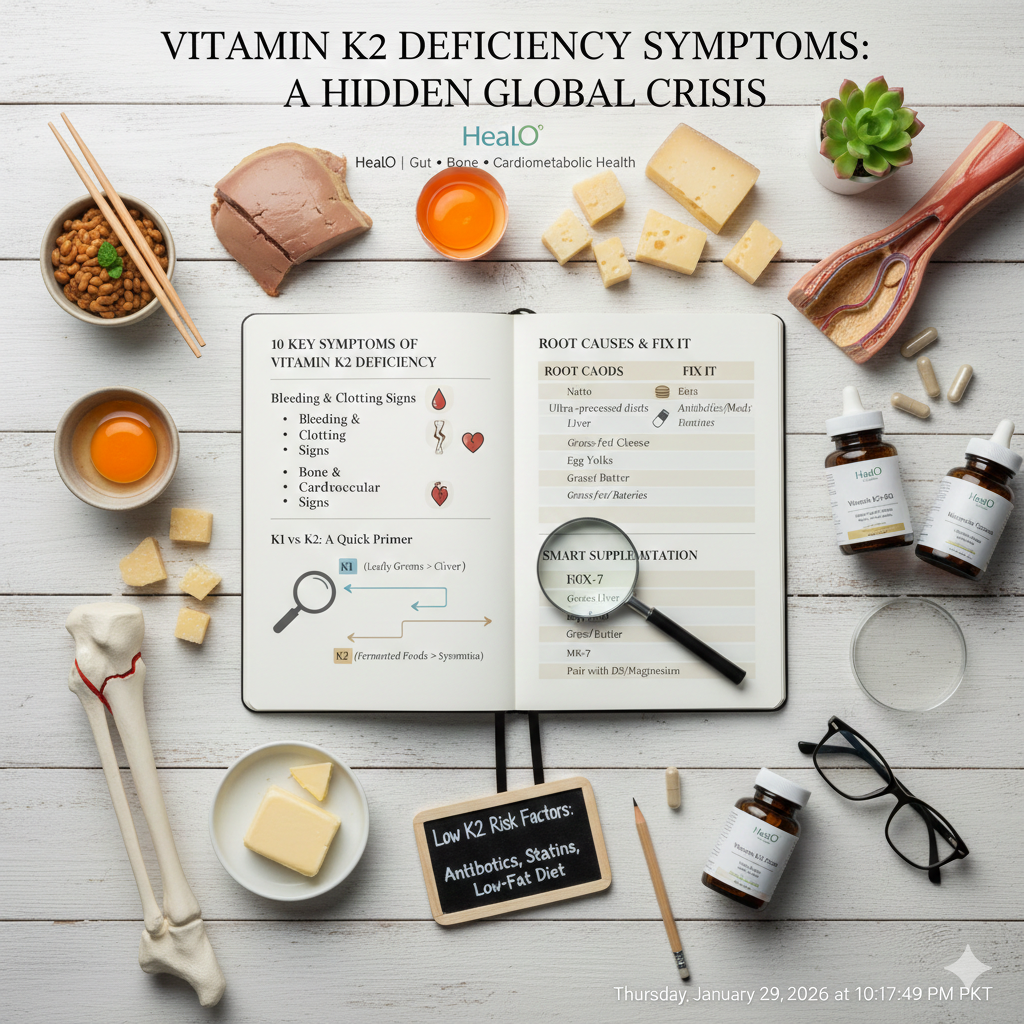
10 Key Symptoms of Vitamin K2 Deficiency
Root Causes You Should Know
Fixing the Deficiency: Foods & Supplements
Safety First
HealO Takeaway
K1 vs. K2: A Quick Primer
Vitamin K is fat-soluble and historically associated with blood clotting—but not all vitamin K behaves the same.
Vitamin K1 (phylloquinone)
Found in leafy greens. Primarily supports clotting.
Vitamin K2 (menaquinones: MK-4, MK-7, etc.)
Found in fermented foods and animal fats. Acts systemically—directing calcium, regulating tissues, and influencing gene expression.
Key distinction:
K1 stays mostly in the liver.
K2 travels to bones, arteries, brain, and gut.
Among supplements, MK-7 most closely mimics food-based K2 due to superior absorption and longer half-life.
Vitamin K2’s Vital Roles
Vitamin K2 activates proteins that tell calcium where to go—and where not to go.
Its established and emerging roles include:
Bone mineralization and fracture prevention
Prevention of arterial calcification
Cardiovascular flexibility
Brain and eye health (emerging evidence)
Gut barrier integrity and immune balance
Low K2 status is associated with:
Why Vitamin K2 Deficiency Is a Global Problem
Deficiency is now detected using functional markers such as undercarboxylated osteocalcin, which consistently show inadequate K2 status—even in “healthy” populations.
Bone Fractures: Early Warning Signs
Polish children (ages 5–15):
Low K2 status strongly associated with low-energy fractures.
European elderly:
~36% of hip fracture patients were K2-deficient on admission; this rose to 64% after short periods of fasting post-surgery.
Cardiovascular Disease: A Silent Driver
South Asians (MASALA study):
Low K2 intake was linked to coronary artery calcification progression comparable to high-risk Western populations.
Chinese dialysis patients:
Low K2 status doubled cardiovascular mortality and tripled major cardiac events.
Vitamin K2 deficiency doesn’t announce itself—it accumulates damage quietly.
10 Key Symptoms of Vitamin K2 Deficiency
Many symptoms are subtle until advanced disease develops.
Bleeding & Clotting Signs
Easy bruising
Bleeding gums or prolonged bleeding from wounds/injections
Heavy menstrual bleeding
Blood in stool or urine
Prolonged PT/INR
Bone & Cardiovascular Signs
Frequent low-impact fractures
Reduced bone density or osteoporosis
Arterial stiffness or calcification (imaging findings)
Increased heart attack or cardiovascular mortality risk
Children
Poor bone development or delayed skeletal growth
(Newborns receive vitamin K injections for a reason—deficiency is dangerous early in life.)
Root Causes of Vitamin K2 Deficiency
Several converging factors drive deficiency worldwide:
Dietary scarcity:
K2 is rare—found mainly in fermented foods and organ meats.
Ultra-processed diets:
Displace traditional K2-rich foods.
Poor K1 → K2 conversion:
Human gut bacteria convert very little K1 into usable K2.
Outdated RDAs:
Focus on clotting—not bone or cardiovascular protection.
Malabsorption conditions:
IBD, Crohn’s disease, celiac disease.
Medications:
Antibiotics, anticonvulsants, TB drugs, cephalosporins, warfarin.
Fix It: Foods & Supplements
Power Foods (Best Natural Sources)
Grass-fed > grain-fed for K2 content.
Smart Supplementation
Form: MK-7 (clinically studied, long-acting)
Adults: ~180 mcg/day
Children: ~45 mcg/day (age-appropriate guidance required)
Pair with: Vitamin D3 and adequate magnesium
Important:
Vitamin K1 supplementation alone does not replicate K2’s bone or cardiovascular benefits.
Safety First
⚠️ Exception:
Individuals on vitamin K–antagonist blood thinners (e.g., warfarin) must consult their physician.
HealO Takeaway
Vitamin K2 deficiency is not rare—it’s structural, driven by modern food systems.
It silently fuels:
Fragile bones
Vascular calcification
Cardiovascular disease
The solution is not fear—but awareness, testing, and intentional nutrition.
Prioritize K2-rich foods. Supplement wisely when needed.
This is prevention at its most powerful.
References
- https://www.ncbi.nlm.nih.gov/pmc/articles/PMC3255495
- https://www.ncbi.nlm.nih.gov/pubmed/16869104
- https://www.ncbi.nlm.nih.gov/pubmed/24296867
- https://www.ncbi.nlm.nih.gov/pubmed/17349078
- https://www.ncbi.nlm.nih.gov/pubmed/17349078
- https://www.ncbi.nlm.nih.gov/pubmed/19450370
- https://www.ncbi.nlm.nih.gov/pmc/articles/PMC3178021/
- https://www.ncbi.nlm.nih.gov/pubmed/27200471
- https://www.ncbi.nlm.nih.gov/books/NBK209820/
- https://academic.oup.com/jn/article/148/suppl_3/1567S/5026326
- https://www.ncbi.nlm.nih.gov/pubmed/6885274
- https://www.ncbi.nlm.nih.gov/pubmed/29617314
- https://www.ncbi.nlm.nih.gov/pubmed/30371151
- https://www.ncbi.nlm.nih.gov/pubmed/21781006
- https://www.ncbi.nlm.nih.gov/pubmed/18279558
- https://www.nutraceuticalsworld.com/contents/view_breaking-news/2019-01-11/vitamin-k2-status-linked-to-brain-and-eye-health/991
- https://www.ncbi.nlm.nih.gov/pubmed/24089220
- https://www.ncbi.nlm.nih.gov/pubmed/15514282
- https://www.ncbi.nlm.nih.gov/pubmed/18722618
- https://www.ncbi.nlm.nih.gov/pubmed/25694037
- https://www.ncbi.nlm.nih.gov/pubmed/24402301
- https://www.ncbi.nlm.nih.gov/pubmed/24845468
- https://www.ncbi.nlm.nih.gov/pubmed/20424220
- https://www.ncbi.nlm.nih.gov/pubmed/29724016
- https://www.ncbi.nlm.nih.gov/pubmed/439009
- https://www.ncbi.nlm.nih.gov/pubmed/29882816
- https://www.ncbi.nlm.nih.gov/pubmed/30618350
- https://pubmed.ncbi.nlm.nih.gov/17874826/
- https://www.ncbi.nlm.nih.gov/pmc/articles/PMC2730374/
- https://www.mdpi.com/1422-0067/24/3/2986

2 Responses