Your daily diet quietly programs your colon health—and vitamin K2 may be one of the most overlooked nutrients doing that work.
This matters more than ever:
IBS affects ~18% of Pakistanis
Colorectal cancer is the 3rd most common cancer worldwide
Gut inflammation and “leaky gut” are rising alongside ultra-processed diets
Emerging research links vitamin K2 to lower gut inflammation, stronger intestinal barriers, immune balance, and reduced cancer risk.
Let’s break down why this fat-soluble vitamin deserves a place in your gut-health strategy.
Why Vitamin K2 Matters for Colon Health
(9 Key Connections)
Vitamin K2 may support colon health by:
Reducing gut inflammation via alkaline phosphatase activation
Strengthening tight junctions to reduce leaky gut
Supporting microbial conversion of K1 → K2 (variable by gut health)
Enhancing bile flow and digestive enzyme activity
Modulating immune responses (T-cell balance)
Being chronically low in modern diets
Becoming depleted in IBD and Crohn’s disease
Showing protective associations against colon and liver cancers
Being depleted by antibiotics and other common medications
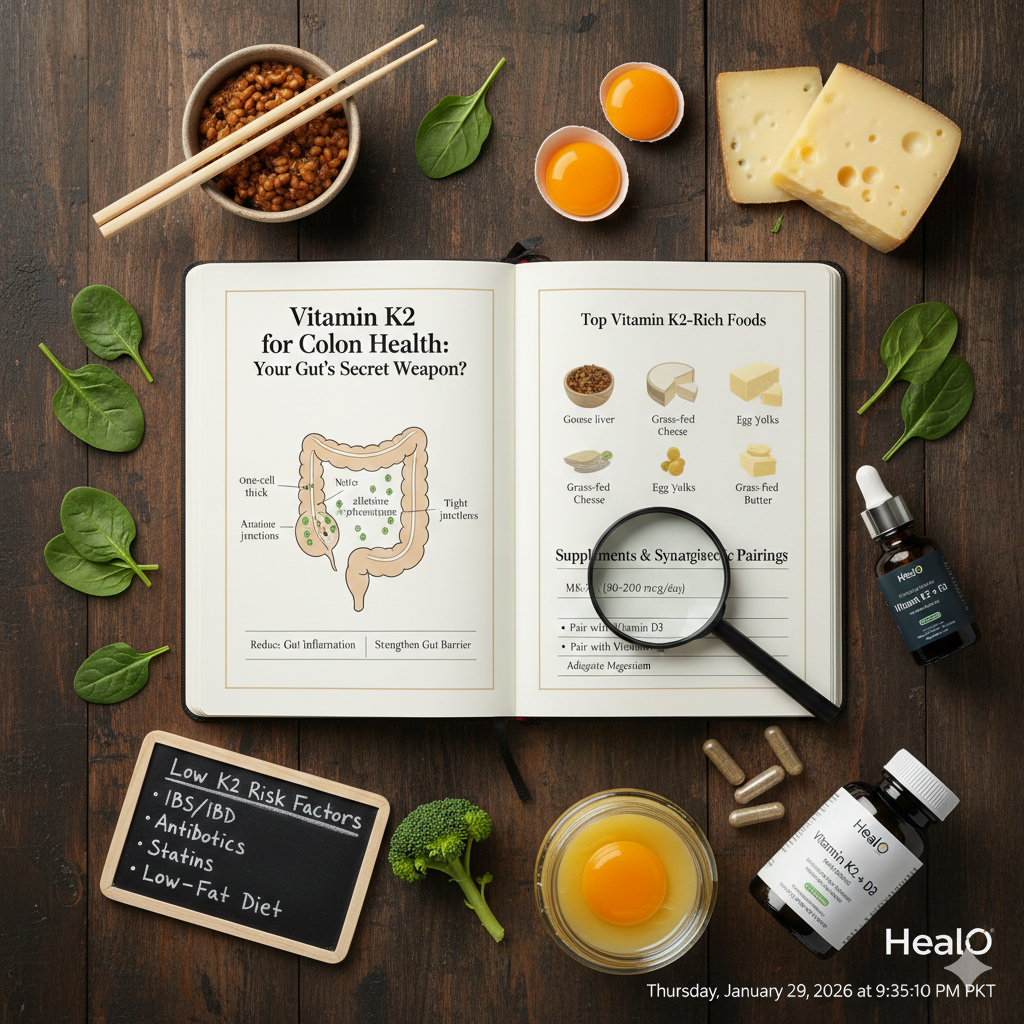
Top Vitamin K2–Rich Foods
Vitamin K2 exists mainly as MK-4 and MK-7, concentrated in fermented and organ foods. Grass-fed sources consistently contain more.
Highest dietary sources:
Liver remains one of the most nutrient-dense foods on earth.
However, you’d need large quantities to match natto’s K2 content.
Why Vitamin K2 Deficiency Is So Common
Vitamin K2 deficiency is now recognized across all age groups, including children.
Key reasons:
Very few foods contain meaningful K2
Modern diets avoid fermented and organ foods
Low-fat dieting reduces absorption
Chronic gut inflammation impairs utilization
Blood levels frequently remain low even in people eating “healthy” diets.
Can Your Gut Make Enough K2?
Some gut bacteria convert vitamin K1 (from leafy greens) into K2—but output varies dramatically.
Factors affecting production:
Even individuals with “healthy” guts often fail to reach protective K2 levels without dietary or supplemental support.
Key Colon Benefits of Vitamin K2
Your colon lining is only one cell thick—and metabolically active. K2 supports it in multiple ways.
1. Reduces Gut Inflammation
Vitamin K2 activates intestinal alkaline phosphatase, which:
Animal models show reduced colitis severity with K2 supplementation.
2. Strengthens the Gut Barrier
Vitamin K2 activates the pregnane X receptor (PXR), which:
In combination with vitamin D3, K2 has been shown to reduce zonulin, a key leaky-gut marker.
3. Supports Digestion
Vitamin K2 is stored in the pancreas, suggesting roles in:
Disruption here often worsens bloating, malabsorption, and IBS symptoms.
4. Balances Gut Immunity
K2 helps regulate:
This immune-modulating effect may explain benefits seen in:
5. Lowers Cancer Risk (Early Evidence)
Observational and animal studies associate higher K2 intake with:
Lower colorectal cancer mortality
Improved cancer prognosis
Reduced tumor size via microbiome modulation
Protection against liver and gastric cancers
While not a treatment, K2 appears protective.
Risk Factors for Low Vitamin K2
You may be especially at risk if you have:
IBS, IBD, Crohn’s disease, celiac disease
History of frequent antibiotic use
Long-term statin or laxative use
Fat malabsorption disorders
⚠️ Warfarin users must consult their physician before supplementing.
Supplements & Synergistic Pairings
MK-7 is the most bioavailable and longest-acting form.
Best practice at HealO:
Vitamin D testing is strongly recommended before long-term use.
Other Colon-Supportive Nutrients
Vitamin K2 works best as part of a system:
Safety Notes
Bonus benefits include:
HealO Takeaway
Vitamin K2 is not just a “bone vitamin.”
It’s a gut-immune-barrier regulator—quietly protecting your colon from inflammation, permeability, and long-term disease risk.
In a world of processed foods and chronic gut stress, every bite of K2 counts.
References
- https://www.ncbi.nlm.nih.gov/pmc/articles/PMC3255495
- https://www.ncbi.nlm.nih.gov/pubmed/16869104
- https://www.ncbi.nlm.nih.gov/pubmed/24296867
- https://www.ncbi.nlm.nih.gov/pubmed/17349078
- https://www.ncbi.nlm.nih.gov/pubmed/17349078
- https://www.ncbi.nlm.nih.gov/pubmed/19450370
- https://www.ncbi.nlm.nih.gov/pmc/articles/PMC3178021/
- https://www.ncbi.nlm.nih.gov/pubmed/27200471
- https://www.ncbi.nlm.nih.gov/books/NBK209820/
- https://academic.oup.com/jn/article/148/suppl_3/1567S/5026326
- https://www.ncbi.nlm.nih.gov/pubmed/6885274
- https://www.ncbi.nlm.nih.gov/pubmed/29617314
- https://www.ncbi.nlm.nih.gov/pubmed/30371151
- https://www.ncbi.nlm.nih.gov/pubmed/21781006
- https://www.ncbi.nlm.nih.gov/pubmed/18279558
- https://www.nutraceuticalsworld.com/contents/view_breaking-news/2019-01-11/vitamin-k2-status-linked-to-brain-and-eye-health/991
- https://www.ncbi.nlm.nih.gov/pubmed/24089220
- https://www.ncbi.nlm.nih.gov/pubmed/15514282
- https://www.ncbi.nlm.nih.gov/pubmed/18722618
- https://www.ncbi.nlm.nih.gov/pubmed/25694037
- https://www.ncbi.nlm.nih.gov/pubmed/24402301
- https://www.ncbi.nlm.nih.gov/pubmed/24845468
- https://www.ncbi.nlm.nih.gov/pubmed/20424220
- https://www.ncbi.nlm.nih.gov/pubmed/29724016
- https://www.ncbi.nlm.nih.gov/pubmed/439009
- https://www.ncbi.nlm.nih.gov/pubmed/29882816
- https://www.ncbi.nlm.nih.gov/pubmed/30618350
- https://pubmed.ncbi.nlm.nih.gov/17874826/
- https://www.ncbi.nlm.nih.gov/pmc/articles/PMC2730374/
- https://www.mdpi.com/1422-0067/24/3/2986
- https://pubmed.ncbi.nlm.nih.gov/36769323/
- https://thehealthyrd.com/comprehensive-leaky-gut-diet-guide-how-to-heal-your-gut/
- https://www.ncbi.nlm.nih.gov/pmc/articles/PMC6116188/
- https://www.mdpi.com/2072-6643/17/2/304
- https://www.ncbi.nlm.nih.gov/pmc/articles/PMC6116188/
- https://www.ncbi.nlm.nih.gov/pmc/articles/PMC6515216/
- https://pubmed.ncbi.nlm.nih.gov/29480629/
- https://pubmed.ncbi.nlm.nih.gov/30014604/
- https://pubmed.ncbi.nlm.nih.gov/32768697/
- https://www.mdpi.com/2077-0383/13/12/3476
- https://pubmed.ncbi.nlm.nih.gov/33390552/
- https://www.ncbi.nlm.nih.gov/pmc/articles/PMC5958717/
- https://pubmed.ncbi.nlm.nih.gov/15514282/
- https://www.ncbi.nlm.nih.gov/pmc/articles/PMC7352899/
- https://pmc.ncbi.nlm.nih.gov/articles/PMC9509427/
- https://pmc.ncbi.nlm.nih.gov/articles/PMC7191194/
- https://ods.od.nih.gov/factsheets/VitaminK-HealthProfessional/

2 Responses