You don’t feel bad exactly.
Just… not like yourself.
Less energy than you used to have.
Brain fog that comes and goes.
Weight creeping up in places it never did before.
Blood pressure “borderline,” but not alarming.
Your doctor says you’re not diabetic.
You look healthy. Maybe even thin.
So you shrug it off.
Probably age. Probably stress.
But what if it’s not?
This Might Sound Uncomfortably Familiar
Tell me if this resonates:
You don’t feel as sharp or resilient as you used to—and chalk it up to getting older
You deal with brain fog, fatigue, weight gain, or rising blood pressure markers—but you’re told you’re “fine”
Certain foods make you feel unwell, yet outwardly you look fit, lean, or “healthy”
If so, you’re not alone.
Roughly 2 in 5 adults now show signs of insulin resistance and early cardiometabolic risk—even without diabetes.
And if you’re noticing daily symptoms, there’s a strong chance insulin resistance is already in play.
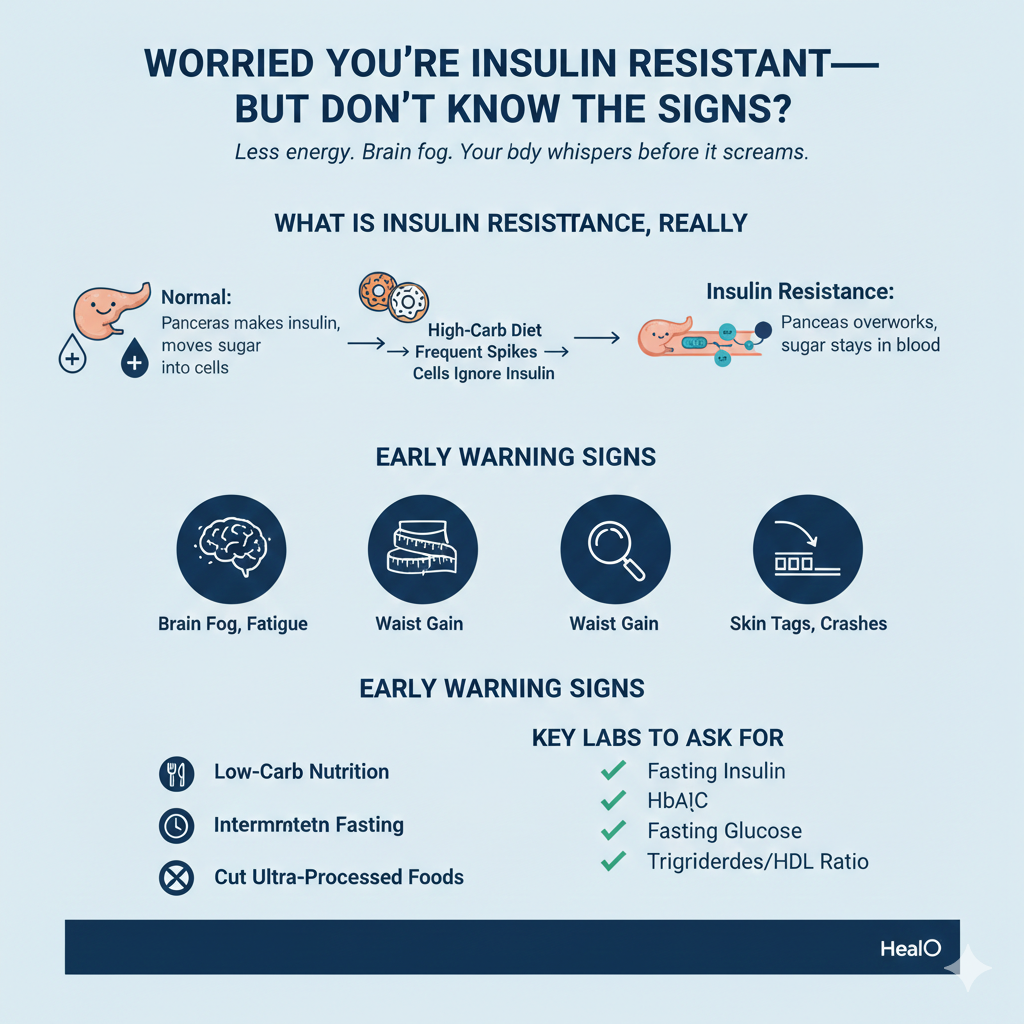
What Is Insulin Resistance, Really?
Insulin resistance (IR) is poorly explained in mainstream healthcare—but it’s one of the most studied drivers of modern chronic disease.
To understand it, you first need to understand insulin.
What Insulin Is Supposed to Do
Insulin is a hormone released by the pancreas every time you eat. Its job is simple:
Move sugar (glucose) out of the bloodstream
Deliver it into muscle, liver, or fat cells for energy or storage
Under healthy conditions, this system works smoothly.
Where Things Go Wrong
When you regularly eat foods that spike blood sugar—refined carbohydrates, sugars, ultra-processed foods—your body releases large amounts of insulin, repeatedly.
Over time:
Cells are exposed to insulin too often
Receptors stop responding efficiently
The pancreas compensates by producing even more insulin
Eventually, sugar stops entering cells properly and remains in the bloodstream, where it damages blood vessels, the liver, the heart, and nerves.
That state is insulin resistance.
Blood sugar may still look “normal” for years—because insulin is working overtime behind the scenes.
Why Insulin Resistance Is So Easy to Miss
Insulin resistance rarely announces itself with dramatic symptoms.
You can be insulin resistant even if you are:
That’s why lab work matters more than appearance.
Some people experience subtle signs—fatigue, hair thinning, skin changes—but many feel “off” without knowing why.
What Increases Your Risk?
Food is the biggest driver—but not the only one.
Your risk rises if you:
Eat a high-sugar, high-refined-carb diet
Take steroid medications
Have a family history of diabetes
Live under chronic psychological stress
Spend most of the day sedentary
Carry excess visceral (abdominal) fat
These factors compound quietly over time.
Why Insulin Resistance Matters (Especially for the Heart)
Insulin resistance is not just a “pre-diabetes issue.”
It is:
A stronger predictor of cardiovascular disease than LDL cholesterol alone
Closely linked to heart attacks, heart failure, and vascular damage
Associated with fatty liver disease, hypertension, PCOS, thyroid dysfunction, and autoimmune flares
There’s even emerging evidence linking insulin resistance to cardiac amyloidosis, a condition that is often missed until late stages.
Addressing insulin resistance early dramatically changes long-term outcomes.
Early Warning Signs You Shouldn’t Ignore
These often appear before diabetes:
Crashing energy or brain fog 2–3 hours after meals
Waist circumference >31.5 inches (Pakistani women) or >35.4 inches (Pakistani men)
Skin tags, unexplained acne, or darkened skin folds
Constant thirst despite adequate hydration
Lightheadedness or poor concentration
A Note for Women
Hormonal fluctuations (PCOS, perimenopause, thyroid disorders) can mask or accelerate insulin resistance, making early detection even more important.
How Insulin Resistance Is Diagnosed
You cannot reliably diagnose insulin resistance by feel alone.
Key labs include:
By the time glucose is elevated, insulin resistance has often existed for years.
Don’t guess. Test.
Can Insulin Resistance Be Reversed?
Yes—especially when caught early.
Insulin resistance didn’t develop overnight, and it won’t disappear overnight.
But meaningful improvements can begin within weeks.
The Core Strategy: Lower Insulin Exposure
1. Adopt a Low-Carb Framework
Reducing carbohydrate intake lowers insulin demand and allows receptors to resensitize.
A practical target: <100 g carbs/day
Some people choose structured approaches like keto or carnivore
Others simply remove refined carbs and sugars
Consistency matters more than labels.
2. Use Intermittent Fasting Strategically
The less often insulin is released, the more sensitive cells can become.
Intermittent fasting doesn’t mean multi-day fasts.
Common approaches include:
Even modest fasting can improve insulin sensitivity relatively quickly.
3. Cut Sugar and Ultra-Processed Foods
Sugar and refined carbohydrates have a high glycemic load and keep insulin chronically elevated.
Prioritize:
Whole foods
Animal proteins
Vegetables
Nuts and seeds
Minimize foods with:
Long ingredient lists
Seed oils
Artificial sweeteners
Refined flour
The Bigger Picture
Insulin resistance is not a personal failure.
It’s the predictable outcome of modern food systems, stress, and misinformation.
But it is also one of the most reversible early disease states we know.
When insulin resistance improves, people often see:
Better energy and mental clarity
Reduced inflammation
Improved blood pressure and lipid markers
Improvements in thyroid, autoimmune, and hormonal symptoms
HealO Takeaway
Insulin resistance doesn’t shout.
It whispers—through fatigue, brain fog, waist size, and lab trends.
If you listen early, the path back to metabolic health is not extreme, expensive, or hopeless.
It’s informed, intentional, and powerful.
You don’t need to wait for disease.
You can reclaim metabolic health now.
References
- https://link.springer.com/article/10.1007/s00125-011-2204-7?correlationId=4d9ea02c-da9a-44df-a279-bfae59b39531&error=cookies_not_supported&code=0aeb9909-283c-4944-9fd9-31417b7dac78
- https://www.sciencedirect.com/science/article/pii/S2213858719300762
- https://www.uab.edu/news/research/item/12289-uab-researchers-find-that-40-percent-of-young-american-adults-have-insulin-resistance-and-cardiovascular-risk-factors
- https://www.physiology.org/doi/abs/10.1152/japplphysiol.00683.2005
- https://pubmed.ncbi.nlm.nih.gov/11460565/
- https://www.webmd.com/diabetes/insulin-resistance-syndrome
- https://emedicine.medscape.com/article/122501-overview
- https://www.niddk.nih.gov/health-information/diabetes/overview/what-is-diabetes/prediabetes-insulin-resistance
- https://obesitymedicine.org/blog/obesity-and-insulin-resistance/
- https://pmc.ncbi.nlm.nih.gov/articles/PMC1204764/
- https://caryobgyn.com/the-connection-between-pcos-and-insulin-resistance/
- https://burjeel.com/pcos-and-metabolism-managing-insulin-resistance-and-weight/#:~:text=FAQ-,1.,and%20better%20quality%20of%20life.


2 Responses