
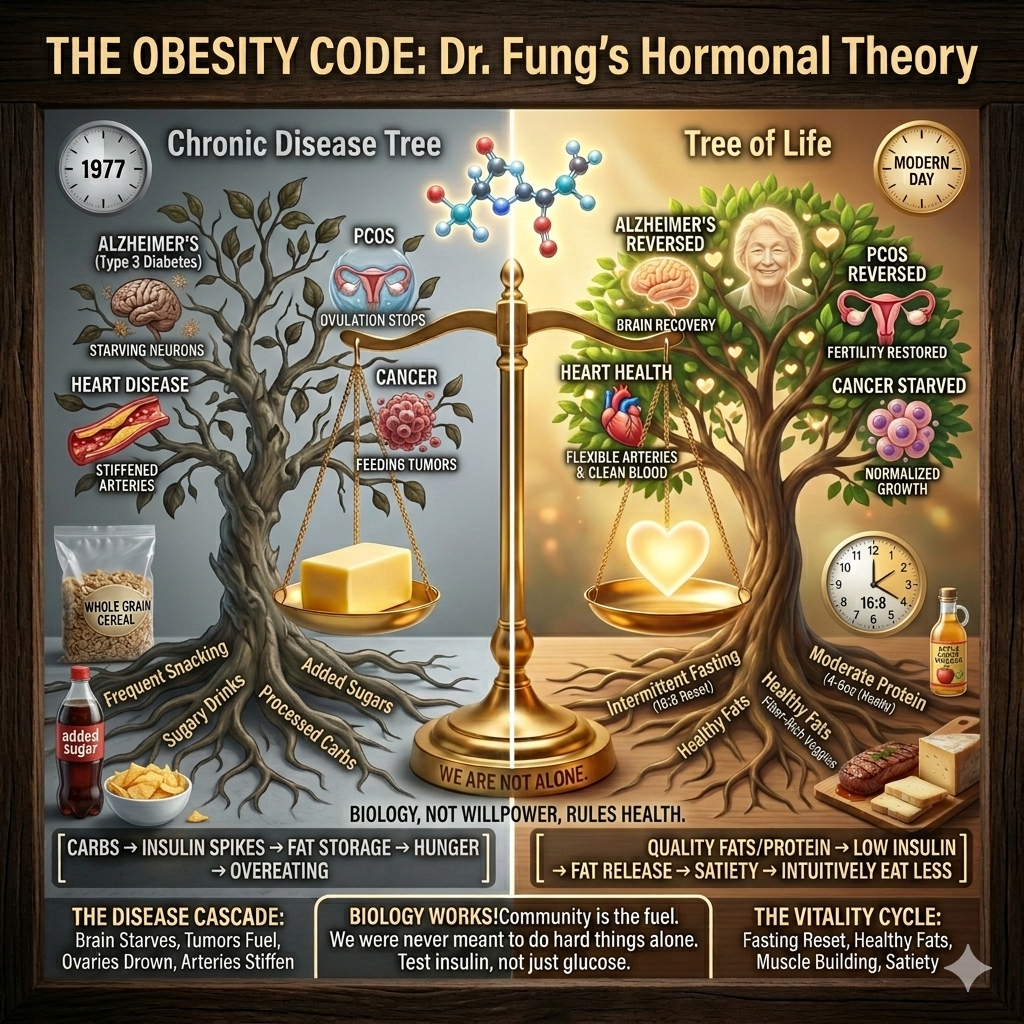
🧠 Why Calories Don’t Matter—And Insulin Does
📋 Preface: The Paradigm Shift
For decades, we’ve been told that weight loss is simple: eat less, move more, burn more calories than you consume. And when that fails—as it does for millions—the conclusion is equally simple: you lack willpower.
But what if the entire model is wrong?
Dr. Jason Fung’s landmark book The Obesity Code revolutionizes how we view obesity, framing it as a hormonal imbalance driven by insulin rather than mere calorie excess. This Canadian nephrologist offers practical strategies like intermittent fasting and targeted dietary shifts for sustainable weight loss and metabolic health.
This guide explains the science, exposes the failures of calorie counting, and provides Fung’s practical protocol for breaking free from the insulin trap.
🔬 Part I: The Core Hormonal Theory
📉 The Calorie Myth
| Traditional View | Fung’s Reality |
|---|---|
| Calories in > calories out = weight gain | Hormones regulate fat storage |
| Eat less, move more | Insulin drives accumulation |
| Willpower determines success | Biology determines hunger |
| Obesity is energy imbalance | Obesity is hormonal dysfunction |
🏭 The Insulin Hypothesis
| Factor | Role |
|---|---|
| Insulin | Primary fat storage hormone |
| Chronically elevated insulin | Promotes fat accumulation |
| Insulin resistance | Blocks fat release |
| Set weight | Body defends hormonal set point |
“Obesity is not caused by overeating. Overeating is caused by obesity.” — Dr. Jason Fung
🔄 The Vicious Cycle
| Step | Event |
|---|---|
| 1 | Frequent snacking and refined carbs |
| 2 | Insulin spikes repeatedly |
| 3 | Fat cells lock energy away |
| 4 | Body perceives starvation |
| 5 | Hunger increases |
| 6 | More eating |
| 7 | Insulin rises further |
| 8 | Set weight increases |
This is why weight loss feels impossible despite calorie restriction or exercise. The body is fighting to maintain its hormonal set point.
📊 Historical Evidence
| Observation | Implication |
|---|---|
| Obesity exploded post-1977 | Low-fat guidelines increased carbs |
| Traditional cultures ate more calories | But remained lean |
| Dieters regain 95% of weight | Calories don’t address cause |
| Fasting traditions worldwide | Hormonal reset built into cultures |
🧪 Part II: Insulin Resistance Explained
⚡ What Triggers High Insulin
| Offender | Mechanism |
|---|---|
| Added sugars | Direct insulin spike |
| Fructose (worst) | Liver overload, fat production |
| Refined grains | Rapid glucose conversion |
| Frequent snacking | Constant insulin elevation |
| Processed carbs | Blood sugar roller coaster |
🔒 What Insulin Does
| Action | Effect |
|---|---|
| Blocks fat burning | Lipolysis inhibited |
| Promotes fat storage | Adipocytes expand |
| Increases hunger | Brain receives starvation signal |
| Raises set weight | Body defends higher weight |
🧬 The Resistance Cascade
| Stage | Event |
|---|---|
| 1 | High insulin from carbs |
| 2 | Cells numb to signal |
| 3 | Pancreas pumps more |
| 4 | More insulin, more resistance |
| 5 | Fat cells lock energy away |
| 6 | Body starves amid plenty |
| 7 | Overeating ensues |
🏥 Diseases of Civilization
| Condition | Insulin Link |
|---|---|
| Type 2 diabetes | Pancreas exhausts |
| Fatty liver | Fructose drives fat production |
| PCOS | Ovaries flooded with insulin |
| Heart disease | Inflammation + metabolic dysfunction |
| Alzheimer’s | “Type 3 diabetes” |
| Cancer | Insulin as growth factor |
“Insulin resistance underlies not only obesity but most chronic diseases of the modern world.” — Dr. Jason Fung
⏱️ Part III: Intermittent Fasting—The Hormonal Reset
🔄 What Fasting Does
| Effect | Mechanism |
|---|---|
| Insulin drops | No food stimulus |
| Fat burning begins | Lipolysis activated |
| Hormonal balance resets | Set weight lowers |
| Repair processes | Autophagy activated |
| Hunger normalizes | Ghrelin regulates |
📅 The Fasting Protocol
| Schedule | Duration | Frequency |
|---|---|---|
| 16:8 | 16 hours fast, 8-hour window | Daily |
| 24-hour | Complete day without food | 1-2 times weekly |
| 36-hour | Overnight + full day + next overnight | 1 time weekly |
🧠 Why Fasting Works
| Mechanism | Benefit |
|---|---|
| Insulin drops to zero | Fat cells release energy |
| Counter-regulatory hormones rise | Maintain energy |
| No muscle loss | Growth hormone protects |
| Evolutionary pattern | Humans adapted to feast/famine |
| Global traditions | Every culture has fasting |
✅ Safety and Adaptation
| Concern | Reality |
|---|---|
| Starvation mode | Not relevant for intermittent fasting |
| Muscle loss | Preserved with adequate protein |
| Blood sugar | Stabilizes with adaptation |
| Hunger | Passes in waves |
| Energy | Improves after adaptation |
“Fasting is not starvation. Starvation is forced, prolonged fasting; fasting is chosen, time-limited.” — Dr. Jason Fung
🍽️ Part IV: Key Dietary Rules
❌ What to Cut
| Food | Why | Insulin Effect |
|---|---|---|
| Added sugars | Direct spike | +++ |
| Fructose (worst) | Liver converts to fat | +++ |
| Refined grains | Rapid glucose | +++ |
| Snacks | Constant elevation | + |
| Liquid calories | No satiety | ++ |
⚖️ Moderate Protein
| Protein Source | Amount | Insulin Effect |
|---|---|---|
| Meat | 4-6oz per meal | Minimal |
| Eggs | 3-4 per day | Minimal |
| Fish | 4-6oz per meal | Minimal |
| Excess protein | >30g per meal | Converts to glucose |
✅ What to Boost
| Food | Benefit | How to Use |
|---|---|---|
| Fiber | Slows absorption | Vegetables, seeds |
| Natural fats | No insulin response | Butter, ghee, olive oil |
| Vinegar | Improves sensitivity | Salad dressings |
| Whole foods | Nutrient density | All meals |
🕒 When to Eat
| Rule | Why |
|---|---|
| Eat when hungry | Trust appetite |
| Stop when satisfied | No counting |
| Ignore meal timing dogma | Breakfast not essential |
| No snacking | Let insulin drop |
“The timing of food matters as much as the food itself.” — Dr. Jason Fung
📊 Part V: Myths Challenged
| Myth | Fung’s Counterpoint |
|---|---|
| Calories rule all | Hormones dictate storage; 100 calories of soda ≠ salmon |
| Willpower deficit | Hormonal dysfunction drives overeating, not laziness |
| Exercise fixes obesity | It helps fitness but barely dents hormonal fat storage |
| Low-fat diets work | They spike insulin via carbs, worsening resistance |
| Breakfast is essential | Creates hunger, extends eating window |
| Many small meals boost metabolism | Keeps insulin constantly elevated |
| Fasting burns muscle | Growth hormone protects muscle |
🔥 The 100-Calorie Comparison
| Food | Hormonal Effect | Result |
|---|---|---|
| Soda (100 cal) | Insulin spike | Fat storage |
| Salmon (100 cal) | Minimal insulin | Satiety, nutrients |
“All calories are not created equal because all foods are not metabolized equally.” — Dr. Jason Fung
👥 Part VI: Who Benefits Most
🎯 Ideal Candidates
| Profile | Why It Works |
|---|---|
| Gaining despite low calories | Hormonal dysfunction identified |
| Battling prediabetes | Insulin resistance reversible |
| Curious about fasting | Evidence-based protocol |
| Stalled weight loss | Breaks through set point |
| Normal weight prevention | Stops insulin-driven diseases |
👨⚕️ Health Professionals
| Role | Benefit |
|---|---|
| Doctors | Evidence-based tools |
| Dietitians | Paradigm shift |
| Coaches | Practical protocols |
| Researchers | Comprehensive framework |
The Pakistani Application
For Pakistani readers on LCHF or OMAD, Fung’s approach aligns perfectly:
| Desi Adaptation | Fung’s Principle |
|---|---|
| Avoid sugary chai | Cut added sugars |
| Embrace ghee | Natural fats |
| Fiber-rich veggies | Boost fiber |
| Meat-based meals | Moderate protein |
| OMAD schedule | Intermittent fasting |
⚠️ Part VII: Minor Critiques and Tips
📝 Sample Menu Considerations
| Concern | Adjustment |
|---|---|
| Some grains included | Skip for stricter low-carb |
| Dairy may spike insulin | Test individual tolerance |
| Fruit recommendations | Limit to berries |
| Legumes included | Moderate if sensitive |
🔄 Keto vs. Fasting
| Approach | Insulin Effect | Synergy |
|---|---|---|
| Ketogenic diet | Lowers insulin | Both work |
| Intermittent fasting | Drops to zero | Combined powerful |
| Both together | Maximum effect | Pair with HIIT/trekking |
📈 Getting Started
| Step | Action |
|---|---|
| 1 | Start with 12:12 (12 hours fast) |
| 2 | Extend to 14:10 |
| 3 | Progress to 16:8 |
| 4 | Add 24-hour fast weekly |
| 5 | Monitor glucose if diabetic |
🎯 Part VIII: The Bottom Line
🔥 What We Know for Sure
| Truth | Implication |
|---|---|
| Obesity is hormonal, not caloric | Fix insulin, not calories |
| Insulin drives fat storage | Lower it to lose fat |
| Fasting resets hormones | Most powerful tool |
| Food quality matters | Whole foods only |
| Timing matters | Let insulin drop |
| Set weight exists | Body defends its level |
💫 The Fung Protocol
| Element | Target |
|---|---|
| Cut | Added sugars, refined grains, snacks |
| Moderate | Protein (4-6oz per meal) |
| Boost | Fiber, natural fats, vinegar |
| Fast | 16:8 daily + 24h weekly |
| Trust | Hunger and satiety |
🕊️ The Final Word
“The body knows how to regulate weight when properly fed and given time to rest from food.” — Dr. Jason Fung
| Promise | Fulfillment |
|---|---|
| Sustainable weight loss | Without hunger |
| Metabolic health | Restored |
| Insulin resistance | Reversed |
| Freedom from counting | Intuitive eating |
The science is clear. The protocol works. The time is now.
Stop counting calories. Start fixing hormones.
Your body knows what to do.
📚 References
🔑 Key Works by Dr. Jason Fung
| Resource | Contribution |
|---|---|
| Fung, J. (2016). The Obesity Code: Unlocking the Secrets of Weight Loss. Greystone Books. | The definitive hormonal theory of obesity |
| Fung, J. (2018). The Complete Guide to Fasting. Victory Belt Publishing. | Practical fasting protocols |
| Fung, J. (2020). The Diabetes Code. Greystone Books. | Reversing type 2 diabetes |
🧪 Insulin Resistance Research
| Study | Finding |
|---|---|
| Reaven, G. M. (1988). Banting lecture 1988: Role of insulin resistance in human disease. Diabetes, 37(12), 1595-1607. | Original description of metabolic syndrome |
| Petersen, M. C., & Shulman, G. I. (2018). Mechanisms of insulin action and insulin resistance. Physiological Reviews, 98(4), 2133-2223. | Comprehensive molecular review |
⏱️ Fasting Research
| Study | Finding |
|---|---|
| Halberg, N., et al. (2005). Effect of intermittent fasting and refeeding on insulin action in healthy men. Journal of Applied Physiology, 99(6), 2128-2136. | Fasting improves insulin sensitivity |
| Harvie, M. N., et al. (2011). The effects of intermittent or continuous energy restriction on weight loss and metabolic disease risk markers. International Journal of Obesity, 35(5), 714-727. | Intermittent fasting effective for weight loss |
| Mattson, M. P., et al. (2018). Intermittent metabolic switching, neuroplasticity and brain health. Nature Reviews Neuroscience, 19(2), 63-80. | Fasting benefits brain health |
📊 Historical and Epidemiological Evidence
| Study | Finding |
|---|---|
| Taubes, G. (2007). Good Calories, Bad Calories. Knopf. | Comprehensive history of diet-heart hypothesis |
| Bray, G. A., et al. (2004). Consumption of high-fructose corn syrup in beverages may play a role in the epidemic of obesity. American Journal of Clinical Nutrition, 79(4), 537-543. | Fructose link to obesity |
| Ludwig, D. S., & Ebbeling, C. B. (2018). The carbohydrate-insulin model of obesity. JAMA Internal Medicine, 178(8), 1098-1103. | Hormonal model validation |
🏥 Clinical Outcomes
| Study | Finding |
|---|---|
| Fung, J., et al. (2016). Therapeutic use of intermittent fasting for people with type 2 diabetes as an alternative to insulin. BMJ Case Reports, 2016, bcr2015214102. | Case series showing diabetes reversal |
| Sainsbury, A., et al. (2018). Effect of intermittent fasting on weight loss and metabolic disease risk markers. Obesity Reviews, 19(8), 1102-1114. | Systematic review |
⚠️ Disclaimer: This article is for informational purposes only and does not constitute medical advice. The information presented synthesizes the research and conclusions of Dr. Jason Fung and other cited researchers. Always consult with qualified healthcare providers regarding your specific health situation, especially before making significant changes to your diet, fasting protocols, or medication regimens. Fasting may require medical supervision for those on diabetes medications or with certain health conditions.
- Recent Post